
The region was rocked by many dramatic events and developments following the Zionist entity's crime of assassinating the martyr of Islam and humanity, His Eminence the Secretary-General of Hezbollah, Sayyed Hassan Nasrallah. The Israeli enemy expanded its aggression in an unprecedented manner, and the regime of Syrian President Bashar al-Assad quickly collapsed. Takfiri groups took control of the power structure in Damascus, pushing forcefully toward normalization with the enemy entity. Lebanese political forces hostile to Hezbollah began speaking brazenly about the "necessity of disarming Hezbollah," despite their silence during the era of the martyred Sayyed Nasrallah, refusing to open this issue, even discussing it secretly. Furthermore, the assassination of Sayyed Nasrallah emboldened the Israeli enemy to launch an aggression against the Islamic Republic of Iran.
Considering previous events, the magnitude of the nation's loss in the assassination of a great resistance figure like the martyr of humanity, Sayyed Hassan Nasrallah, becomes clear. He was the leader of the liberation movement in Lebanon, the leader of Hezbollah's battle to enter politics, and the leader of the prisoner release deals. He fulfilled his promise and foiled the so-called "Middle East" project in the July 2006 war. He was also the biggest obstacle to the takfiri groups' attempts to control Syria. Therefore, he was "a great asset to Lebanon and the Islamic world," as Sayyed Ali Khamenei, the leader of the Islamic Revolution in Iran, emphasizes.
Regarding Lebanese affairs, he—may Allah have mercy on him—maintained the golden triple equation of "army, resistance, and people." He was able to build Hezbollah's military capabilities in various fields and stood firm against foreign ambitions to plunder Lebanon's wealth by adopting the issue of demarcating the maritime border with the enemy entity, Israel.
His Eminence, the Secretary-General of the Lebanese Hezbollah, the martyr of humanity, Sayyed Hassan Nasrallah, led the battle to support Gaza one day after the outbreak of "Al-Aqsa Flood" battle. He emphasized—in a subsequent speech—that supporting Gaza was decisive and final, a fact that both the Americans and the French acknowledged. He continued to escalate until he met Allah as a martyr on the road to Jerusalem. The supreme martyr, Sayyed Hassan Nasrallah, was an exceptional leader in every way, even in formulating the concept of martyrdom. In his will to the resistance, he said: "We are not defeated. When we are victorious, we are victorious, and when we are martyred, we are victorious. We are on the verge of a great victory. We must not be defeated as a result of the martydom of one of our great leaders. Rather, we must carry his blood, his banner, and his goals, and move forward with firm resolve and a passion to meet Allah."
Throughout his jihadist career, the Israeli enemy considered the martyr Hassan Nasrallah as the most serious threat. Therefore, the decision to assassinate and liquidate him had been prepared years in advance. The operation targeting him was not just a routine airstrike; it was the result of meticulous intelligence planning spanning months. It was one of the most daring operations in the history of the Zionist Mossad. The enemy relied on the tactic of "phased deception," from disrupting communications to targeting warehouses, all the way to the command bunker, upon which 83 American-made bunker-busting bombs were dropped.
Lebanon is considered the most prominent loser of a great figure like Sayyed Hassan Nasrallah. After his martyrdom, the Israeli enemy attempted to invade southern Lebanon to reoccupy it, but Sayyed Nasrallah's men stood guard, foiling his plans, which had lasted for more than 50 days. The party was able to regroup and rebuild its internal structure, and Sheikh Naim Qassem was chosen to succeed the martyr Nasrallah as Secretary-General of Hezbollah.
These events led to rapid changes in Lebanon. A new president and prime minister were elected, but they quickly proved their subservience to foreign powers. These political forces, backed by the Americans, Saudis, and Zionists, began loudly declaring the "necessity of Hezbollah surrendering its weapons," presenting the Lebanese people with the image that the party had lost all its strength after the martyrdom of Sayyed Nasrallah, and that all it needed to do was raise the white flag and surrender. However, these attempts failed due to the steadfastness of Sheikh Naim Qassem and Hezbollah's ability to recover. Instead of the martyrdom of Sayyed Hassan Nasrallah discouraging the party, it became an incentive for greater steadfastness, continued adherence to its approach, and loyalty to its sacrifice and the sacrifice of its martyrs in confronting the occupation and all its agents within the country.
Syria in the Bosom of Normalization, and Iran Confronts Aggression
Regarding Syria, engaging in the fight against the takfiri groups of ISIS and al-Nusra has been the biggest ordeal Hezbollah has faced since 2011. It is more dangerous than the July 2006 war, as the supreme martyr himself says. This is because what is happening in Syria is a major strife, an American, Zionist, Qatari, and Saudi project aimed at eliminating the resistance and settling the Palestinian issue.
The assassination of Sayyed Hassan Nasrallah led to significant achievements for the enemy entity. As the first months of the crime passed, the strength and character of the martyred leader became clear, as did the correctness of his position and his role in protecting the Arab region from Zionist penetration. The enemy's inability to achieve its expansionist dreams became clear. The axis of resistance lost Syria, and Syrian President Bashar al-Assad fled after his army was unable to confront the takfiri groups. After these groups came to power, Hezbollah was facing two imminent dangers threatening its national security: from the eastern side, al-Julani's groups in Syria, and from the southern side, the Zionist entity.
Today, Syria is experiencing normalization and falling into the Zionist bosom, after having been an obstacle to the Zionists for many years. It has also become a breeding ground for terrorist groups flocking from all over the world. The efforts of the supreme martyr, Sayyed Hassan Nasrallah, have unfortunately been in vain. Whereas Hezbollah fighters once confined these groups to Idlib, these groups now control entire provinces and run a country with broad American and international recognition.
While Lebanon and Syria have suffered from the loss of their supreme martyr, Hassan Nasrallah, the Islamic Republic of Iran has also lost its most prominent ally in the region. One of the repercussions of his assassination—may Allah have mercy on him—was the brutal aggression against the Islamic Republic of Iran, initiated by the Israeli enemy, with American approval, on Friday, June 13, 2025. The aggression lasted for 12 days, ending with the defeat of the enemy entity and the cessation of the war without an agreement, making it possible for it to return at any moment.
Yemen, Nasrallah's Successor
The Israeli enemy felt that, with the assassination of Sayyed Hassan, it had removed a huge boulder from its path. It sought to expand its influence in the region. It seized control of large parts of southern Syria. The criminal Netanyahu now openly speaks of establishing the Zionist project called "Greater Israel" and "changing the Middle East." He continues this approach despite the bitterness of his defeat by Iran, expanding the scope of his regional influence, even to the point of attacking Qatar in an attempt to assassinate the negotiating delegation of Hamas leaders.
The Israeli enemy relies on unlimited American support, Arab complicity, and the abandonment of Islamic countries. This encourages it to continue its occupation of the Gaza Strip and to undertake aggressive measures in the region, potentially including countries that have never been targeted before. Faced with all these challenges and dangers, it currently faces no alternative but Yemen, with its leader, its people, and its armed forces.
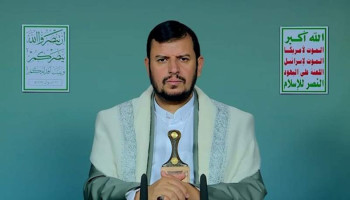
While the Arab and Islamic nations and the free people of the world have lost a martyr for humanity, Sayyed Hassan Nasrallah, who possessed charisma, a strong personality, and a rhetorical eloquence replete with every expression of pride, dignity, and loftiness, as well as a refusal to submit, be subservient, or beholden to enemies, today all eyes are on Sayyed Leader Abdul-Malik Badr al-Din al-Houthi—may Allah protect him—who was held in high esteem, pride, and respect by the martyr himself.
The free people of the world find in the speeches of the Leader a way to fill the void they have lost in the personality of the martyred Sayyed Hassan Nasrallah. They also find in the Yemeni front supporting Gaza a stunning spectacle that expresses the dignity and pride of this nation, presenting to the world a sublime model of free, independent Islamic states. They also find in the Yemeni military operations compensation for the terrible loss suffered by the Arabs as a result of Zionist arrogance, and a restoration of the dignity of the entire nation. Yemen is now the strong alternative, standing firmly against the ambitions and schemes of the Israeli enemy. It is a strong, cohesive front that has embarrassed and confused the temporary entity, which has repeatedly acknowledged its inability to defeat it.
In light of these changes, several possible scenarios emerge regarding the fate of the region following the assassination of the supreme martyr, Sayyed Hassan Nasrallah. The most dangerous of these is that the Zionist entity—with American support—continues to expand its territorial control of the region, and moves toward a new attempt to invade Lebanon by land, in concert with takfiri groups in Syria, and by deploying tools of treachery and betrayal within Lebanon. This scenario could lead to the possibility of the war expanding to include the Islamic Republic of Iran and Yemen. The plan to expand its territorial control could also extend to other countries, such as Egypt and Jordan, and to the repeated targeting of the Qatari capital, Doha.
The scenario is the most dangerous for the region, and it is the most likely, given the changes and developments sweeping it. Another scenario could be that the status quo remains unchanged, with Gaza remaining subject to heavy bombardment, violent raids, and a tight blockade. Continued violations of the ceasefire with Lebanon continue, along with expansion into southern Syria, forcing al-Julani regime to sign a "security agreement" that serves the enemy entity's interests, and freezing any new aggressive military action against Iran.
The optimistic scenario - which is unexpected - is that Arab and Islamic countries will awaken, sense the danger posed by the criminal entity, and work to sever diplomatic relations with it, sign joint defense agreements among themselves, and provide support to resistance movements to confront American-Zionist arrogance. This is considered the best option that could stop Zionist brutality and restore the prestige of the Arab and Islamic nation. However, it is unlikely, due to the Arab and Islamic regimes' embrace of America and the difficulty of their breaking away from their cycle of subservience to America.
#The_Zionist_enemy #The_American_British_aggression_against_Yemen
#US_is_the_mother_of_terrorism
#Al_Aqsa_flood