Ansarollah Website. Report | Yahya Al-Shami
A little over a decade ago, this report would have been enough to land its author in the regime's prisons. This irony alone demonstrates how far Yemen has progressed in achieving self-governance and liberating itself from the tutelage of the embassy and the hegemony of Washington in the struggle to restore sovereignty and achieve independence. This is a reminder. As for the subject of the report:
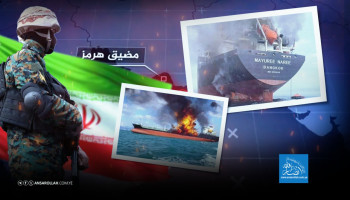
The ongoing regional conflict has entered a phase of intense confrontation that extends beyond the borders of Gaza to encompass the arteries of the global economy and international shipping lanes. Today, the geography of the region, specifically the Strait of Hormuz and Bab al-Mandab, stands out as strategic deterrents that have reshaped the concept of American military hegemony. What is happening now is a confrontation between two logics: the logic of traditional fleets, which has been ingrained in the global consciousness since World War II, and the logic of "technological will" adopted by the resistance forces in the Islamic world.
Hormuz: The Dual Valve of Peace and Threat
In political memory, the Strait of Hormuz is linked to the ancient Kingdom of Hormuz and its defiance of early colonial ambitions. Today, however, it has transformed into a global energy reservoir that controls the fate of markets. Approximately twenty million barrels of oil pass through this narrow waterway daily, granting Iran and its allies the immense power to cripple the global capitalist system without resorting to a full-scale conventional war.
Meanwhile, the United States—which brandishes the threat of war—finds itself constrained by the cost of such a conflict. Any disruption in Hormuz would mean skyrocketing fuel prices and crashes in global stock markets. This has historically led Washington to adopt a policy of showy bluster rather than direct confrontation, which could result in collective economic suicide.
The Economic Bleeding of the Occupation
Beyond the direct battlefronts, a fierce war of numbers is raging, inflicting heavy losses on the Zionist entity and its allies. Shipping reports indicate a near-total paralysis of the port of Eilat, which has lost more than 80% of its revenue due to Yemeni operations in the Red Sea and has yet to recover despite the ceasefire agreement. This is to say nothing of the strategic impact on Zionist shipping and maritime companies. Furthermore, military pressure has forced major shipping companies to reroute their vessels around the Cape of Good Hope, adding millions of dollars in fuel costs and extending delivery times by two weeks.
This bleeding extends to military costs themselves. The US Navy is forced to use interceptor missiles, each costing two million dollars, to shoot down drones that cost only a few thousand dollars to manufacture. This financial war of attrition has made protecting Israeli shipping a heavy burden on the US treasury and exacerbating inflation within the occupied territories.
The Decline of the Aircraft Carrier Era and the Superiority of Hypersonic Missiles
For eighty years, since the Battle of Midway, the aircraft carrier has been the ultimate symbol of American power. However, this symbol now faces a technological challenge that has eroded its invulnerability and diminished its enduring symbolic power. The acquisition by resistance forces of hypersonic missiles, exceeding five times the speed of sound and capable of maneuvering to evade radar, has made these floating cities easy and likely targets, in addition to other advanced, highly efficient, and low-cost weapons.
American fleets are now forced to operate a thousand kilometers from the coast to ensure their safety. This distance significantly reduces the combat effectiveness of their aircraft carriers, transforming the carrier from a sovereign offensive tool into a defensive asset. Washington fears losing it, as this would represent a strategic and historical blow to its imperial prestige.
Alternative Projects and the Resilience of Geography
In an attempt to circumvent this reality, Washington and the Zionist entity proposed alternative economic corridors linking India to Europe via Haifa, aiming to marginalize the resistant Islamic geography. However, the events of "Al-Aqsa Flood" and the steadfast Yemeni position proved that any project that disregards the rights of the region's peoples remains doomed to failure. Yemen imposed a new sovereign equation: the Red Sea will not be safe for those perpetrating genocide in Gaza. This equation forced Washington to withdraw militarily and accept the results of negotiations that affirmed Sana'a's sovereignty over its territorial waters.
The End of Hegemony and the Birth of a New Order
Current conflicts confirm that we are witnessing the end of the era of "American maritime policemanship." The world is moving towards a regional order determined by nations possessing the will and the "point-based" technology, not by powers with massive fleets incapable of protecting themselves. History is being written now in these volatile straits, where geography has proven its loyalty, and where material power, however great, remains inadequate in the face of a people's awareness of their rights and their determination to break the chains of dependency.