Ansarollah Website Official Report
U.S. foreign policy toward the Middle East did not evolve along a natural trajectory of engagement followed by withdrawal. Rather, it repositioned the region within the architecture of global dominance.
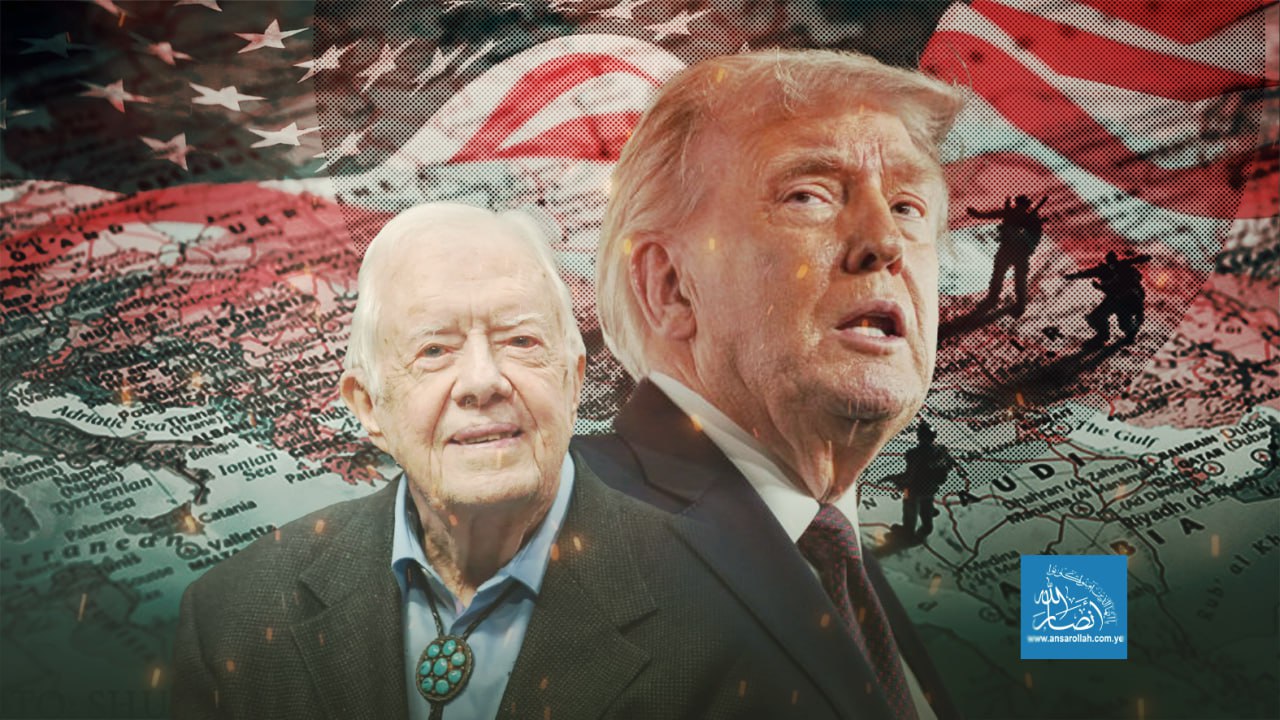
This strategic shift was formally inaugurated in 1980, when President Jimmy Carter declared that “the Gulf constitutes a vital interest of the United States, and any attempt by any outside force to gain control of it will be repelled by military force.”
That declaration amounted to the region’s formal incorporation into the hard core of American national security doctrine. It forged a direct link between energy security, freedom of navigation, and the preservation of Western supremacy.
From that moment onward, Washington embarked on an expansive military buildup across the region—entrenching its bases, consolidating its presence, and effectively transforming the Gulf into an American lake.
In this context, the Gulf was never viewed merely as an energy reservoir. It was understood as a strategic choke point in the arteries of the global economy. Military presence thus became a mechanism of control—designed to regulate the region and to prevent any regional or international power from reshaping its geopolitical order beyond American will.
After the Cold War
The end of the Cold War did not dismantle the logic established in 1980; it repurposed it. Washington replaced the rhetoric of containing Soviet expansion with the language of “regional crisis management,” entrenching this shift during the 1991 Gulf War, when it redrew the rules of Gulf security by force.
It then sustained a policy of pressure on Iraq and, following the attacks of 2001, placed the region at the heart of its grand strategy under the banner of the “war on terror.”
The objective itself did not change—only the declared justification did. Hegemony was preserved, while the political vocabulary was adjusted. The United States moved from confronting a rival global superpower to immersing itself in the internal affairs and conflicts of regional states, under the headings of democracy promotion and counterterrorism—ensuring that the region remained firmly within its sphere of dominance.
When the administration of Barack Obama (2009–2017) recalibrated strategic priorities under the so-called “pivot to Asia” in 2011 and 2012, the United States did not exit the Middle East. Rather, it reduced the level of direct intervention while preserving its instruments of control.
The region was treated as a space that must be prevented from erupting. In this sense, Washington reorganized its sphere of influence without relinquishing it—scaling back political ambition while maintaining military power and readiness for armed intervention.
The Donald Trump Phase
The administration of Donald Trump recast this shift in more explicit terms. The rise of China was placed at the forefront of strategic challenges, while renewed emphasis was given to the Western Hemisphere as the natural extension of American security. In this recalibration, the Middle East moved from being a fixed pillar of U.S. grand strategy to a theater governed by cost–benefit calculations.
Washington did not remove the region from its strategic ledger, but it redefined its role within it. No longer did it pursue the sweeping project of remolding regional regimes as it had in the aftermath of 2001. Instead, the focus shifted to preventing the erosion of American power and forestalling the ascendancy of its adversaries.
In this sense, the transition was from an ambitious blueprint to engineer a “New Middle East” to a policy of balance management—one that permits regional actors to maneuver, but strictly beneath an American-imposed ceiling.
The United States retained what it frames as the right to military intervention—forceful intervention—whenever any actor approaches what it considers a red line: threatening Israeli superiority, disrupting maritime routes tied to the Israeli entity, or undermining the broader Western deterrence architecture.
American strategic elites came to recognize that deep entanglement in the region drains resources at a time when strategic competition with China is accelerating.
The result was a lower-cost management approach—relying on sanctions, alliances, and maritime deterrence—without relinquishing, in Washington’s view, the capacity for decisive action should circumstances demand it.
The Energy File
The United States no longer depends on Gulf oil as directly as it did in the 1980s, having emerged as a leading producer through the shale revolution. Yet reduced imports do not equate to diminished importance.
Energy markets are inherently global, and any disruption in the Strait of Hormuz or the Bab el-Mandeb reverberates through global prices—fueling inflationary pressures and constraining growth within the American economy itself.
For that reason, Washington continues to treat the security of maritime chokepoints as integral to the stability of the economic order it leads. The Gulf is not viewed merely as a fuel reservoir, but as a strategic lever capable of shaping the tempo of the global economy in line with American interests.
Accordingly, the United States has maintained its naval deployment and sustained its protection of vital sea lanes. It has not abandoned the Gulf; rather, it has redefined its position—from a direct energy supplier to a decisive pillar of global market stability.
The American presence endures, even as political ambition has been tempered. What has shifted is the method: from detailed micromanagement of regional conflicts to a structural management of the broader strategic space—ensuring the region remains anchored within the Western orbit, even amid shifting global priorities.
Circles of American Engagement in the Region
Washington has not defined the limits of its engagement in the Middle East through a neutral concept of “stability,” despite invoking it as the banner of its interventions. Instead, it has drawn three interlocking circles designed to reproduce regional power balances in service of its global strategic architecture.
The first circle centers on entrenching Israeli supremacy as a fixed pillar of Western dominance in the region. The United States has not confined itself to shielding “Israel’s security” from direct threats; it has worked systematically to guarantee its enduring qualitative military edge and to prevent the emergence of any effective deterrent balance capable of constraining its freedom of action.
Accordingly, military, political, and diplomatic support for Israel is not treated as an ordinary alliance, but as a cornerstone of a broader regional design—one that ensures Israel remains the preeminent power able to impose facts on the ground, alter boundaries, and shape regional decision-making without fear of prohibitive strategic cost.
The second circle involves preventing any regional power from breaking this strategic monopoly or reshaping the region’s geopolitical space beyond American will.
This has not been limited to confronting Iran as a political adversary; rather, it reflects a broader refusal to allow the rise of any axis capable of exercising independent security or economic decision-making.
Washington has therefore framed Iran’s regional presence not merely as a bilateral dispute, but as a challenge to what it calls the “balance structure” that keeps the region in a condition of external security dependence. Sanctions were imposed, alliances consolidated, and managed conflicts sustained—all to prevent that presence from maturing into an integrated deterrence equation capable of rewriting the region’s rules of engagement.
The third circle is articulated under the banner of “securing maritime corridors”—not simply as commercial routes, but as vital arteries of the U.S.-led economic order. American policymakers have long understood that control over energy and trade routes translates into leverage over the tempo of the global economy.
Hence, the security of the Strait of Hormuz, the Bab el-Mandeb, and the Suez Canal has been explicitly tied to international market stability. Washington has not hesitated to deploy naval force or assemble multilateral security frameworks to assert dominance over these waterways—as seen in the “Prosperity Guardian” coalition and the so-called “Rough Rider” operation during the 2023–2025 aggression against Yemen.
In this framework, freedom of navigation is embedded within the architecture of global order itself, not treated as a mere technical issue of maritime transport.
Within these three circles, Washington acts with assertive rigor. Beyond them, it scales back direct involvement and shifts greater burdens onto its allies—transitioning from day-to-day conflict management to the maintenance of an overarching balance that keeps the region anchored within the Western strategic orbit without the costs of deep entanglement.
In this sense, the American shift does not signify a literal withdrawal from the region. Rather, it reflects a move from granular management of conflict to structural management of the regional order—retaining the levers of strategic superiority while preventing the emergence of an autonomous regional system capable of redefining the balance of power outside the framework it has set.
A Shift in Degree, Not in Essence
The United States has not abandoned the foundation it laid in the early 1980s; rather, it has recalibrated its intensity and refined its instruments. Washington may no longer be prepared to launch a full-scale Gulf war as it did in 1991, yet it has equally refused to tolerate regional developments that could erode Israeli superiority, strengthen the so-called Axis of Resistance, or endanger vital maritime corridors.
In effect, the region has moved from a fixed pillar within U.S. grand strategy to a conditional theater—activated according to the scale of perceived threat. Within this framework, Yemen’s strategic relevance is measured not solely by its intrinsic weight, but by the extent to which it influences these broader balances of power.
This shift imposes a more realistic reading of American engagement. The region has neither witnessed a complete withdrawal nor continued to experience the dense, direct dominance of previous decades.
Instead, it has entered a phase of indirect management, in which Washington preserves the core levers of power while reordering its priorities in line with its larger structural confrontation. Yet even amid this recalibration, the strategic domain it consolidated since 1980 remains firmly under its overarching control.