Published: 9 Ramadan 1447 AH
As the first anniversary of the physical departure of the Master of the Martyrs of the Ummah, the Secretary-General of Hezbollah, Hassan Nasrallah (may Allah be pleased with him), passes, it affirms that exceptional figures do not leave the scene by the burial of their bodies in the earth. Rather, they grow in presence and influence within the conscience of the masses and the balance of conflict.
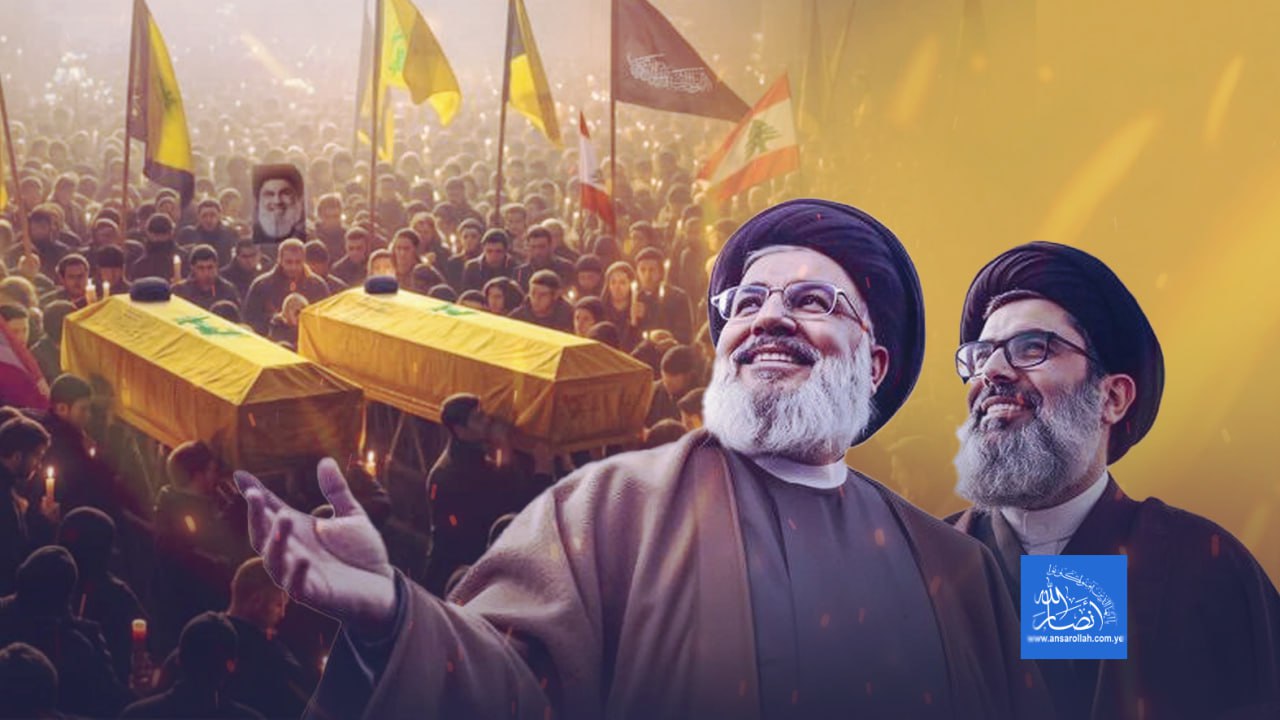
Since the moment of the historic funeral procession that filled the streets of Beirut, that date has transformed into a watershed in Arab and Islamic collective consciousness. It transcended Lebanese geography to become a global icon of liberation.
The commemoration comes at an exceptionally complex regional moment, as the Israeli enemy continues its criminal aggression against Lebanon and Palestine, attempting to break the will of the resistance environment whose consciousness Nasrallah shaped over decades. Yet popular reactions and media and political elites across the Arab world—from steadfast Yemen, through resolute Cairo, to steadfast Baghdad, and finally to the stronghold of resistance in Lebanon—agree that betting on the absence of his impact is a losing wager.
Testimonies from media leaders and activists affirm that Sayyed Nasrallah left behind a school of insight and formulated a dignity equation that transformed oppressed peoples into a force not to be underestimated in the global deterrence balance. They stress that his blood has become the fuel nourishing the veins of the nation toward the inevitability of the promised victory.
On the first anniversary of the funeral of the two martyrs, Sayyed Hassan Nasrallah and Sayyed Hashem Safieddine, Hezbollah Secretary-General Naim Qassem confirmed that the historic funeral scene embodied a popular pledge of allegiance and a renewal of commitment to the continuity of the resistance and the restoration of its capabilities.
He stressed that the political implications of the funeral demonstrate the cohesion between leadership, fighters, and the people, emphasizing that ideological resistance is not defeated despite sacrifices and conspiracies. On a personal level, he recalled his companion Nasrallah, describing him as a towering mountain. He pledged to the resistance’s supporters to proceed in the battle of “Uli al-Ba’s” with full readiness until victory or martyrdom, affirming: “The land is ours, our right to defend it is legitimate, and there is no place for defeat.”
Strategic Implications of the Funeral and the Shattering of Defeatist Bets
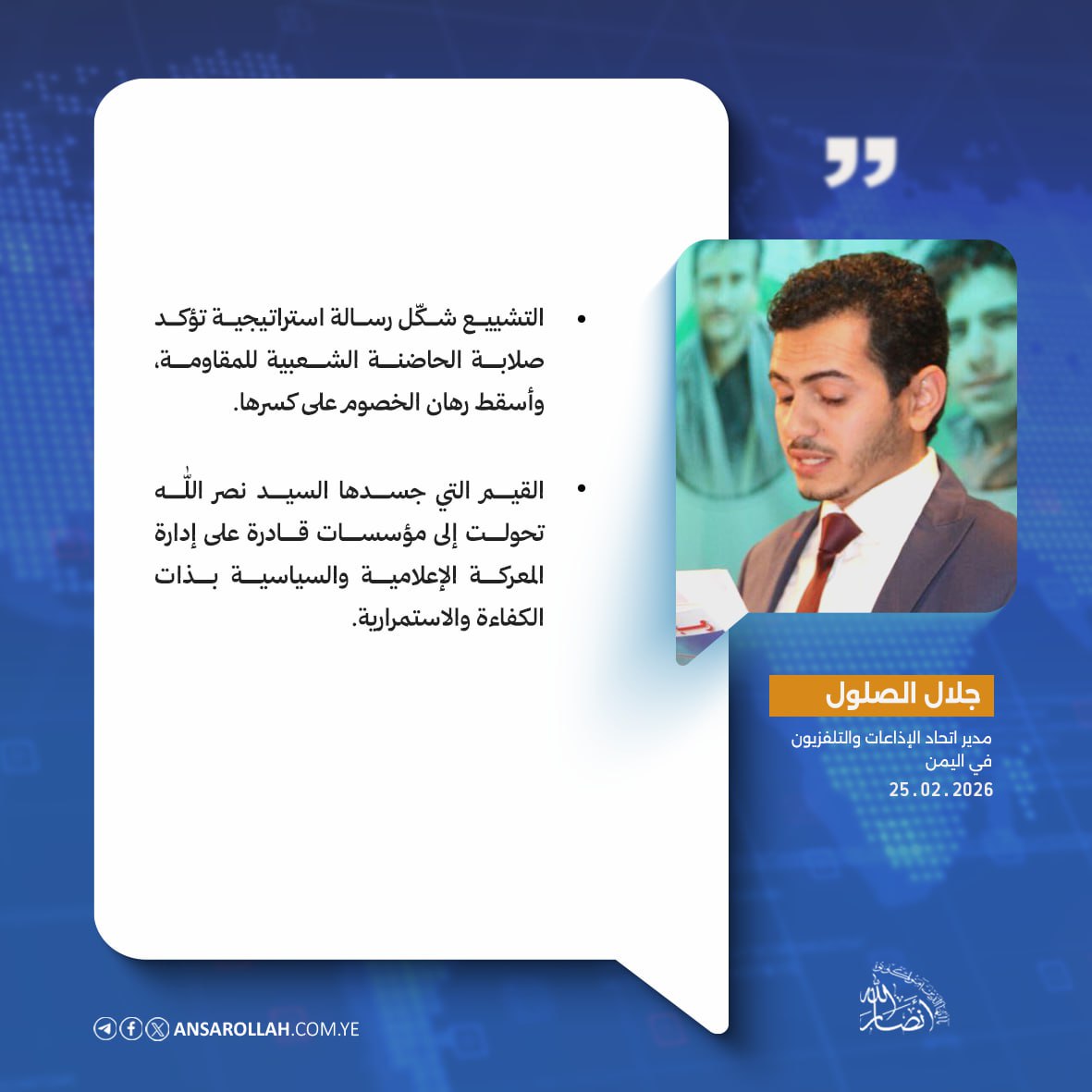
In this context, Director of the Yemeni Radio and Television Union, Professor Jalal Al-Saloul, affirmed that the significance of the anniversary of the funeral of the Master of Islam and Humanity stems from the profound symbolism that historic scene acquired and the political connotations it carried beyond the limits of geography and time.
In remarks to Ansarallah’s website, Al-Saloul explained that commemorating the occasion, amid escalating Israeli aggression and ongoing threats, carries immense importance in affirming the steadfastness of the popular incubator of resistance. He stressed that the massive public turnout sent a clear message to adversaries at home and abroad that betting on breaking this incubator is a losing wager. The relationship between leadership and audience, he added, transcends circumstantial calculations and political pressures, and the image of the funeral remains engraved in global consciousness as a defining marker in the trajectory of peoples.
Media analysis of the event further highlights it as a tool for cementing the “mental image” of victory. Broad coverage and insistence on commemorating the anniversary as an act of resistance confront the hostile media machine that attempted to portray the leader’s departure as the beginning of the end. The resilience of resistance-aligned media institutions embodies the values personified by Sayyed Nasrallah have become institutions that transcend individuals, capable of managing the media and political battle with the same efficiency with which the leader delivered his historic speeches.
Nasrallah: Compass of the Free and Title of Sovereignty
In a related context, Iraqi media activist Diaa Al-Daraji described the funeral anniversary as a popular referendum on a path, a line, and a cause, considering Nasrallah a school of steadfastness and a symbol who never compromised when siege intensified and nations conspired.
In remarks to Ansarallah’s website, he emphasized that the anniversary is a station for renewing insight. He affirmed that honesty with the people was the secret behind the rallying around leadership, and that Nasrallah will remain present in every stance of honor and defense of land and dignity.

For his part, Iraqi media activist Laith Jaafar added a universal dimension to the martyr, describing him as an icon of liberation for all free people around the world.
In his remarks to Ansarallah’s website, Jaafar said that commemorating his memory injects new blood into the veins of the nation to envision a future led by leaderships that reject submission to colonialism or normalization. He stressed that Nasrallah inaugurated the beginning of the end for thrones that see their survival in dependency, citing his historic statement, “Israel is weaker than a spider’s web,” as a cornerstone for a new era ruled by the free.
The Iraqi solidarity with Sayyed Nasrallah’s legacy clearly reflects unity of emotional arenas before military ones. Statements emerging from Baghdad demonstrate the depth of impact left by “Abu Hadi” in shaping an Iraqi generation that sees resistance not merely as a local option but as a comprehensive national and Islamic identity. The discourse of Al-Daraji and Jaafar represents the pulse of the Iraqi street, which views Nasrallah as an expansion of the revolution of Imam Hussein, making his memory an active driver of political consciousness rejecting American and Zionist hegemony in the region.

Farsighted Insight that Defeats Aggression
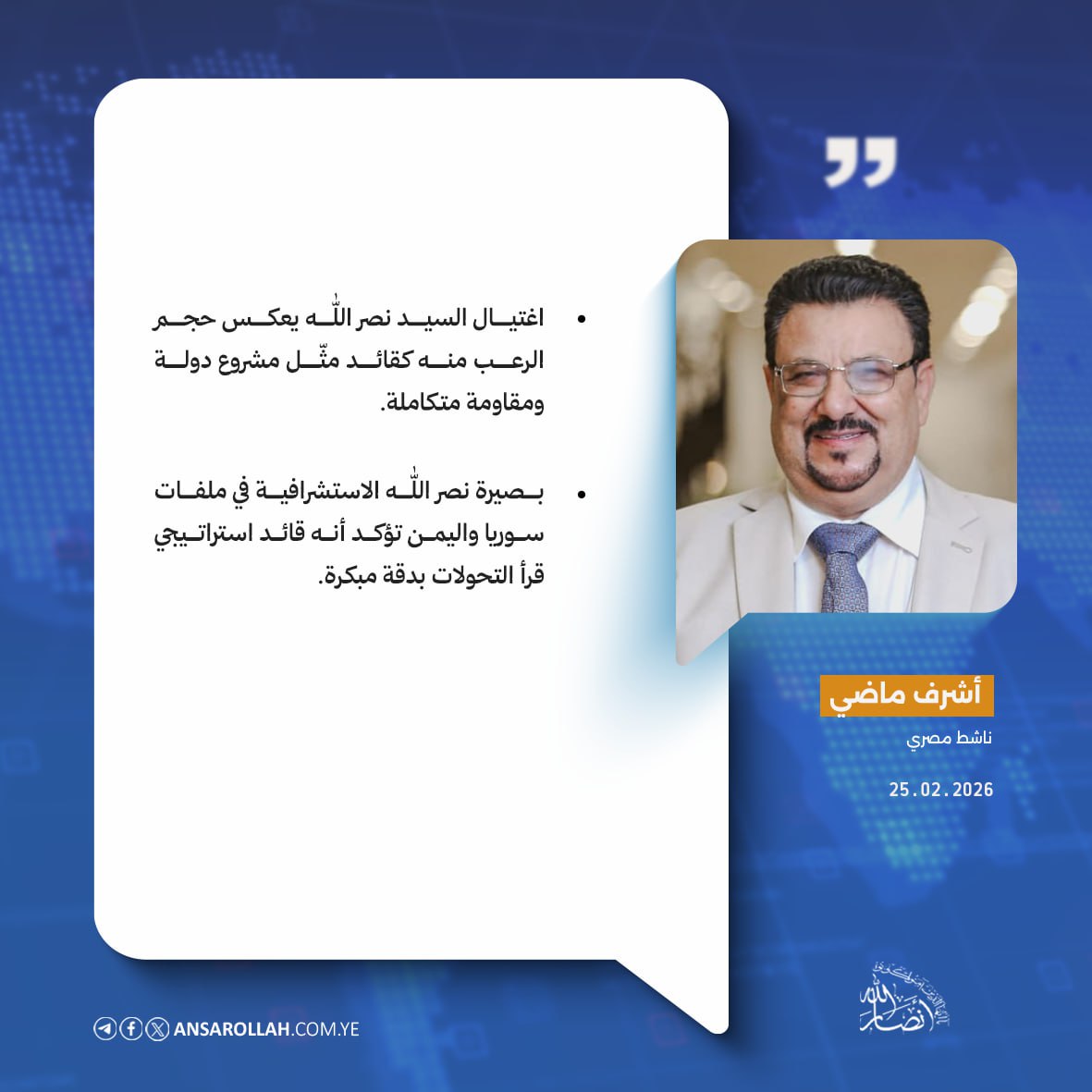
From Egypt, media activist Ashraf Madi affirmed that grief overshadowed the lovers of “Abu Hadi” from one end of Egypt to the other, asserting that Sayyed Nasrallah embodied the value and stature that entrenched the meaning of true struggle.
In exclusive remarks to Ansarallah’s website, Madi pointed out that the scale of explosives used in his assassination reflects Zionist terror of a man who represented an entire state. He praised Nasrallah’s farsighted insight, which warned against takfiri groups in Syria and anticipated Yemen’s role as the “keystone” in the region—realities that are now visible in Yemen’s resilience and the unraveling of suspicious projects.
Madi’s Egyptian reading breaks through the barriers of media blockade, demonstrating that Nasrallah’s thought has penetrated both elite and popular circles in Egypt, as he expressed the lost dignity of the Arab.
The consensus around Sayyed Nasrallah stands as compelling evidence of the accuracy of his political predictions, especially regarding Syria and Yemen, granting him the attribute of a “strategic leader” who was not deceived by appearances and read events with certainty. This made his words “like bullets” in the chests of normalizers and the submissive.
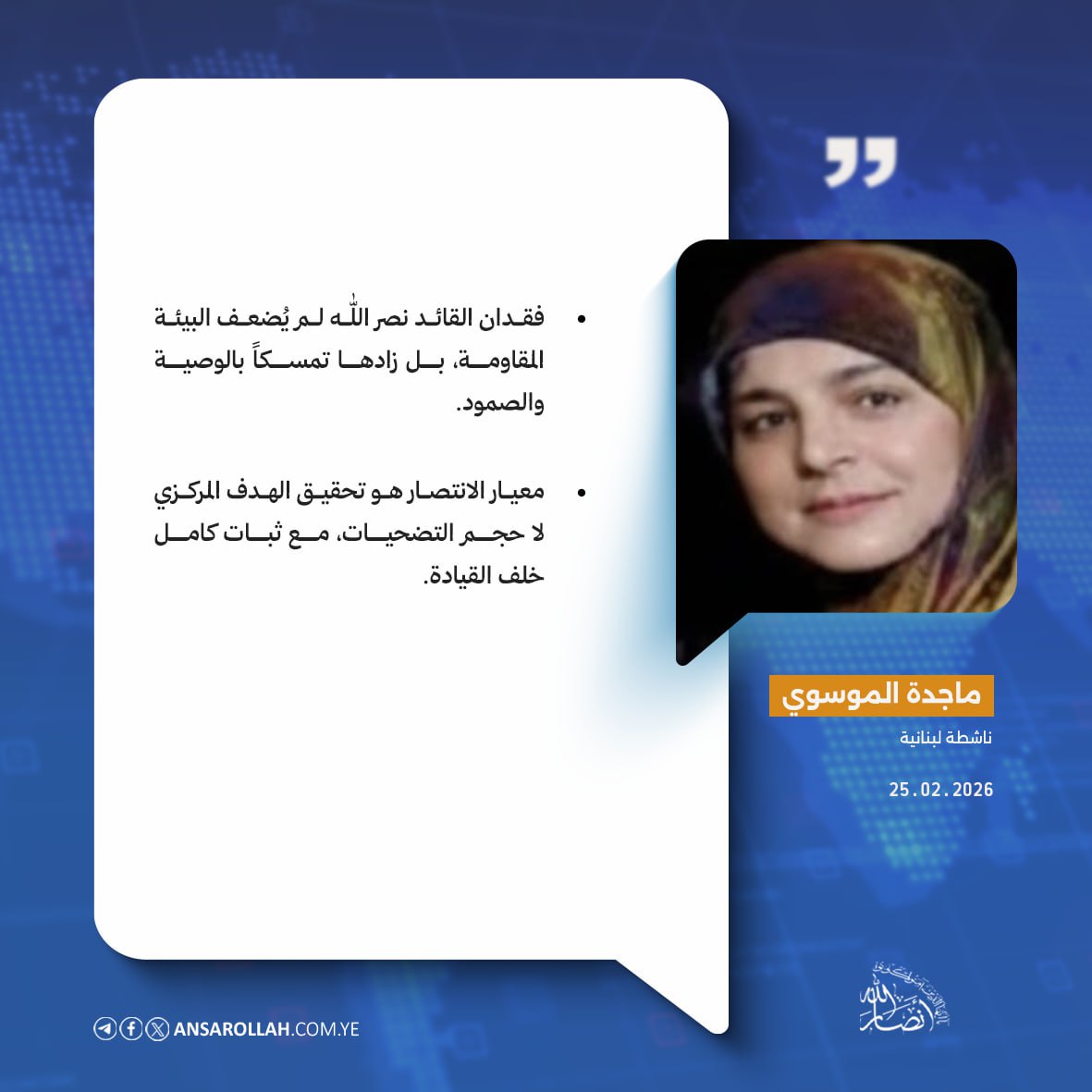
In Lebanon, media activist Majda Al-Moussawi said that the days have remained dark since the loss of the Sayyed, yet they are charged with steadfastness and insight.
In exclusive remarks to Ansarallah’s website, Al-Moussawi affirmed that homes destroyed and livelihoods burned have only increased the sons of the resistance in adherence to the testament of the most sacred martyr. She stressed that victory is measured by the magnitude of the central objective, not by the number of victims, and that the sons of the “den” preserve their rage for the promised day of retribution, standing firm like mountains behind their wise leadership.
An Undimmed Radiance and an Approaching Dawn
In conclusion, this outpouring of statements and testimonies demonstrates that the Martyr of Islam and Humanity, Sayyed Hassan Nasrallah (may Allah be pleased with him), has moved from just being the leader of a party or front to becoming an idea—and ideas do not die by the edge of a sword or the force of bombs.
The first anniversary of his departure and funeral marks a revival for the entire nation and a restoration of its self-confidence in confronting the mightiest global military arsenal. The martyr Nasrallah succeeded in planting a culture of patience and insight, as Majda Al-Moussawi described; he entrenched the concept of true sovereignty advocated by Diaa Al-Daraji and Laith Jaafar; he proved the credibility of a historic leader as analyzed by Ashraf Madi; and he solidified the popular incubator as a fortified shield, as Jalal Al-Saloul affirms today.
Resistance now appears more determined to continue the path, drawing from the martyr’s undimmed radiance a generational force propelling it toward a day when the world will bear witness to the magnitude of its might.
The blood of the Martyr of Humanity, Sayyed Hassan Nasrallah, remains the sure guarantee that the future will not belong to normalizers or the submissive, but to the free who believe that dignity is seized, not begged for, and that the absence of the body is merely a new birth for a spirit that will lead the great battle of liberation from the heights of its martyrdom.