
Published: 16 Ramadan 1447 AH
The region is witnessing an unprecedented escalation following the martyrdom of the Leader of the Islamic Revolution in Iran, Sayyid Ali Khamenei—may Allah's mercy be upon him—in an event that marks a pivotal turning point in the history of the conflict with the forces of global arrogance represented by the United States and “Israel.”
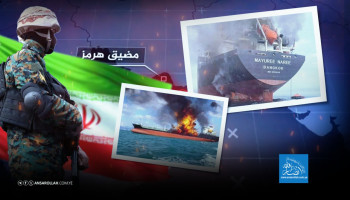
The ongoing confrontation between the Islamic Republic of Iran on one side and the United States and its protégé “Israel” on the other has reached its peak, surpassing the boundaries of conventional responses. Amidst an American bet on destabilizing the Iranian domestic front and overturning the political system through a qualitative strike targeting the apex of leadership. However, Iran’s swift, intense, and continuous response has sent multiple messages of defiance, emphasizing the defense of national sovereignty without hesitation.
These messages draw strength from faith in Allah and the massive popular mobilization that has filled squares and streets with millions expressing support for the state and the Islamic Revolutionary Guard Corps in the sacred battle against the Americans and Zionists.
Arab media activists largely agree that Iran’s demonstrated capability to strike American bases in the region represents a qualitative shift in the nature of the confrontation. According to them, it signals a transition from a policy of gradual pressure to a direct confrontation with open-ended possibilities. They describe the Iranian response as a redefinition of the rules of engagement and an affirmation of the continuity of the state’s strategic decision-making despite the aggression.
Amid intense regional and international anticipation, the current phase appears to be governed by a new deterrence equation that may reshape the maps of influence and alliances across the region.
Reshaping the Deterrence Equation
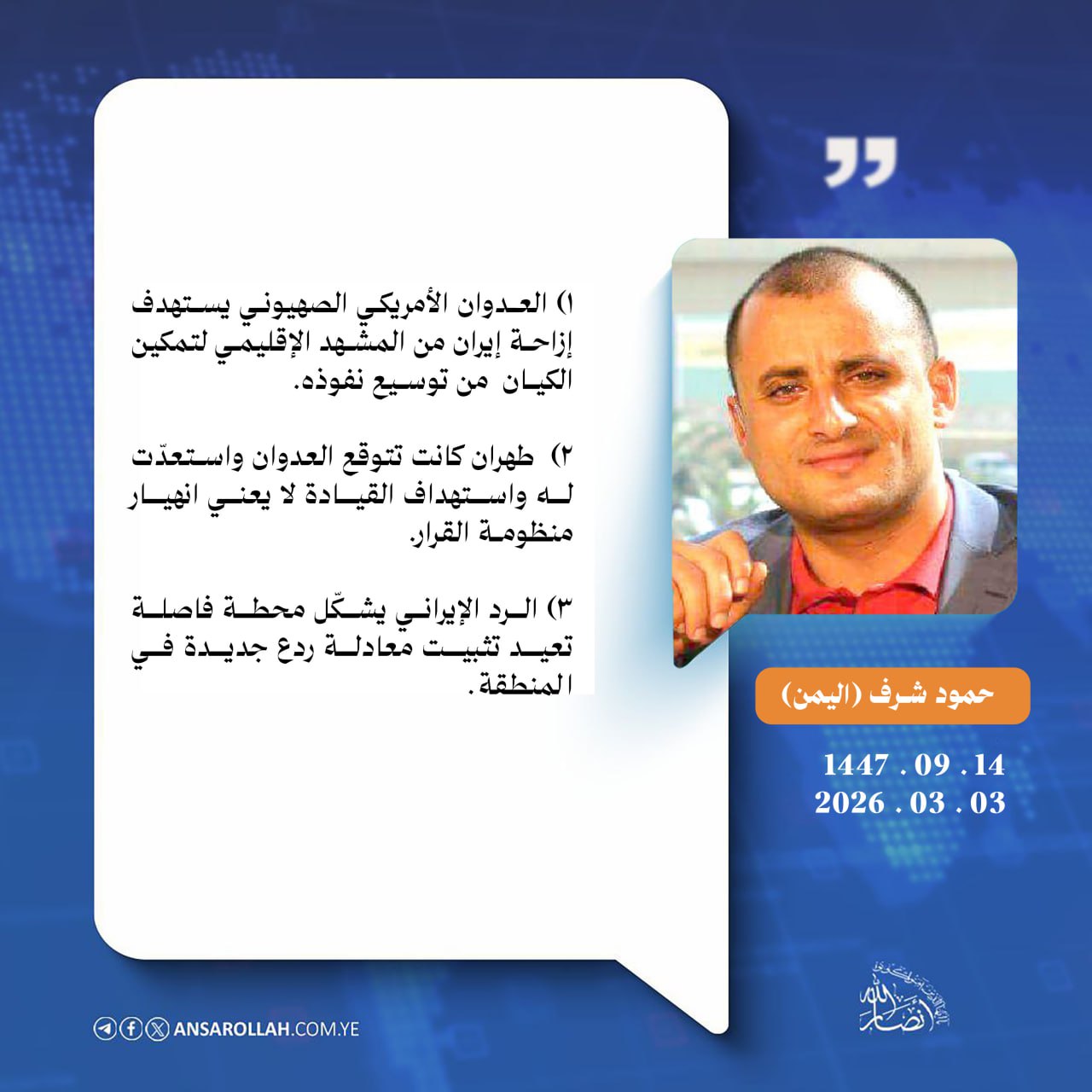
From Yemen, media figure Hamoud Sharaf believes that the American-Israeli aggression against Iran comes as part of an attempt to remove Tehran from the regional landscape, thereby opening the door for the Israeli entity to expand its influence within their concept of “Greater Israel.”
In remarks to Ansar Allah’s website, Sharaf emphasized that Tehran had anticipated such a scenario and had prepared for it at multiple levels, arguing that the Iranian response reflects a high level of strategic readiness. He pointed out that targeting the leadership—including the martyrdom of Sayyed Ali Khamenei—does not lead to the collapse of the decision-making system. Instead, it fosters greater cohesion within state institutions. Sharaf described the battle as decisive, asserting that its outcome will determine the future position of the Axis of Resistance in the coming phase.
Sharaf further noted that Iran’s response goes beyond the direct military dimension and carries political messages regarding the continuity of the state and the resilience of its institutional structure. He confirmed that Tehran aims through its escalation to establish a new deterrence equation that forces its adversaries to reconsider their calculations.
For his part, Iraqi media activist Muntadhar al-Kanani affirmed that the attack represents an American attempt to cover up a series of accumulated failures in the region by targeting a central pillar of the Axis of Resistance.
Speaking in a special interview with Ansar Allah’s website, al-Kanani explained that the bet on destabilizing Iran’s domestic front or weakening its ability to respond has not materialized, as evidenced by the speed and scale of the retaliatory strikes. He stressed that the structure of Iran’s political system is designed to ensure the continuity of decision-making even in the absence of prominent leadership figures, thereby strengthening the state’s capacity to continue the confrontation without a strategic vacuum.
Al-Kanani believes that what is unfolding goes beyond a traditional military response and instead represents a decisive turning point that could redraw the balance of power in the region, particularly given the possibility of an expansion of the confrontation and the entry of other regional actors into the conflict.
.jpg)
A Long War of Attrition
While the Americans appear to believe that aggression against Tehran will lead to its submission and force it to surrender within a short period, Iranian leadership has affirmed its readiness to engage in a long-term battle in defense of sovereignty and independence.
On this point, Egyptian media activist Ihab Shawqi emphasized that the escalation was not a spontaneous development but rather the result of prior planning. He argued that negotiation tracks served as a cover for gradual military preparations.
In remarks to Ansar Allah’s website, Shawqi stated that Iran’s rapid response demonstrates the readiness of its military institutions and the continuity of strategic decision-making despite the targeting of senior leadership figures. He noted that the confrontation carries dimensions that go beyond a bilateral conflict, touching on the broader structure of the international order amid major transformations and the rise of powers competing with the United States.
Shawqi also pointed out that the expansion of the confrontation remains a real possibility given the complexity of the regional scene as American insistence on dragging the region toward war in service of the “temporary entity.” He stressed that the speed of Iran’s response reflects an understanding of the existential nature of the battle, which explains the determination to project the image of a state capable of initiating action rather than limiting itself to defensive responses.

Meanwhile, Tunisian media activist Nadhir Mohammed believes that the current developments represent a shift from a policy of indirect pressure to a more explicit military confrontation. He argued that attempts to exert influence through sanctions or through exploiting domestic protests had failed to achieve their objectives, prompting Washington and “Tel Aviv,” to adopt the option of direct escalation.
In his comments to Ansar Allah’s website, Mohammed stated that targeting military infrastructure and senior leadership aims to weaken the command-and-control system. However, he noted that Iran’s response indicates that Tehran has retained its ability to take the initiative. He predicted that the coming phase will be governed by precise calculations of the deterrence balance, with the possibility of sliding into a prolonged war of attrition.
A Losing American Bet
As mutual military escalation between Iran and the United States continues, the region finds itself in an extremely sensitive phase that raises fundamental questions about the future of regional balances. The bet on creating a strategic shock within Iran by targeting the top of the leadership hierarchy has not achieved its immediate objective, as state institutions continue to manage and expand the response.
At the same time, Iran’s unprecedented retaliation opens the door to a new equation that redefines the limits of engagement between the two sides. The continuation of the conflict could lead to a reshaping of the region and its place within a changing international system. Between the possibilities of calculated de-escalation and a slide into a broader confrontation, the balance of deterrence remains the decisive factor in determining the path ahead.