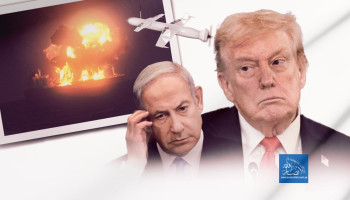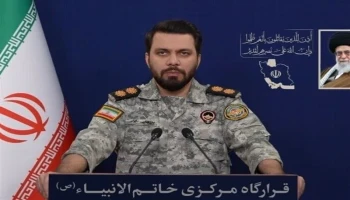

On an exceptional day, the Islamic Resistance in Lebanon carried out 45 separate military operations yesterday, Tuesday, spanning 24 hours, in one of the most extensive campaigns of resistance and attrition witnessed in southern Lebanon since the start of the aggression. The operations ranged from fierce ground clashes in border villages to precise strikes targeting the Israeli heartland, establishing a new equation: the resistance holds the initiative in an arena that recognizes only the language of force.
The resistance operations varied, including missile strikes, drone attacks, and direct ground engagements. These operations comprised 24 missile strikes, including bombardments with advanced and heavy missiles; 14 attacks by attack drones; and 3 intense ground clashes involving well-executed ambushes and heavy artillery shelling. Additionally, an enemy drone, a Hermes 450, was shot down with a surface-to-air missile.
The scope of the attacks extended to 27 targets within occupied Palestine, concentrated in settlements and cities in the northern Galilee, compared to 18 operations carried out inside Lebanese territory targeting enemy movements and gatherings in border villages.
In terms of military targets, the resistance managed to completely destroy or directly hit five Merkava tanks, in addition to three armored personnel carriers and Humvees. The strikes also targeted seven sensitive strategic military bases, most notably the Stella Maris naval observation base, the Nasharim base southeast of Haifa, the Tefen base east of Acre, and the Meron and Berea air defense and observation bases, along with the Ras al-Naqoura naval site and the Admit barracks. Furthermore, more than 10 command centers and field military positions were targeted, including a high-ranking commander's convoy. The Israeli enemy admitted to the killing of at least four Zionists, including a captain and a battalion commander in the Nahal Brigade, and the wounding of three others, one critically, in addition to the destruction of at least seven military vehicles.
The most significant operation of the day was the Beit Lev ambush, which lasted three continuous hours. Explosive devices were detonated against an Israeli armored force, and its members were engaged with light and medium weapons. The reinforcement force that rushed to the scene was then targeted with guided missiles. At 8:00 PM, the "Khaibar 2" wave was launched, comprising eight simultaneous operations targeting strategic bases and settlements. This demonstrated the resistance's ability to manage the battle with precise timing and meticulous organization.
An Eight-Headed Thunderbolt
On an evening no different from the previous one in the anticipation of the Zionists in northern occupied Palestine, the enemy leadership was surprised to find that the silence they had come to rely on was nothing but an illusion that quickly dissipated as the clock struck eight. At a precise moment—as if the hands of a clock had ignited a spark—the Islamic Resistance in Lebanon carried out eight simultaneous operations, codenamed "Khaibar 2," announcing a new phase in the long war of attrition.
The strikes were not random, but rather carefully planned to create a picture of coordinated destruction. The strategic "Stella Maris" naval surveillance base north of Haifa, that electronic eye monitoring the coast, was targeted and suddenly found itself under a barrage of sophisticated missiles that shattered it forever. At the same moment, other missiles and attack drones rained down on the "Nishrim" base southeast of Haifa, while military infrastructure in the Kiryat area north of the city was bombarded, reaching as far as the "Tefen" base east of Acre, which was not spared from the resistance's fire.
The operations were not limited to targeting military bases; they extended to four border settlements: Shlomi, Shomera, Zar'it, and Nahariya, where rockets rained down, reminding the Zionist settlers that their sense of security was nothing but an illusion. In a clear admission, Channel 12 revealed that the enemy army confirmed to the Zionist settlers that it had not detected any Hezbollah movement and therefore had not issued any warning. Twenty continuous minutes of launching, with more than forty rockets and drones, established a new equation: the resistance is capable of striking wherever and whenever it chooses, undetected by the surveillance systems the enemy has long boasted about.
Bint Jbeil: The Epic of Resistance in the Valley of Traps
While missiles rained down on Haifa, the land in southern Lebanon was witnessing another chapter of heroic resistance. In an attempt to seize the symbolically significant city of Bint Jbeil, the enemy army launched a ground incursion along the Ainata axis, relying on a massive armored force that had never before encountered such well-laid ambushes as those prepared by the resistance operations room.
On the night of March 28, resistance observers spotted four Merkava tanks, two bulldozers, and an armored personnel carrier moving from the direction of Khallat al-Tarouq towards Khallat al-Khanouq. This was just the beginning. At dawn the following day, a combined force of 25 armored vehicles from the 401st and Givati Brigades advanced towards the Aqaba area and the Fariz Heights in Ainata. Little did the Zionist force know that it was walking into a carefully prepared trap.
At 1:30 AM, as the advancing force reached the heights of Ghadmatha, the Mujahideen's engineering unit simultaneously detonated explosive devices targeting a Merkava tank and a D9 bulldozer. The explosion signaled the start of a well-executed ambush that immediately halted the Israeli advance and forced the forces to turn towards Karhaboun-Khallat al-Hajja, where the resistance was also waiting for them.
The confrontation was not limited to a single day, but extended over three days of continuous clashes. That same evening, the enemy attempted to advance again, only to be surprised by a Shawaz explosive device that destroyed another tank in the al-Sidr area, followed by a second tank explosion in the same location. On Monday, the Mujahideen engaged in three successive clashes within the town of Ainata, during which they targeted a Merkava tank with a guided missile and struck an enemy command post near Tell al-Friz with a precision-guided missile.
The missile hit its target with pinpoint accuracy. Throughout these clashes, the resistance artillery remained active, shelling enemy positions more than fifteen times. This demonstrated the resistance's ability to manage the battle in all its dimensions, from engineering ambushes and artillery fire to guided missiles and attack drones, which released footage of targeting two armored personnel carriers and a Hummer in the town of Bayada.
The toll of these clashes was significant: four Zionist soldiers killed, including a captain, and three wounded, one critically. This brings the total number of enemy fatalities in southern Lebanon since the start of the war to ten, according to the enemy's own admission, which typically acknowledges only a small fraction of its losses. However, more important than the numbers was the message: the ground advance towards Bint Jbeil had become a quagmire, and any attempt to penetrate further would be met with well-prepared ambushes exceeding all expectations.
Zionist Confessions: No Magic Solution
The Hebrew media didn't just report the news; they delved into deeper analysis, revealing the extent of the frustration within the Zionist "military establishment." In rare statements, former officials and experts from the enemy's "army" and "Mossad" described the Lebanese arena in terms they were unaccustomed to using: "complex," "intricate," and "completely different from any other region."
Res. Major General Danny Yatom, the former head of the Mossad, was the most candid when he admitted that Hezbollah fighters in southern Lebanon "possess a relative advantage over the Israeli army thanks to their intimate knowledge of the terrain." He added, "Every tree trunk and every small hill can be used as an ambush site for Hezbollah forces." This statement alone is enough to paint a picture of the battle the enemy is waging: a war in which confident advances are impossible because the very geography is on the side of the resistance.
Yatom continued, saying that controlling the land up to the Litani River would not solve the problem of rockets and missiles, and that the real challenge lay in changing the overall tactics, not just the strategy. He seemed to be admitting that all the enemy's plans for confronting Hezbollah needed a radical overhaul.
Reserve Lieutenant Colonel Oren Lasham, a former high-ranking officer in the Israeli Air Force, was even more blunt, stating in his assessment: "There is no magic solution to the Lebanese issue." He added that "the Israeli army has tried every approach over the past 18 years, including the Second Lebanon War, yet the situation remains complex and fraught with challenges."
In the same vein, Channel 14 reported that the problem in Lebanon was that Israeli forces were "constantly on the move, leaving them exposed to Hezbollah fighters who exploit the terrain and target them." Channel 12 acknowledged that the enemy army had not penetrated tens of kilometers into Lebanese territory, and that this deficiency was clearly felt in the fighting.
New Tactics Reshape the Confrontation
What the Hebrew media revealed about the nature of the fighting was more than just an admission; it was more like an intelligence assessment of a qualitative shift in the resistance's performance. According to the Hebrew channel "i24 NEWS," Hezbollah is confronting the Israeli enemy army with new tactics it has never encountered before: "Small groups of fighters strike Israeli forces with pinpoint accuracy, then disappear among the hills and valleys they know well." These tactics—according to Israeli security sources—have caused tangible losses and forced a restructuring of operational plans in several locations. Even more striking is that the anti-tank missiles Hezbollah is using today are "more advanced than before," reflecting prior preparations and an escalation in the nature of the confrontation that Tel Aviv did not anticipate.
In conclusion, what is happening in southern Lebanon is a protracted war of attrition, in which the resistance has skillfully exploited the geography to its advantage, mastered the art of ambushes and modern tactics, and raised the stakes to a level the Israeli enemy is unaccustomed to. Meanwhile, the enemy's human losses are mounting, and the gap between its claims of victory and the realities on the ground is widening.
The clearest truth remains that "Khaibar 2" was not merely a military operation, but rather a declaration of a new phase in the deterrence equation, one whose essence is that southern Lebanon will remain—as it always has been—a nightmare haunting the Zionists.