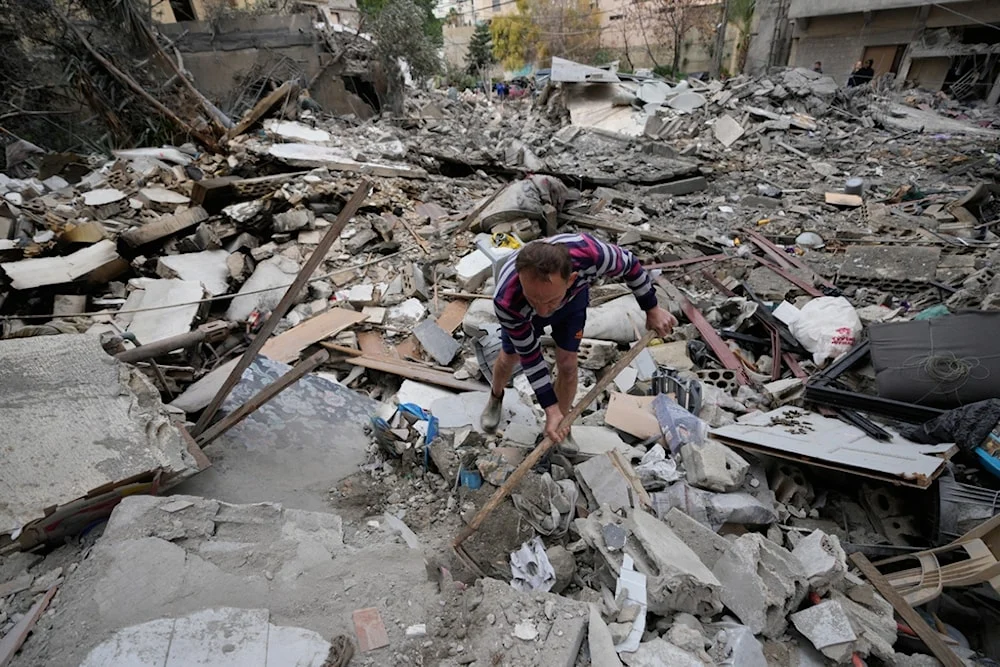
The Israeli occupation has demolished entire villages in southern Lebanon as part of its ongoing border offensive, using remotely triggered explosives to level homes in mass detonations that have left residents describing their communities as erased.
Videos reviewed by The Guardian show Israeli forces carrying out controlled explosions in the villages of al-Taybeh, Naqoura, and Deir Seryan along the Lebanon-Palestinian border. Lebanese media have reported additional detonations in nearby border towns, though satellite verification was not always available.
The destruction followed statements by "Israel’s" War Minister, Israel Katz, who called for the demolition of “all houses” in border villages, referencing what he described as the “model used in Rafah and Beit Hanoun in Gaza” to prevent threats to northern "Israel". In Gaza, Israeli operations have previously destroyed an estimated 90% of homes in Rafah.
Rights groups and legal experts have described the tactic as part of a broader pattern of “domicide”, the systematic destruction of civilian housing that renders entire areas uninhabitable.
South Lebanon and Gaza, two sides of the same victim
Israeli occupation forces keep framing attacks on civilian infrastructure and residences as targeting "Hezbollah infrastructure", including tunnels and military facilities allegedly embedded within civilian areas and homes. This falls into the repeated fashion of their false claims in Gaza and how all of Gaza's buildings, including hospitals, are "Hamas headquarters".
"Israel" has also announced plans to maintain control over large parts of southern Lebanon, establishing a “security zone” extending to the Litani River. Under this plan, displaced residents would not be permitted to return until "Israel" decides that northern settler communities are secure, raising concerns of prolonged or permanent displacement.
Rights organizations, however, have warned that the destruction may constitute unlawful “wanton destruction” under international law, which prohibits the deliberate targeting of civilian property unless strictly required for military operations.
“The possibility that Hezbollah may use some civilian structures in Lebanon’s border villages for military purposes does not justify the wide-scale destruction of entire villages along the border,” said Ramzi Kaiss, Lebanon researcher at Human Rights Watch.
Coordinated destruction of villages
The footage reviewed shows synchronized demolitions flattening residential areas and public spaces, with entire neighbourhoods collapsing in seconds. Residents say the destruction has erased not only buildings, but entire histories tied to their homes and land.
Ahmad Abu Taam, a 56-year-old shop owner from al-Taybeh, told The Guardian that he watched the town square, where his business was located, being destroyed.
“The first thing we saw was the town square being blown up. I have a shop there. A person’s whole life is in that place, their work, their memories, everything. Suddenly you see it exploding in front of you,” he said. “From that moment, I felt that I had become a refugee. I feel like I have no home.”
Abu Taam had previously been displaced during the 2024 Israeli war on Lebanon and had returned to rebuild his business after earlier damage. He said that returning once felt like recovery.
“When you arrive, it feels like you’ve found something you lost. But this time, everything is gone. Everything has been wiped out,” he said.
Entire life's work erased
Ahmad Ibrahim, a 50-year-old farmer from Deir Seryan, left his home on March 2, expecting to return shortly. He left behind personal belongings and family photographs, assuming he would recover them later.
“My whole life is there, I’ve never really left beyond 10-13km. It’s a beautiful, typical village – at least it was before the war. Its people are kind and generous,” he said.
He described how the coming of spring would normally transform the village into a place of gathering, farming, and family life, something now lost to displacement.
“The children remember the good times – spring and summer evenings, going out to the fields, collecting flowers and herbs, having dinner outdoors, making tea over a fire,” he said.
In Naqoura, physician and hotel owner Mohammed Hashem described the destruction of the Luna motel, which he built over 15 years and opened in 2012. The hotel had hosted tourists, Lebanese holidaymakers, and UN peacekeepers stationed in the area.
“In summer, occupancy would reach 100%. We received good ratings and awards. Overall, we were happy – living peacefully, with good productivity,” he said. “It really was a family business.”
Hashem said he was overwhelmed by messages of support after news of the hotel’s destruction circulated online.
“We received thousands of likes and comments. People expressed how much they loved the place. Our guests were always happy – good prices, good service,” he said.
Southern heritage
The villages of southern Lebanon have long been shaped by cycles of war and displacement dating back to the late 1970s. Over time, they became symbolic anchors for a global diaspora spread across Australia, Africa, and Europe.
Families would return seasonally, often rebuilding large homes for short stays during summer and spring, reinforcing emotional and cultural ties to the land.
“People would build houses worth a million dollars just to stay for a week or 10 days a year. The village becomes the centre of the family,” Abu Taam said.
Now, many of those anchors no longer exist.
“You feel a deep sense of frustration. Like someone has the power to erase you,” he said.
Source:Websites