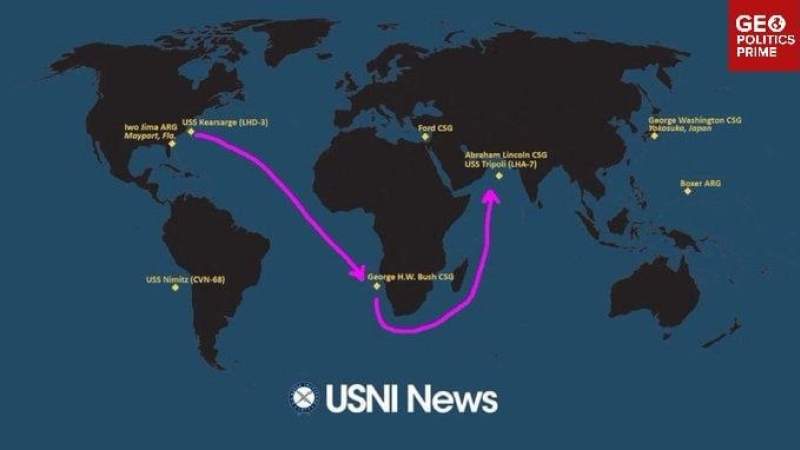
The US aircraft carrier USS George H.W. Bush has taken an unprecedented route around Africa to avoid transiting the Red Sea and the Bab al-Mandab Strait, in a move that US defense officials acknowledge reflects growing concern over the capabilities of the Yemeni Armed Forces.
The USS George H.W. Bush (CVN-77) Carrier Strike Group is currently operating off the coast of Namibia, having sailed around the African continent rather than taking the traditional route through the Mediterranean and the Suez Canal, according to a report published Monday by the US Naval Institute News (USNI News).
Two US defense officials confirmed to USNI News that the carrier and its escort vessels—the USS Donald Cook (DDG-75), USS Mason (DDG-87), and USS Ross (DDG-71), along with the fast oiler USNS Arctic (TAOE-8)—are circumventing Africa to join the growing US naval presence in the Arabian Sea.
The alternative route allows the carrier strike group to "avoid transiting the Red Sea and Bab el-Mandeb, both of which have been the focus of Yemen's drone and missile attacks on US ships over the past two years," the report stated.
Context of Yemeni Operations
The Bab al-Mandab Strait, a narrow waterway between Yemen and the Horn of Africa, has been a central arena for Yemeni military operations. For over two years, the Yemeni Armed Forces have conducted drone and missile strikes against US and Israeli-affiliated vessels in the Red Sea and the Arabian Sea in support of Gaza and the Palestinian people .
According to analysts, the Houthi movement—which controls large parts of Yemen including the capital Sana'a—has demonstrated significant capacity to threaten maritime traffic through this strategic chokepoint, which controls access to the Suez Canal .
Iranian Commander: "All US Forces Will Flee"
The development comes amid statements from senior Iranian military commanders emphasizing the strategic importance of Bab al-Mandab. Brigadier General Esmail Qaani, commander of the Quds Force of the Islamic Revolutionary Guard Corps, stated earlier this month that "the fate of all US forces in the region is to flee and withdraw".
Referring to the USS Gerald R. Ford, Qaani said: "The criminal Trump must dismiss the commander of the aircraft carrier Gerald Ford," asserting that the carrier "did not dare to cross Bab el-Mandab Strait for fear of the mujahideen and the Yemeni people" and that "after weeks of movement in the Red Sea, it left the region".
Strategic Significance
Ali Akbar Velayati, former Iranian Foreign Minister, has noted that the unified command of the resistance front views Bab al-Mandab with the same strategic importance as the Strait of Hormuz—a chokepoint through which approximately 20% of global oil passes.
Deputy Information Minister Mohammed Mansour warned last month that "the option of closing the Bab el-Mandab Strait is a Yemeni option that can be implemented should the aggression against Iran and Lebanon escalate".
Yemeni Leadership: Red Sea Closed to Enemy Military Movements
In his most recent address last Thursday, the leader of the revolution, Sayyed Abdulmalik al-Houthi outlined significant strategic achievements of the Yemeni front, including the complete closure of the Red Sea to American and Israeli military movements targeting Iran and resistance axis countries.
The leader stated that the Yemeni Armed Forces have effectively transitioned to "joint operations" with axis nations, striking Zionist enemy positions with ballistic missiles and drones in a calculated and escalating campaign.
The diversion of the USS George H.W. Bush around Africa represents a notable shift in US naval deployment patterns, reflecting the changed strategic reality in the Red Sea. The maneuver effectively acknowledges Yemen's capacity to threaten military vessels transiting the Bab al-Mandab Strait—a capability that has reshaped the operational calculus of naval forces in the region.
Source:Websites