Ansarollah Website. Report
Eleven years into the ongoing U.S.-Saudi aggression against Yemen, the devastating consequences of this brutal and savage war are no longer confined to the military and security spheres.
They have extended to every aspect of economic, social, and daily life, casting a heavy shadow over the lives of ordinary Yemenis and severely undermining their standard of living.
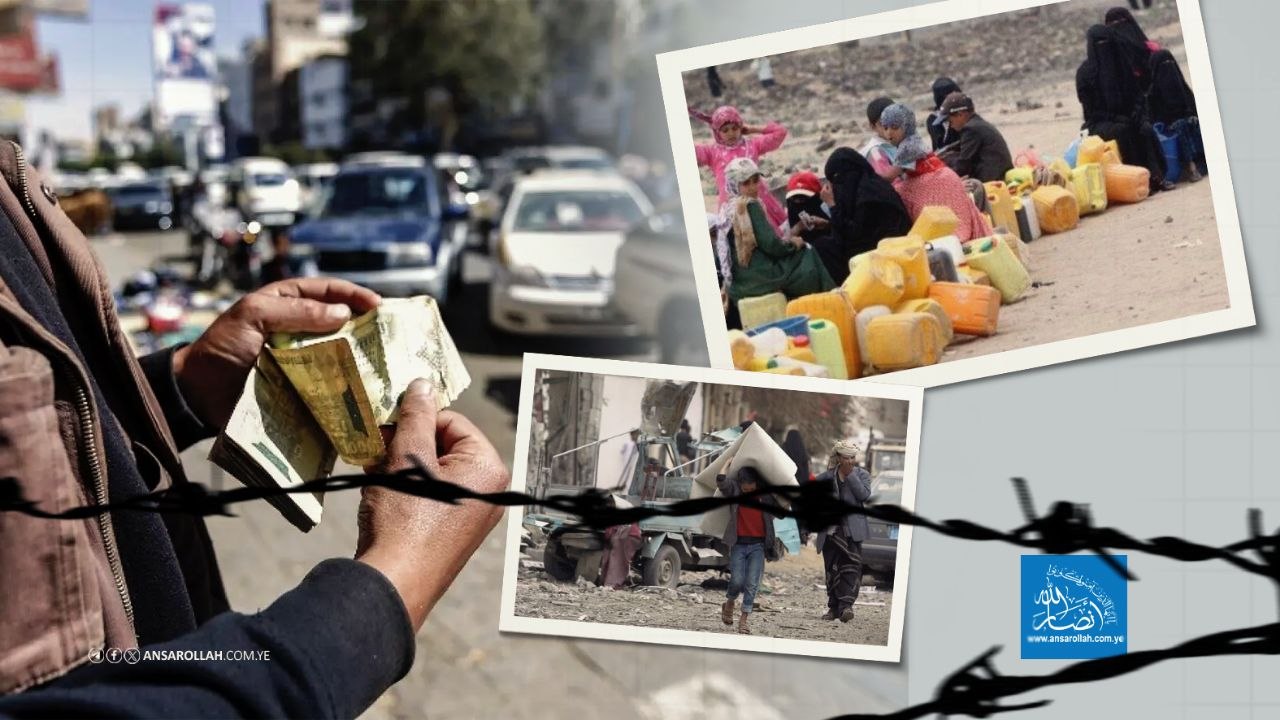
Years of aggression and a brutal blockade have triggered a sharp decline in economic activity, crippled numerous productive and service sectors, driven poverty and unemployment rates higher, and eroded purchasing power.
Basic services—including healthcare, education, electricity, and water—have deteriorated dramatically, while the suspension of salaries has compounded the suffering. As a result, the lives of countless Yemenis have been turned into a living nightmare through what is portrayed as a deliberate policy pursued by Saudi Arabia, Yemen’s hostile neighbor.
Saudi Arabia has deliberately imposed blockade restrictions on trade, imports, and exports, while extensive damage to infrastructure and disruptions to markets and supply chains have further deepened the crisis.
These measures were designed to punish the Yemeni people and intensify their economic hardship by driving up the prices of essential goods, fuel, and medicines. Consequently, the financial burden on Yemeni households has increased substantially, forcing large numbers of families to rely on humanitarian assistance to secure their most basic necessities.
Targeting Education: Saudi Arabia’s Weapon to Subjugate Yemen and Destroy Its Future
With the start of every new academic year, another chapter of the silent humanitarian suffering inflicted by nearly eleven years of aggression and blockade unfolds in Yemeni households.
Education—long regarded as a gateway to hope and a better future—has been transformed into a crushing financial burden, adding to the hardships already weighing heavily on parents.
The severe deterioration of the public education sector, driven by the suspension of salaries and the destruction of infrastructure, has left families facing an impossible choice: either surrender to the reality of a struggling and under-resourced public education system, or turn to private education, which has itself become an exorbitant investment and a profit-driven business consuming what remains of household savings amid the staggering rise in tuition fees and the soaring cost of school supplies, textbooks, and uniforms.
This tragic reality constitutes a full-fledged crime deliberately engineered by Saudi Arabia. From a position of arrogance and vindictiveness, Riyadh looks upon the suffering of the Yemeni people while seeking, through the tools of economic warfare, to destroy both the present and the future.
Targeting education and impoverishing teachers and families alike form part of a malicious Saudi strategy aimed at weakening Yemenis, tearing apart their social fabric, and keeping future generations trapped in ignorance, so that Yemenis are reduced to little more than a source of cheap labor serving the Saudi job market—deprived of knowledge, sovereignty, and development.
Destroying the Economic Foundation and Obstructing Development
Yemen’s economy has suffered a severe decline throughout the years of aggression as a result of deliberate airstrikes aimed at crippling state institutions and economic activity.
Critical infrastructure—including roads, bridges, ports, airports, and productive facilities—was intentionally targeted in attacks designed to inflict the greatest possible damage on trade, transportation, and production.
The direct bombardment of factories and key infrastructure led to a sharp drop in both domestic and foreign investment, while employment opportunities dwindled as thousands of industrial and commercial enterprises either ceased operations entirely or drastically scaled back their activities.
Human rights and humanitarian reports maintain that Saudi Arabia bears primary responsibility for much of this destruction. These assessments cite airstrikes, the blockade, and other measures associated with the aggression, arguing that such policies were intended to force the Yemeni people into submission and compel the country's leadership to surrender.
As a direct consequence, Yemen’s economy was severely weakened, while prospects for recovery, reconstruction, and sustainable development were significantly undermined.
Deteriorating Living Conditions and the Expansion of Poverty
The brutal aggression has dealt a devastating blow to the incomes of Yemeni families, as unemployment rates have surged and salary payments for large numbers of public-sector employees across various state institutions have been suspended or severely disrupted, particularly within the education sector.
At the same time, the prices of food, fuel, medicines, and essential services have risen sharply, eroding citizens’ purchasing power and driving increasing numbers of people into poverty.
The Yemeni people believe that Riyadh’s policies—implemented through the blockade, restrictions on trade, ports, and border crossings, as well as the continuation of the aggression for nearly a decade—have deepened and prolonged the country’s living crisis.
They view these measures as a primary cause of the worsening suffering of civilians and a major factor behind what the United Nations has described as the world’s worst man-made humanitarian crisis.
Long-Term Impacts on the Economy and Society
The effects of the aggression have not been limited to immediate losses; they have extended to a broader deterioration in economic growth, capital flight, and the emigration of skilled professionals.
Investor confidence in the economic environment has significantly weakened, while poverty levels and food insecurity have risen sharply. At the same time, economic recovery has become increasingly difficult due to the scale of destruction inflicted on institutions, infrastructure, and productive sectors.
In this context, a number of observers argue that the continuation of the aggression and the associated economic measures—for which Saudi Arabia bears primary responsibility—has prolonged both the economic and humanitarian crisis.
They note that these developments have left deep structural scars that will require many years of sustained effort to repair, along with extensive reconstruction to restore economic and social stability.
A broad segment of Yemenis also maintains that the economic measures linked to the conflict, including the blockade, financial restrictions, and the suspension of salary payments, have been used as instruments of war and as tools of pressure against the Yemeni population.
An Economic and Social Front Thwarting Subjugation Plans
Despite the severity of the conditions, the scale of suffering, and the heavy human and material losses—including the large number of martyrs and wounded—the Yemeni people have demonstrated remarkable resilience and endurance.
This has been reflected in the continuation of informal social activities, strong family solidarity, and the adoption of alternative livelihood strategies, all of which have helped prevent a total collapse of the social fabric despite the prolonged and complex nature of the war.
Government measures have also played a significant role in curbing the deterioration of financial conditions, particularly through efforts to stabilize the national currency exchange rate via various monetary and regulatory interventions, as well as measures aimed at controlling the banking sector and limiting currency speculation.
These efforts have contributed, to a considerable extent, to easing the severity of economic collapse and preventing further erosion of citizens’ purchasing power.
In this context, these policies can be seen as one of the factors underpinning economic resilience under extremely difficult circumstances, as they have helped maintain a minimum level of monetary stability despite ongoing pressures from economic warfare, declining revenues, weak public resources, and the control of oil and gas wealth, along with the closure of air and land entry points.
Towards Restoring Hope and Building the Future
Despite the immense suffering endured by Yemenis throughout years of aggression, scenes of resilience and social cohesion continue to reflect a strong capacity to endure and confront ongoing challenges.
In this context, Yemeni voices have grown louder across all forums and arenas, denouncing the imposed reality and what they describe as the economic strangulation of blockade policies.
Popular demands are no longer limited to appeals to international organizations or reliance on what they see as futile diplomatic solutions; rather, public sentiment in Yemen increasingly calls—clearly and explicitly—for a shift toward decisive options and direct confrontation with the Saudi regime to reclaim what it considers usurped rights by force of arms, foremost among them salaries and revenues from oil and gas, as well as the full lifting of the blockade on airports and seaports.
These popular pressures and calls are also said to align with the leadership’s vision, as renewed appeals emphasize strengthening national and social cohesion and unifying efforts to overcome the consequences of war and restore rights and living conditions through all available means.
In this regard, Ansar Allah leader Sayyed Abdul-Malik al-Houthi stressed the importance of “cooperation in our country, both at the official and popular levels, to confront the risks and challenges arising from what he described as comprehensive hostile targeting of the Yemeni people.
He also cited, among other factors, what he described as the occupation of large parts of the country, control over national oil and gas resources, violations of Yemen’s sovereignty and independence in all forms, and the imposition of a blockade and a comprehensive economic war against the population.
He further referred to the mobilization of extremist groups and mercenaries aimed at targeting civilians and destabilizing society, as well as what he described as a range of hostile conspiracies carried out by the coalition of aggression under U.S. supervision and with direct Saudi implementation.”
Thus, hope remains anchored in this comprehensive mobilization and the convergence of popular and official efforts to respond to this call, in a way that would establish new equations capable of enabling Yemenis to regain their full rights and normal life, and to build a stable state founded on justice, development, and peace.