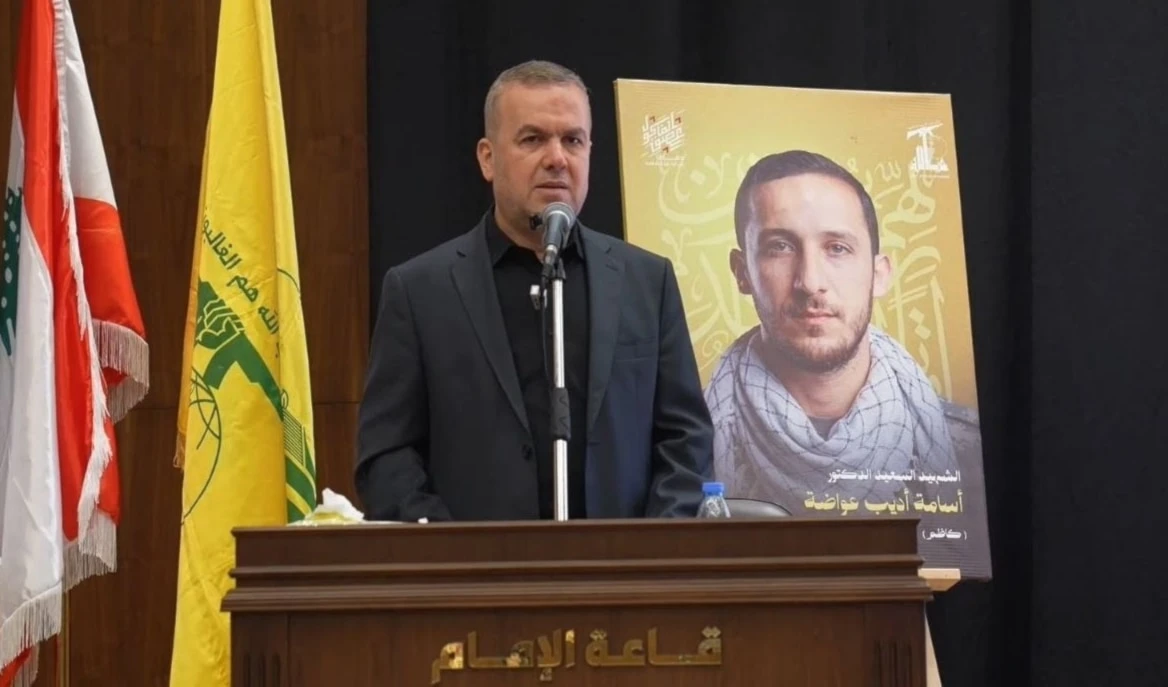
Member of the Loyalty to the Resistance Bloc in the Lebanese Parliament, MP Hassan Fadlallah, declared that the "agreement of humiliation and shame" signed by the Lebanese authority "will not see the light of day and will not be implemented." He stressed that the Resistance's weapon will remain to protect and defend Lebanon and that the Resistance's hand "will remain on the trigger," considering that any American–Iranian agreement will not pass without guaranteeing the withdrawal of the Israeli occupation from Lebanese territories.
Speaking at a memorial ceremony organized by Hezbollah for the martyr Ali Al-Rida Haidar Fakih at the Sayyida al-Zahra hall in Ain al-Delbeh, in the southern suburbs of Beirut (Dahiyeh), Fadlallah emphasized that the Resistance will continue its legitimate right to defend its people. He asserted that the Resistance possesses the elements of strength that enable it to confront conspiracies, pointing out that the current attempt aims to block the Iranian–American memorandum of understanding, during which Iran insisted that the cessation of aggression on Lebanon and the withdrawal of the Israeli occupation from it must be the first clause of any agreement.
MP Fadlallah added that the Islamic Republic "will not sign any agreement that does not guarantee an Israeli withdrawal from Lebanon," noting that there is an "regional equation extending from the Strait of Hormuz to Bab al-Mandab, reaching Ali al-Taher and the frontline villages," which works in Lebanon's favor.
He criticized the Lebanese authority, stating that it has "signed a document of surrender" and abandoned the concept of a sovereign state. He accused it of prioritizing external loyalties over the interests of the Lebanese people, "selling out the South and its people," and exonerating the Israeli occupation of its crimes. Fadlallah considered that the authority is practicing political hypocrisy and falsifying facts, and that it seeks, with American support, to disrupt national balances and target the environment of the Resistance.
He stated that in the face of the crimes against the nation committed by the authority, it is more certain today than ever before that our weapon is what protects us, liberates our land, and defends our existence. He added that the authority's actions will serve as an additional incentive to acquire all means of power. "Those who do not possess weapons will buy them; in fact, generations of youth are demanding today to be trained on weapons to defend their people's rights and existence," he said, explaining that as a result of what they witness at the hands of the occupation and the practices of the authority, they have lost hope in the possibility of building a state capable of providing protection for its people.
Fadlallah mentioned that the authority is working to shift the conflict from a confrontation with the Israeli occupation into an internal conflict, describing this as "the ugliest function for a ruling authority." In contrast, he affirmed the Resistance's keenness on the country's stability and on the Lebanese Army, stressing that the cause of the Resistance is "national and not sectarian," and that it enjoys the support of Lebanese from various sects despite the pressures they face.
He clarified that the Resistance will continue its path until the liberation of the land and the protection of the people, emphasizing that the future of Lebanon will only be shaped by what preserves its sovereignty and rights, and that "anything the Resistance does not approve of will not pass."
He concluded by saying, "It is our destiny as a community and an environment to remain revolutionaries and resistance fighters against occupation and injustice; this is our history, which is full of sacrifices for the sake of living with pride, dignity, and freedom. We were forced to bear arms in defense of our existence and to liberate our land because we did not have a state that assumed its responsibilities or performed its duties—in fact, it was sometimes on the side of the occupation, as happened in 1982."


