Military strikes do not all carry the same meaning. Some are measured by the targets they hit; others by the questions they leave behind. And some operations go beyond their immediate impact to create a defining moment in the course of a conflict, forcing the adversary to reconsider its calculations.
This is what is happening today with the Saudi enemy, which had believed that the United States would shield it from Yemeni fire. Against this backdrop, the military operation carried out by the Yemeni Armed Forces against targets in Riyadh and Yanbu stands as one of the most consequential operations in the course of the confrontation.
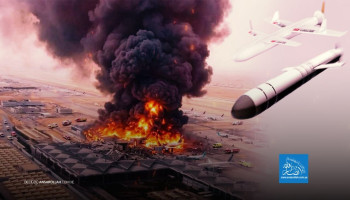
On the morning of September 19, missiles and drones were launched toward geographically dispersed targets deep inside the Kingdom. Riyadh, with its significance as a political, military, and economic center, and Yanbu, with its role as a major oil and export hub on the Red Sea, were simultaneously brought into the Yemeni military theater.
The strikes were carried out using a combination of ballistic and cruise missiles and drones in a multi-pronged operation. This is where the operation’s significance lies, even before considering the extent of the damage it caused.
Riyadh is the heart of decision-making and the political center of gravity where military, security, and economic institutions converge. When Yemeni fire reaches this heart with such intensity, the message extends beyond the targeted facility, raising questions about the state itself and its ability to protect its most vital center.
Yanbu, meanwhile, represents the other side of the equation: the economic, energy, and export dimension, particularly given the importance of the western coastline as an alternative route for Saudi exports.
Bringing Riyadh and Yanbu together in a single operation therefore gives the strikes a different significance: the capital on one side and an economic lifeline on the other. In other words, a strike against the center of decision-making carried out in parallel with a strike against one of the centers of economic power.
This is precisely what makes the operation significant not merely as an isolated military incident, but as a development that could mark a shift in the nature of the conflict.
Riyadh in the Crosshairs of Yemeni Fire
In Riyadh, attention centered on King Khalid International Airport and the disruption to air traffic that accompanied the strike, including fires and the reported targeting of fuel tanks and airport-related facilities.
Flights were reportedly diverted and the airspace temporarily closed, presenting a picture of Saudi vulnerability as Riyadh, which is supposed to be the Kingdom’s most heavily fortified area, became part of the theater of operations.
For many years, the war was premised on the assumption that Yemen would be the battlefield, while Saudi Arabia would remain the side with the secure strategic depth needed to manage the conflict from beyond its borders.
Distance itself thus became part of the protection system, while vital Saudi facilities were shielded by layers of Western air defenses, political calculations, and military alliances.
If Riyadh is the symbol of political power, Yanbu is the symbol of energy: a Red Sea port hosting facilities linked to Saudi Arabia’s oil transportation and export network, as well as the East–West Pipeline, which provides the Kingdom with a strategic outlet for exporting a substantial share of its oil while bypassing the Strait of Hormuz.
Yanbu’s importance has increased further amid disruptions to navigation through the Strait, given its role as a vital gateway for Saudi exports on the Red Sea.
For this reason, targeting Yanbu cannot be viewed merely as an attack on an oil facility; rather, it represents pressure on one of the key links in the chain connecting Saudi oil to global markets.
The equation therefore becomes clearer: Riyadh says the decisions are made here, while Yanbu says the economy flows from here.
When the Yemeni threat reaches both locations simultaneously, its significance goes beyond the immediate material damage to become a test of the state’s ability to protect its centers of gravity. This is the strategic logic behind the Yemeni dual strike.
The Collapse of the Bet on Air Defenses
Military power is not always measured by the number of missiles that reach their targets, but by its ability to force an adversary to divide its attention, resources, and calculations across multiple fronts at the same time.
The latest military operation was built around precisely this principle, employing a mix of ballistic and cruise missiles alongside drones, creating multiple trajectories, altitudes, and forms of threat.
Setting aside the technical details, the message behind this diversity is clear: the battle is no longer confined to one side’s ability to launch fire, but to its ability to mount a complex operation that forces an air defense network to confront a simultaneous, multi-directional threat.
This brings one of the most sensitive issues in the Saudi air-defense picture into focus. Saudi Arabia has spent vast sums building a defensive network centered on advanced systems, including Patriot and THAAD, while drawing on a range of expertise and strategic partnerships.
Yet the ability of attacks to penetrate deep into Saudi territory raises a fundamental question about the value of such a defense network: what is the purpose of a system of defenses if a strike can still reach the heart of the very area presumed to be the most heavily protected?
The Psychological and Strategic Dimensions of the Yemeni Strikes
War is waged with weapons, but it is also waged through the image each side holds of its adversary’s capabilities. When Saudi Arabia’s strategic depth was viewed as a protected zone, that perception itself formed part of Saudi power.
But as long-range Yemeni strikes were repeated and hit their targets with precision, that perception began to erode. Deterrence, therefore, became as much a psychological and strategic process as a military one.
Deterrence rests on convincing an adversary that the cost of a given action will be high. Conversely, when an adversary discovers that the other side is capable of reaching sensitive targets deep inside its territory, its calculations begin to change.
This helps explain the slogan “siege for siege.” The operation was preceded by developments in the Red Sea, followed by air operations deep inside Saudi territory that added another dimension to the pressure, alongside the establishment of control over the western coastline and the expulsion of Saudi military buildups, while a comprehensive maritime blockade on Saudi shipping was imposed at the same time.
The fronts, therefore, are not separate: from the sea to the coastline and onward to the Saudi interior, they form interconnected links within a single system.
This is perhaps the most significant development in the current picture: the war is increasingly being understood as a network of interconnected theaters rather than a collection of isolated fronts.
From the Red Sea to Bab al-Mandab, from the western coastline to the skies, and from oil facilities to Riyadh, a new equation is taking shape in Saudi Arabia’s security calculations.
Here, too, Yanbu warrants attention as more than simply an economic target. Yanbu is a key route for Saudi oil exports to the Red Sea, and any disruption along that route reverberates through exports, markets, insurance costs, and tanker traffic.
Oil is one of the pillars of the Saudi state, a primary source of revenue, and a cornerstone of the Kingdom’s role in the global economy. For that reason, any approach toward energy facilities means approaching an exceptionally sensitive point in the equation of Saudi power.
The issue therefore extends beyond the borders of Yemen and Saudi Arabia. When energy routes or export facilities face major disruption, global markets begin to assess the risks differently: insurance costs rise, shipping companies revise their calculations, and refineries and buyers become more sensitive to supply risks. Every additional barrel becomes tied to a longer chain of political and security considerations.
In other words, the reverberations of a strike can reach places far beyond the point where it lands. This is one of the defining characteristics of modern warfare: a strike limited in geographic scope can generate a far-reaching economic impact when it hits a strategic node.
Riyadh Knocks on Doors It Never Imagined It Would Have to Open
In a scene that lays bare the scale of the predicament, The Washington Post reports that the escalation of Yemeni operations disrupting the flow of Saudi oil has exposed the limits of U.S. support, with a Saudi official saying that requests for assistance “have gone unheard and unheeded” in Washington.
According to the newspaper, the Trump administration is focused on protecting its core interests, foremost among them freedom of navigation in the Red Sea, and does not want to repeat last year’s experience, when it was forced to reach a military agreement to withdraw from the confrontation with Yemen.
Andrew Leber of the Carnegie Endowment for International Peace argues that Riyadh “made the mistake of assuming Washington would return to strike Yemen militarily on its behalf, as it did in 2024 and 2025.”
But the most consequential revelation came from The Wall Street Journal: Saudi Arabia rushed to Washington—and even to the Israeli entity—seeking intelligence on Yemen.
The U.S. newspaper reports that the Yemeni blockade of Saudi oil could push Riyadh toward cooperation with Israel, while the Yemenis’ recapture of strategically vital territory along the Red Sea coast has “weakened Riyadh’s claims that it can manage the Yemen file on its own.”
Bab al-Mandab in Yemen’s Grip
The U.S. public broadcaster PBS, for its part, painted a bleak picture of the strategic situation, saying that Yemen is expanding its control over the western coastline and islands near Bab al-Mandab, stretching from the port of Mokha to Mayyun Island and then to Greater Hanish and Lesser Hanish.
The strait’s importance as a strategic chokepoint through which a significant share of global trade passes makes this expansion a growing source of concern.
The broadcaster noted that Yemeni attacks had targeted areas including Khamis Mushait, Jizan, Riyadh, and Yanbu, causing casualties and material damage.
This came as a strategic Saudi oil pipeline was also targeted in an attack that could take weeks to repair. The pipeline, stretching roughly 745 miles, carries oil from production areas away from the Gulf to the Red Sea coast.
Former U.S. Ambassador to Saudi Arabia Michael Ratney linked these developments to rising risks in global oil markets, noting that oil prices were approaching $110 a barrel.
Ratney argued that Saudi Arabia’s experience in its war against Yemen, which lasted nearly a decade without producing a decisive military outcome, could ultimately push the Kingdom back toward negotiations and diplomacy, as well as the payment of compensation.
The Enemy’s Admission
Haaretz, an Israeli newspaper—not an Arab or Yemeni publication—offers what may be the most painful admission. The newspaper states that Yemen represents “the most severe military and political defeat suffered by Mohammed bin Salman in more than a decade,” after he had believed that the war against Yemen would amount to little more than “a desert campaign fought with American-made Jeeps.”
The newspaper warns that the impact of the Yemenis extends beyond altering the military and political landscape in Yemen, arguing that they have “joined the ranks of countries that have undermined the foundations of U.S. foreign policy in the region.”
It adds: “The Yemenis today are the ones disrupting maritime traffic to and from Saudi Arabia, and they are the ones striking deep inside Saudi territory, while all Riyadh can do is absorb the blows.”
It expects the Yemenis to raise their demands to include “international recognition as a legitimate government, an end to the blockade, the full reopening of the airspace, and a generous allocation from Saudi Arabia’s oil revenues.”
The Victor Sets the Terms
What is happening today marks the end of one chapter and the beginning of another. Riyadh, which once believed the war would be a brief and easy campaign, now finds itself facing a new reality: its capital is under attack, its oil facilities are being set ablaze, and its allies are abandoning it.
Yemen, which was subjected to a Saudi blockade for years, is now imposing a counter-blockade. Once described as a “poor country,” Yemen has become a weapons producer and an increasingly influential regional and international actor. The regional landscape has been transformed from what it was twelve years ago.
The question now is whether Riyadh will absorb the lesson before it is too late—or whether pride will continue to send the bill.