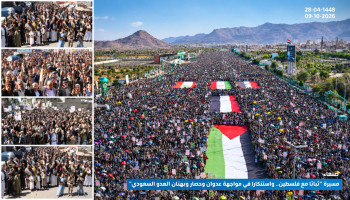
The 12th anniversary of the glorious September 21 Revolution comes as Yemenis continue to defend the principles and objectives of that enduring revolution, in the face of multinational aggressive alliances, most of which act at the behest of the United States, Britain, and the West.
Despite the enemies’ concerted efforts and their enormous military and political capabilities, and their fierce assault against Yemen aimed at overthrowing this blessed revolution, which uprooted the roots of guardianship and consolidated freedom and independence, the men of great resolve, Yemen of wisdom and faith, stood firm like steadfast mountains in confronting the enemies, making the Quranic methodology and allegiance to the standard-bearers of guidance a beacon for their field movements. This made them an important and exceptional phenomenon that astonished the world through their patience, steadfastness, struggle, and valor.
A Genuine Revolution Based on Addressing the Root Causes of Various Problems
In this context, Ansarullah Political Bureau member Ali Al-Dailami considers the September 21 Revolution one of the most important Yemeni revolutions, noting that previous revolutions were not sufficiently strategic and did not address the dimensions of sovereignty, freedom, and independence. Rather, most of them were characterized by nominal independence, while economic ties and political and national decision-making remained linked to foreign powers, from Britain to the United States.
Speaking to the Ansarullah website, Al-Dailami explains that the September 21 Revolution distinguished itself as a genuine revolution based on addressing the root causes of various problems, foremost among them sovereignty, in a manner that guarantees a national decision that is not subject to bargaining or to placing economic interests above Islamic and humanitarian principles, citing the Yemeni position in support of Gaza.
Al-Dailami discusses the development aspects brought about by the September 21 Revolution, explaining that the previous period witnessed decisions that prevented the expansion of grain cultivation and pushed the country toward imports, keeping the state in a state of deficit until it reached the point of importing various necessities. Today, the revolution is working according to a clear vision to address these imbalances, even if this requires time, given the roots of submission and surrender that have extended for more than 62 years.
He points out that supporting the Palestinian cause and Gaza came independently of calculations related to the blockade and aggression—calculations practiced by U.S. proxies, foremost among them Saudi Arabia. He stresses that the revolution’s achievements include military manufacturing, agriculture, restoring national decision-making, and returning Yemen to the forefront, alongside continuing efforts to build Yemen and strengthen its dignity.
According to Al-Dailami, the blockade and aggression constitute challenges with negative repercussions, but they are being addressed through internal solutions and the principle of “blockade in response to blockade and escalation in response to escalation,” particularly as the money and resources of the Yemeni people continue to flow to the Saudi enemy.
He concluded by saying that popular interaction with the leadership, the presence of a methodology and vision, and the availability of capabilities are factors that complement one another along the path of the revolution. He expressed his confidence in achieving major victories, congratulated the leadership and the Yemeni people on the occasion, and recalled the sacrifices of the martyrs who gave their most precious possessions for the sake of dignity and honor.
A Revolution by Yemeni Decision
For his part, Ansarullah Political Bureau member Abdullah Al-Naami describes the September 21 Revolution as “a gift from Allah Almighty to the Yemeni people,” stressing that it emerged from the very heart of the Yemeni people, without extensions, interventions, or external support from any state.
Speaking to the Ansarullah website, Al-Naami affirms that the revolution, by Allah's grace, under the leadership of al-Sayyid Abdul-Malik Badruddin Al-Houthi, and with the people’s response to its call, came to correct the deviations that had marred previous revolutions and to rectify their courses. He notes that among its most prominent achievements was thwarting the U.S., Saudi, and Zionist external projects that sought to tear Yemen apart, dismantle it, and fragment it.
Al-Naami discusses ending guardianship over Yemen and strengthening its sovereignty and national decision-making, enabling it to exercise its own decisions and preserve its sovereignty. He considers the September 21 Revolution to have brought about a transformation in the awareness of the Yemeni people and to have constituted an important historical turning point in their journey.
He adds: “The revolution aroused resentment, anger, and fear among states that had projects inside Yemen after it thwarted those projects and removed them from the arena.” He congratulated the Yemeni people and Leader Sayyed Abdul-Malik Badr Al-Din Al-Houthi on the cherished anniversary of the September 21 Revolution, praising Allah for this blessing and expressing his hope that the revolution will bear greater fruits in the near future and achieve the objectives to which it aspires.
The Revolution and Breaking the Strength of the Aggression
For his part, Director of the Yemeni Center for Political and Strategic Studies Abdulaziz Abu Talib states that from its first day, the September 21 Revolution raised the slogan of freedom and independence in the face of subordination, which was among the main reasons the people rose up against a regime that had surrendered the national decision.
Speaking to the Ansarullah website, Abu Talib explains that the revolution’s success in 2014, and the principles of liberation from guardianship and subordination that it carried, led the Saudi regime to regard it as a departure from the norm and a rebellion against a relationship that had existed for decades under the terms of the Special Committee. After failing to extract a pledge from the revolution’s leadership through political means, it resorted to direct military aggression on March 26, 2015.
He explains that the revolution confronted the aggression in accordance with its slogan and fundamental objective, succeeded in breaking its strength, and established the equation of force confronting force, protection in the face of violation, and independence in the face of subordination. He notes that the revolution restored the state’s political decision-making, protected the country’s sovereignty despite limited resources, and succeeded in building a strong national army capable of protecting the homeland and its gains according to a doctrine and faith-based identity, thereby achieving steadfastness in confronting the most formidable powers.
He points out that the revolution moved Yemen from the position of a regional subordinate to the forefront of regional and international actors, noting that independence enabled it to adopt regional and international positions away from Saudi, Gulf, and Arab orientations that do not align with its identity, culture, and beliefs. In the battle to support the Palestinian people, Yemen is waging the battle of support through a decision independent of the Arab position. For the first time, a purely national government was also formed without intervention or recommendation from the Saudi enemy.
September 21: A Revolution That Breaks Guardianship
Yemenis celebrate this great anniversary as Yemen takes center stage globally in defending the causes and sanctities of the Islamic nation, turning the forces of global arrogance—the United States, the Israeli enemy entity, and their allies—and humiliating them before the world and exposing their falsehood before peoples. This has taken place through fierce battles that are among the most intense in history, in which their armies suffered crushing defeats at the hands of Yemen, confident in Allah. This has prompted the world to question the secret behind Yemen’s strength, vigor, and resilience in confronting its enemies despite its modest capabilities, which pale in comparison with those of the enemy.
On this point, poet, writer, and political analyst Ali Ahmed Jahiz says: “Reading and documenting the historic moment is no less important than creating it, because making history without documenting, reading, reviewing, and evaluating the project and the path that have been consolidated and built leaves it vulnerable to being lost amid changes and deprives it of its effectiveness, continuity, and usefulness to future generations.”
Speaking to the Ansarullah website, Jahiz affirms that the September 21 Revolution was the most important historic moment created by Yemenis, given the national and religious objectives it carried and the change it brought about, rising to the level of an earthquake that shook Yemen and the region. He explains that the revolution’s course does not stop at limited achievements within a limited period, but extends toward achieving higher objectives, foremost among them the liberation of Palestine and the sanctities of the nation. He stresses that the continuation of this path depends on the determination of future generations and their awareness of the revolutionary project.
According to Jahiz, over the course of 12 years, the revolution achieved major successes that transformed Yemen into an active and respected state. Its gains formed the foundation for steadfastness in the face of regional and international mobilization and attempts to return Yemen to its previous state as a country deprived of its sovereignty and a people under foreign guardianship.
He points out that this foundation made Yemen difficult to subjugate and turned it into a formidable front against the projects of the forces of global arrogance. This was manifested during the years of aggression and reinforced in the battle to support Gaza and confront the “Prosperity” coalition led by the United States and Britain, as well as the European “Aspides” coalition, culminating in the revolution’s effectiveness at the military and political levels and in building the human being spiritually, morally, and culturally.
Jahiz concluded that the path toward achieving the revolution’s objectives remains long, calling for continued efforts with the same determination and revolutionary spirit, and for raising generations that carry the project forward and achieve what the current generations have been unable to achieve.