Ansarollah Website | Report by Wadeea Al-Abse
The Saudi regime’s continued reliance on media fabrications and propaganda against Yemen underscores a firm conviction that the situation on the ground—despite the elapsed time—has turned out contrary to plans. Strategic objectives originally set for the aggression have transformed into a heavy burden from which the regime can neither escape nor evade the consequences.
According to observers, monitoring centers, and research institutes—alongside extensive readings of field data analyzed against the relative capabilities of both parties—twelve years of battle have forced the Saudi regime to face fundamental realities. At a minimum, it proved incapable of waging war against the Yemeni people, who are hardened by battle and endurance against hardship. Crucially, it faced the shock of an exposed network of flatterers and hypocrites who once offered gestures of obedience, only to distance themselves when the conflict intensified to avoid disastrous entanglements.
In an effort to overcome this reality, the Saudi regime continues a suicidal and futile battle that gradually eroded its own foundations. Throughout its campaign against the Yemeni people, it utilized available means, including systematic media drives, attempting to tarnish Yemeni conduct in battle while seeking international support and direct military intervention against Yemen. However, meticulous analysis of the military operations and corresponding Yemeni defensive responses reinforced a global perception of high ethical conduct by the Yemeni Armed Forces—a discipline adhering strictly to rules of engagement derived from Islamic principles and recognized international standards. Consequently, media and intelligence narratives produced by Saudi circles frequently collapsed upon the emergence of verified facts.
A Moral and Ethical Framework Governing Military Choices
In the ongoing escalation initiated by the Saudi regime through the bombardment of Sanaa International Airport—aimed at preventing stranded Yemenis from returning home—Riyadh attempted to isolate Yemen and portray it as a rogue actor defying both Islamic and Western norms. When artificial controversy was generated by spreading rumors regarding alleged Yemeni intentions to target Mecca, those claims were met with widespread international skepticism, as they completely contradicted Yemen’s stated positions and religious heritage.
Following this failure, Saudi Arabia—with United States and "Israeli" involvement in the background—resorted to a repeated narrative accusing Yemen of "targeting civilians and residential areas" during missile strikes and drone attacks deep inside Saudi territory. This persistent effort to misrepresent facts highlights a psychological crisis in Riyadh, which seeks any development to offset Yemeni resolve and regain lost balance.
As part of this campaign alleging the "targeting of civilian objects," Saudi media attempted to cite principles of international law, claiming adherence to rules of engagement and international humanitarian law. However, in contrast to these undocumented assertions, operational realities demonstrate that Yemen bases its military and defensive decisions on an established ethical framework. Under this framework, avoiding harm to non-combatants remains a fixed principle, exempt from tactical maneuvering or media exploitation.
This position is reflected in official statements from the Armed Forces, field operations monitored by satellites, and social media documentation, all pointing to a consistent conclusion: the Yemeni target database is selected with high precision using advanced reconnaissance and intelligence capabilities, restricted strictly to legitimate military targets. These include King Khalid Air Base, command and control centers, radar stations, and vital installations directly supporting the war effort.
Attempts to Divert Attention from Air Defense Failures
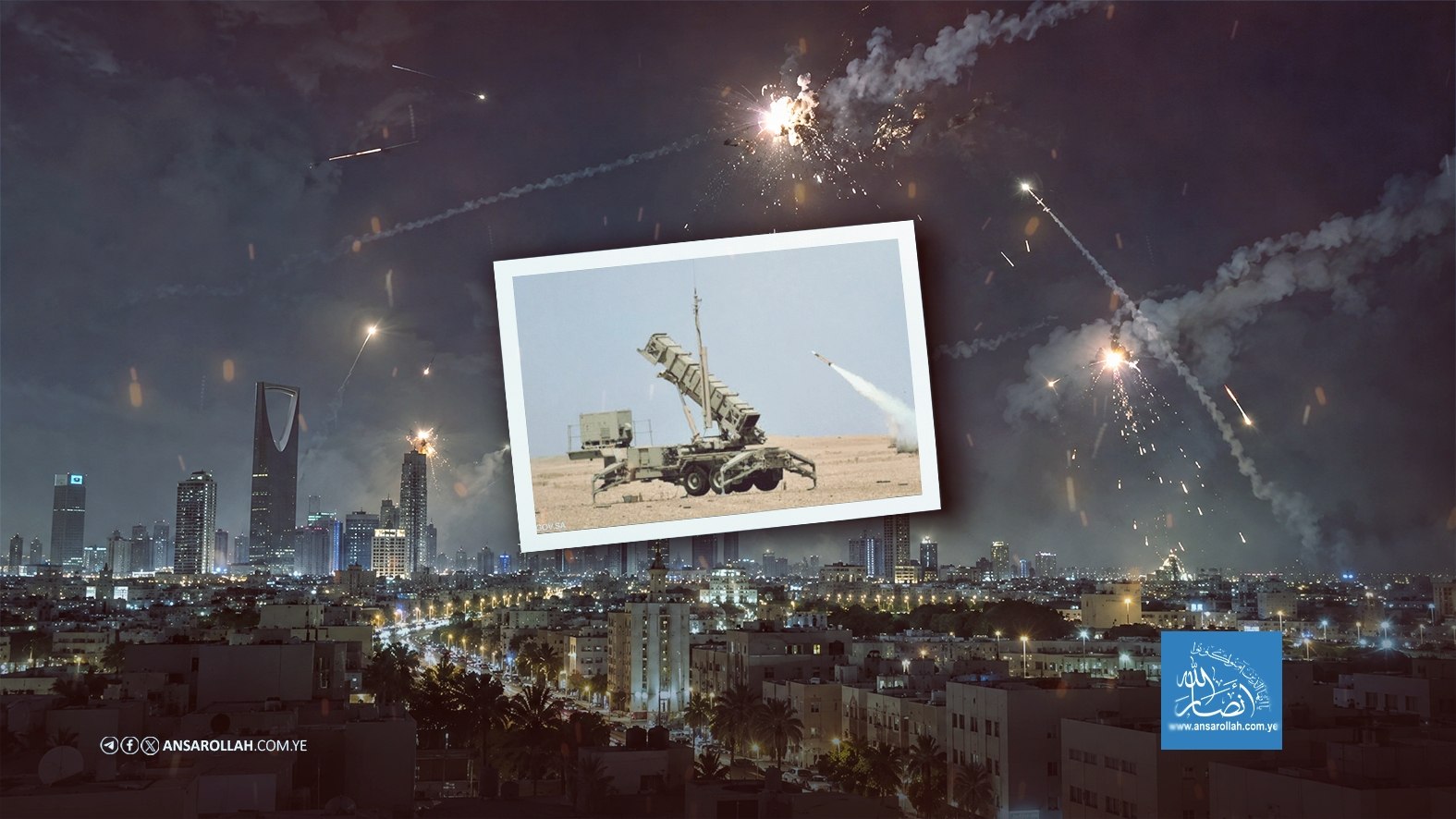
While the Saudi media apparatus amplifies allegations of damage in residential or civilian areas within its territory, technical data and field analyses indicate that the reported minor injuries and material damage result directly from interceptor missile debris generated when Saudi air defense systems are fired over urban centers. This indiscriminate defensive practice of launching interceptions above populated areas serves as the direct cause of risk to civilians and infrastructure, dropping heavy fragments onto homes and streets.
Authorities in Riyadh appear to be in a race against time to politically and editorially leverage these incidents to divert attention from air defense failures, cover field losses, and distract public opinion from the accuracy and impact of Yemeni strikes.
The Yemeni Armed Forces have repeatedly stated: "Claims promoted by Saudi enemy media alleging that we target civilians are entirely baseless. Our operations are strictly limited to precise military targets, bases, and infrastructure supporting the war effort." They added that "damage reported to civilian objects by Saudi media is the direct result of failed and indiscriminate interception operations carried out by enemy air defense systems over cities and residential districts."
Similarly, the Yemeni Ministry of Foreign Affairs clarified to international and regional public opinion that "civilian injuries and damage reported by Saudi authorities following recent strikes are a direct consequence of debris from Patriot defense interceptions launched over densely populated areas." This undermines the credibility of the Saudi narrative against field realities.
A Humanistic Approach Governing Decisions and Conduct
The principles guiding the Yemeni Armed Forces in defending national sovereignty are reflected in both offensive operations and conduct regarding non-combatants or captured enemy forces. This approach extends to post-engagement management, including the treatment of prisoners of war and the administration of secured areas, where international news agencies have documented humanitarian standards governing Yemeni field decisions.
An actor that respects the rights and dignity of prisoners, protects citizens and defeated adversaries upon securing an area, and excludes retaliation from its conduct, does not deliberately target civilians or innocent individuals in their homes with missiles and drones.
Regarding prisoners of war, documented experiences over years of conflict—alongside direct testimonies from hundreds of released prisoners following previous exchanges—indicate that authorities in Sanaa treat detainees according to strict moral guidelines that mandate humane treatment and prohibit abuse or torture. Numerous former detainees have confirmed in public media interviews following their release that they received medical and humanitarian care throughout their detention, experiencing dignified treatment characteristic of authentic Yemeni military ethics.
Logical, Legal, and Fact-Based Realities
In managing regions, cities, and residential centers from which opposing forces were cleared—such as areas along the West Coast—field monitoring showed an absence of retaliatory practices, extrajudicial actions, or collective punishment typically associated with armed conflicts throughout history.
Following the departure of opposing units in West Coast districts, a general amnesty was declared, securing the lives, property, homes, and institutions of all residents—including individuals who had been bearing arms hours prior, provided they surrendered their weapons and departed the battlefield.
Operational records demonstrate the provision of local protection, relief assistance, and emergency medical care to families of combatants aligned with Saudi Arabia, based on an understanding that military action is directed exclusively against external forces and active combatants. Areas secured by the Armed Forces across various fronts experienced immediate stability, with private and public property preserved without discrimination or persecution.
The Party Targeting Civilians
The ethical standards of Yemeni fighters, rooted in religious identity and tribal customs, designate harm to non-combatants as a strict boundary that cannot be crossed under any military circumstances or operational pressure, regardless of the level of escalation.
Conversely, international observers and human rights organizations have documented a record of Saudi airstrikes directly impacting civilians and infrastructure across Yemeni provinces. Reports issued by rights centers detail the scale of human suffering caused by Saudi-American bombardment, with airstrikes resulting in over 60,000 civilian casualties—including 8,262 children and 6,686 women—alongside displacement, economic hardship, and travel restrictions affecting medical patients.
The Saudi-American coalition's operations damaged or destroyed over 620,000 residential homes, more than 460 healthcare facilities, 1,451 educational institutions, and 1,965 mosques, in addition to thousands of agricultural and commercial properties.
These documented statistics place Riyadh's assertions in context, illustrating which party relied on targeting civilians, harming children, applying pressure on non-combatants, and imposing blockades as primary elements of its campaign. Simultaneously, it highlights the distinction between direct strikes on essential infrastructure and a defensive effort adhering to legal and humanitarian standards, committed to protecting non-combatants and preserving human dignity—whether regarding combatants, prisoners of war, or civilians.
Observers maintain that Saudi accusations regarding the targeting of civilians serve as political cover and media maneuvering, while historical records and field evidence remain the determining factor between public narratives and physical reality.