Ansarollah Website | Muhammed Nasser Hatrosh
Footage released by War Media covering Operation "Allah is Stronger in Might and Stronger in Punishment" during the liberation of the West Coast from recruitment networks linked to the Saudi enemy demonstrates a qualitative shift in the operational performance of the Yemeni Armed Forces. This capability ranges from precise intelligence gathering to the acquisition of actionable information that enabled preemptive strikes against weapons depots and staging areas for Saudi-backed recruitment forces. These preemptive operations confused and disrupted the enemy's ranks, paving the way for subsequent storming and clearing operations of hills, military camps, and enemy positions across the West Coast, starting from Hays and Mawza, moving through Al-Khawkhah and Al-Mukha, and reaching Bab al-Mandab.
According to footage documented by War Media, the Saudi enemy mobilized tens of thousands of mercenaries and supplied them with advanced military hardware—estimated by an American newspaper at ten billion dollars. This mobilization highlighted the enemy's intent to attack the positions of the Yemeni Armed Forces, occupy them, and annex the remainder of the West Coast to the occupied provinces in order to tighten the siege on liberated territories.
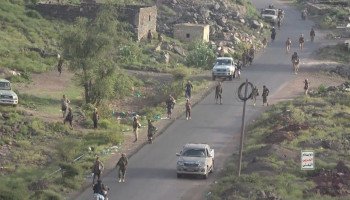
While the Saudi enemy attempts to portray the events on the West Coast as internal betrayal among its proxy forces and mobilizations, the War Media footage reveals the situation as it actually transpired: the bodies of the fallen lined the roads and lay scattered across plains, valleys, mountains, and deserts, in addition to hundreds of wounded and captured personnel who fell into the hands of the fighters and were granted safety and care upon capture. Furthermore, hundreds of military vehicles and armored units were left spread across the entire geography of the West Coast.
All of this conclusively demonstrates that those forces were in a state of full mobilization and high readiness to confront the Yemeni Armed Forces; however, the latter—by the grace and support of Allah Almighty —surprised them with a preemptive strike.
In this context, military expert Brigadier General Mujeeb Shamsan stresses that the collapse of the forward operational base in Al-Mukha represents a major loss for the Saudi enemy, as it served as a primary command center for military operations, fully equipped to monitor various operational tracks.
In statements to Ansarollah website, Shamsan explained that securing the center enabled the Armed Forces to capture confidential intelligence, classified documents, and data stored on computer systems, allowing relevant authorities to analyze operational trajectories and the strategic plans prepared by the enemy for both the past and upcoming phases.
He noted that the elements of surprise accompanying the fall of the center created widespread confusion and panic, adding that personnel fled the facility in haste without destroying its contents, leaving behind their weapons and personal belongings. This allowed the Armed Forces to leverage the left-behind intelligence to trace information sources and networks linked to the coalition.
In a related context, military expert Brigadier General Abed Al-Thour addressed the scale of the mobilization along Al-Mukha, Dhubab, Mawza, and Al-Wazi'iyah fronts, explaining that the presence of seven military divisions equates to roughly 38 brigades, complete with fortifications, equipment, maps, and staging centers. He noted that the swift collapse of this force reflects the high level of professionalism and tactical surprise achieved by the Yemeni Armed Forces.
Speaking to Ansarollah website, Abed Al-Thour explained that the Armed Forces had previously relied on tactical calm and operational secrecy, while closely monitoring hostile movements and violations. Meanwhile, the enemy failed to grasp the actual level of readiness and preparation maintained by Yemeni forces. He indicated that the initial skirmishes, initiated under Saudi orders, were intended to create a pretext for expanding the confrontation; however, the Armed Forces were at peak readiness, neutralizing the scheme and causing the rapid collapse of the mobilized forces despite their numerical and technological superiority. He emphasized that the battle inverted traditional rules of engagement, which typically grant a numerical advantage to the attacking force over the defender.
Downfall of the F-15 Enhances Yemeni Air Defense Capabilities
During the ongoing phase of the liberation campaign and the effort to end the occupation, the Saudi enemy is attempting every available measure to achieve progress or secure results through military escalation and intense airstrikes targeting various liberated provinces, causing civilian casualties and injuries. Nevertheless, Yemeni air defenses are exerting major efforts to intercept these aircraft and prevent them from violating Yemeni airspace, forcing Saudi military aircraft to abandon numerous combat missions and return to base.
In recent days, air defense forces—by the grace of Allah Almighty —successfully downed a Saudi F-15 fighter jet. Military experts view this accomplishment as a practical indication of the development and effectiveness of locally manufactured Yemeni air defense systems, thereby weakening the Saudi enemy in the primary military domain it relies upon in its campaign against Yemen.
Commenting on this development, Brigadier General Mujeeb Shamsan stated: "The downing of the Saudi F-15 fighter jet marks an advancement in Yemeni air defense capabilities, adding to a series of operations that have undermined reliance on air superiority in the confrontation against Yemen." He noted that the interception of the F-15 comes within the context of accumulating defensive capabilities, particularly as the Armed Forces have previously engaged F-15 and F-16 jets, as well as more advanced aircraft, including the F-35 and the B-2 Spirit stealth bomber.
Shamsan concluded that the downing of the fighter jet demonstrates the evolution of Yemen's air defense network and the narrowing of operational space for hostile aircraft, coinciding with ongoing operations aimed at disrupting enemy mobilizations and neutralizing their offensive plans.
For his part, Brigadier General Abed Al-Thour noted that while the downing of the Saudi F-15 is not unprecedented—as the Armed Forces have previously downed F-15 and F-16 aircraft and engaged newer models—its significance lies in serving as an indicator of the continued growth of Yemeni defensive capabilities.
He pointed out that bringing down the aircraft using a locally produced surface-to-air missile demonstrates the continued progress of Yemen's military industries and the air defense system, confirming that any hostile air activity over Yemen will be met with a military response.
General Al-Thour described the F-15 as a modern strike fighter possessing high maneuverability, reconnaissance, tracking, and destruction capabilities, noting that its downing by a Yemeni missile reflects an advanced level of missile and defense capabilities. Recalling previous engagements with F-16s and encounters with F-35s—where one such aircraft faced significant risk upon entering Yemeni airspace—he stated that this underscores the defensive system's capacity to engage aircraft even more advanced than the F-15. He added that the upcoming phase represents a critical turning point for the Saudi enemy, noting that air defense capabilities are among the most closely guarded secrets in military force, and that the circumstances surrounding the downing of the aircraft highlight the state of anxiety and confusion within the enemy's command, praising the professionalism and proficiency demonstrated by the officers and technicians operating the air defense systems.