Ansarollah Website | Report: Wadeea Al-Abasi
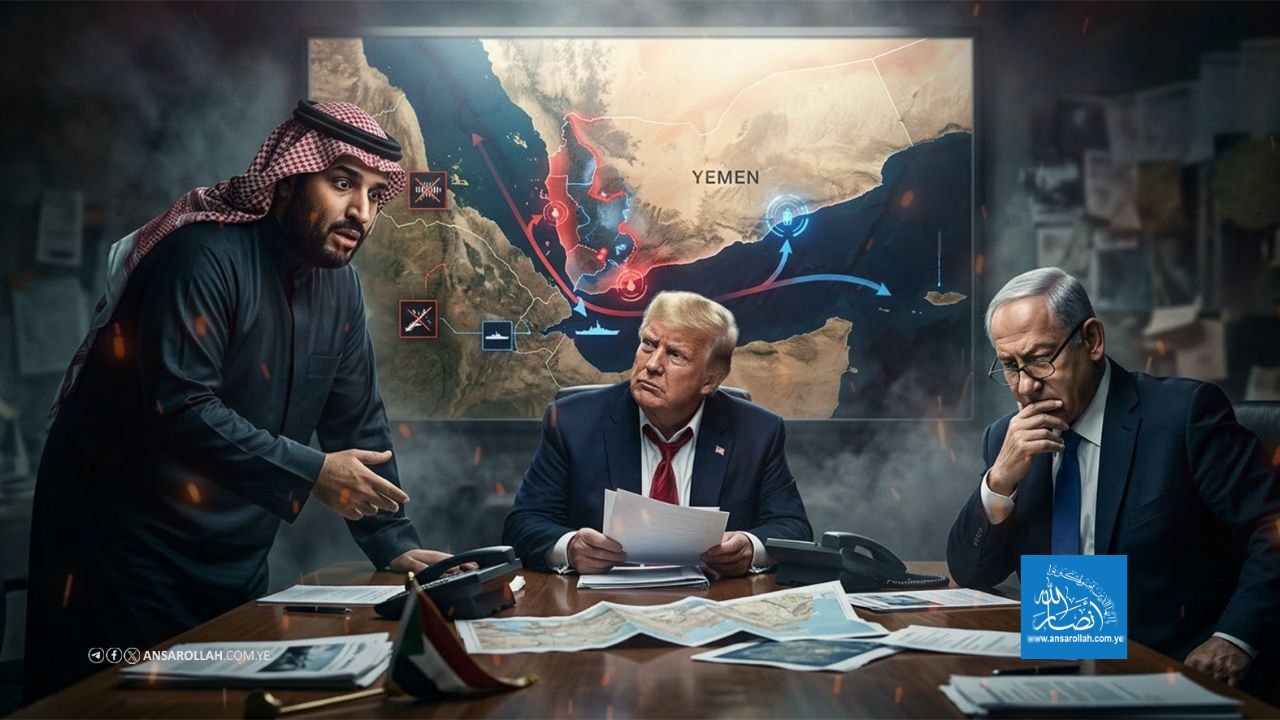
The operation by the Armed Forces to recapture the West Coast, expel Saudi-led mobilizations, and assert sovereignty over the Bab al-Mandab Strait, Mayun Island, and their surroundings as a natural right, continues to cast its shadow over the plans of the "trio of evil"—Saudi Arabia, America, and the Zionist entity—and their ambitions regarding Yemeni lands and resources.
This event represented a major and historic defeat for the project of these countries. The Yemeni West Coast constitutes a vital artery connecting the Indian Ocean to the Mediterranean Sea via the critical Bab al-Mandab waterway, through which approximately 12% of global oil trade and nearly 30% of international container traffic pass. Consequently, for years, this coastal strip remained a theater for a clash of wills. When an anti-Western and anti-aggressive regional coalition force succeeds in establishing full control over this vital corridor, it represents a seismic shift whose impact extends far beyond its immediate geographical boundaries, reaching the decision-making and strategic planning centers of the colonial powers in Riyadh, Washington, and so-called "Tel Aviv."
Failure of the Naval and Economic Blockade Strategy
Yemen’s reclamation of a portion of its territory also constitutes a devastating blow to the plans of Saudi Arabia, which mobilized and expended vast resources—preceded by the UAE—to secure firm control over this strategic area.
Multiple reports by the Reuters news agency confirm that Saudi Arabia's failure to maintain a permanent foothold on the West Coast undermines years of military and political investments by Riyadh and Abu Dhabi. It rewrites the equation of power in the Arabian Peninsula in favor of Yemeni forces, making any future security or political arrangements in the region contingent upon Sana'a's approval and political consent.
Analysis published by The Washington Post and Foreign Policy magazine indicates that the solidifying control of Yemeni forces over the West Coast decisively proves the failure of the naval and economic blockade strategy intended to weaken Yemen's military capabilities. However, what transpired was quite the opposite; Yemeni military industrialization successfully developed a military arsenal and advanced training standards that enabled the armed forces to transition from defense to offense, imposing field and political conditions.
According to analysis by Bloomberg, this strategic shift has completely dismantled Saudi bets on creating an effective buffer strip to prevent military threats from reaching mega Saudi economic projects and ports near the Red Sea (such as Vision 2030 and the NEOM project). This places major economic endeavors and strategic visions in the direct line of threat and under constant security risks that cannot be addressed through traditional technical or security fixes.
Dissolving the Aura of American Might
For America, the events along the West Coast represent a resounding and direct failure of its security approach, which it long promoted as protecting maritime waterways. Washington relied on its naval presence and the formation of multinational coalitions. However, all of this collapsed as the Yemenis solidified their foothold on their western coast, exposing the illusion of American capabilities and alliances, dissipating the aura of its power, and stripping away any exceptional status relative to the rest of the world.
In this context, The Wall Street Journal notes that the American inability to secure the West Coast and prevent Yemeni control demonstrates the limits of its military power against fifth-generation warfare and asymmetric strategies. Massive naval bases, warships, and aircraft carriers have become easy targets, vulnerable to modern, low-cost weaponry should a direct confrontation occur.
The National Interest and Responsible Statecraft cited extensive analyses confirming that the display of American naval power has become a burned card, no longer sufficient to deter rising regional forces possessing precision weapons and the political will to fight. This marks an unprecedented decline in America’s military and security prestige in the Middle East.
This failure is not confined to the battlefield alone; it extends to compromise the credibility of American alliances among its regional partners, who bet heavily on Washington and have now begun to question its capacity to provide a real, effective security umbrella against non-conventional threats.
Severing the Lifeline of Israeli Maritime Sovereignty
The Israeli enemy is not far removed from these repercussions; it recognizes that it is poised to suffer the most dangerous and direct impact of this geopolitical and field transformation. Control over the West Coast is the key to real influence over the port of "Eilat" (Umm al-Rashrash) and the shipping lanes leading to the Gulf of Aqaba and the Mediterranean Sea. The presence of Yemeni forces in this region, armed with modern and long-range weaponry, grants them the direct ability to impose a practical naval blockade or target Israeli enemy navigation and associated shipping directly and continuously. This was demonstrated through a series of Yemeni naval and aerial military operations that paralyzed commercial and mega-vessel traffic at the Port of Eilat and significantly harmed the Israeli economy during the Armed Forces' operations in support of the resistance in Gaza.
In specialized reports carried by the Hebrew intelligence and security site Netsiv.net, the consolidation of Yemen's control over its western coasts is viewed as a strategic and security nightmare threatening the core of "Israeli security doctrine." It severed a major artery of Israeli maritime sovereignty in the Red Sea and the Gulf of Aqaba. The New York Times and Middle East Eye confirmed that Yemen’s transformation into a spearhead within the Axis of Resistance along the southern maritime corridor imposes a new, highly costly security and military burden on "Tel Aviv" logistically. It deprives it of a safe environment for coastal trade and navigation in the Red Sea—a reality the Israeli entity did not face even during the darkest historical periods.
From a Blockaded Local Actor to an Influential Regional Power
Analyses published across various international media outlets, such as Agence France-Presse (AFP), Sputnik, and Russia Today (RT), indicate that the military victory of Yemeni forces on the West Coast reflects a fundamental shift in the doctrine of regional and international deterrence. The West and the occupation entity no longer hold exclusive superiority simply by virtue of possessing modern military technologies.
Intelligence and field analyses published by the Washington Institute for Near East Policy, Foreign Affairs, and Forbes focused on the geopolitical aspect regarding the rising capability of Yemen to reshape the regional order and its decision-making mechanisms. These research studies noted that control of the West Coast handed the Yemenis highly potent diplomatic and political leverage.
Consequently, Washington and Western capitals have been forced to adapt to the new reality, communicating—directly or indirectly through regional mediators like Oman—with the Yemeni leadership regarding navigation and the management of the maritime corridor. This transition from a "blockaded local actor" to a regional power capable of exerting influence constitutes the essence of the geostrategic defeat suffered by the Saudi-American coalition.
Field reports in the French newspaper Le Monde and British outlets The Times and Daily Mail state that the West realized too late that the presence of Yemeni forces along the West Coast is not merely transient military influence. Rather, it represents the consolidation of a new political and geographic reality that imposes security and political arrangements that cannot be bypassed or eliminated through airstrikes or financial and economic blockades.
A New Map of Influence in the Region
Ultimately, the strategic defeat of Saudi Arabia, America, and "Israel" manifests in the fact that the Armed Forces' control over the West Coast lays the foundation for a new reality that does not end with a single military battle. Instead, it extends to establish a long-term security equation in the southern Red Sea. The men of Yemen have demonstrated high proficiency in leveraging their rugged geography and strategic location, turning geography into a winning card that compels the world to redraw its security alliances and policies in one of the most vital and dangerous maritime regions globally.
This victory not only represents military superiority on the ground, but also carries a clear message: traditional Western and regional influence in Bab al-Mandab is virtually at an end, and the region has entered a new phase in which power dynamics and control are distributed among new players possessing the will and capacity to alter the rules of the regional and international game.