Ansarollah Website | Report
It is nothing new for Saudi Arabia to deliberately create a hotspot of tension in the vicinity of Bab al-Mandab. The state of mental and psychological distraction it experiences as a result of the collapse and disintegration pressures forced upon it by Yemen drives it toward actions that reflect neither political acumen nor expertise, but rather demonstrate a loss of its compass of priorities.
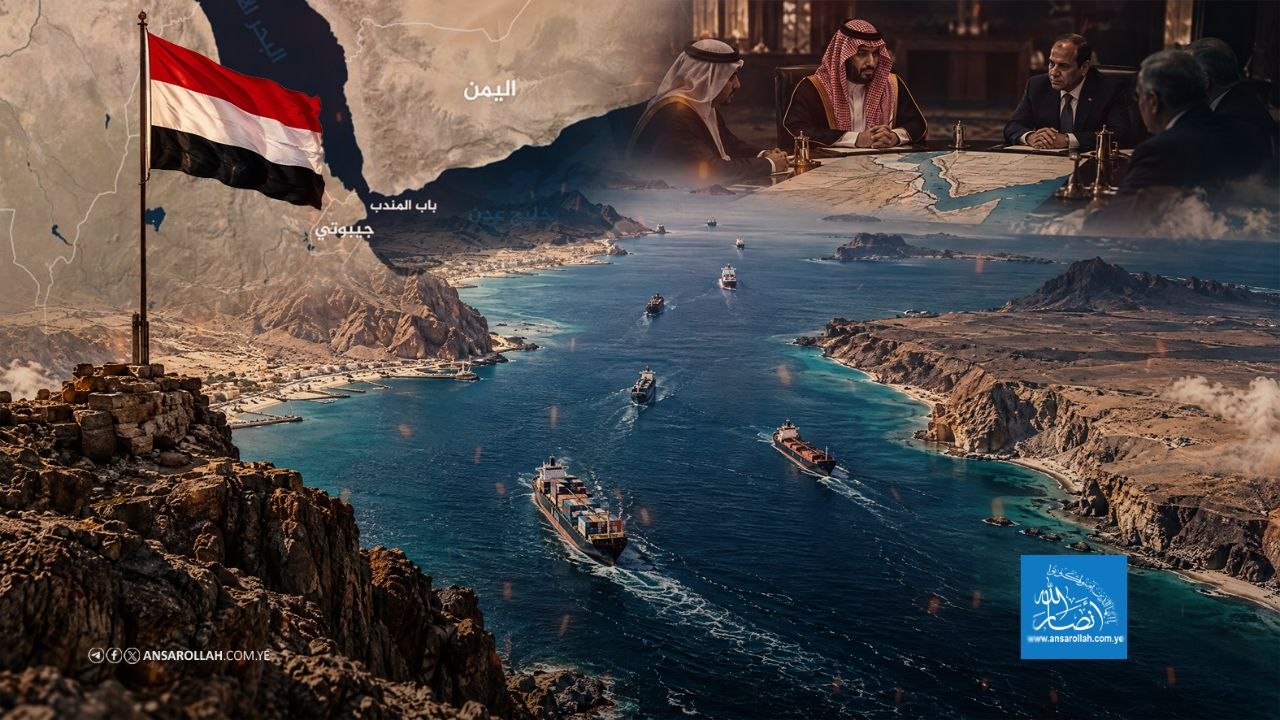
Over the past few days, the Saudi enemy deliberately opened a new front in Bab al-Mandab, deploying thousands of its proxies, supplying them with weapons, military equipment, and armored vehicles, and backing them with hundreds of airstrikes to advance along multiple axes—particularly toward Dhabab airport, as well as advancing toward Bab al-Mandab starting from Ras al-Ara and Al-Modharabah in Lahj. However, what is striking is the Saudi enemy's targeting of Mayun Island, which lies in the middle of Bab al-Mandab, with airstrikes and missiles. This was confirmed by the Spokesperson for the Armed Forces, Brigadier General Yahya Saree, who stressed that the Saudi enemy's targeting of Mayun Island with aerial and missile bombardment directly threatens international maritime navigation, adding that the Saudi aggressor bears full responsibility for the consequences thereof and the resulting threat to the safety of maritime navigation.
At a time when Riyadh’s fragility and inability to curb the rapid, progressive collapse—stemming from the paralysis of its airports, the disruption of its oil production, and the draining of its economic lifelines—are being exposed, it seeks to shuffle the cards in Bab al-Mandab in order to provoke the international community and summon its intervention by alarming it over the new reality imposed by Yemeni forces through their natural and legitimate sovereignty over this vital strait.
On the other hand, Riyadh aims—through its attempt to regain control of the strait—at something far beyond lifting the blockade on its oil exports. It seeks to pass international agendas aimed at internationalizing this maritime region and repositioning military forces within it under flimsy slogans and pretexts, chief among them being "protecting international navigation."
The Hands of the Clock Does Not Turn Back
Riyadh is deluding itself into thinking that shuffling the cards near Bab al-Mandab might grant it a pressure card or a lifeline to pull it out of its current dilemma. Yet, these gambles have repeatedly proven to be failures. The Yemeni forces, who hold the reins of control on the ground and over the water corridor, remain the final arbiters and are impervious to all regional schemes and external dictates. The truth is that gambling on moving these suspicious cards will neither grant Riyadh its lost security nor revive its faltering economy; rather, it will double its state of strategic exposure, laying bare the depth of its comprehensive crisis and leadership confusion in front of the entire world.
Instead of saving itself, these persistent moves contribute to accelerating its pace of collapse and reaffirming the reality that the equation in the Red Sea and Bab al-Mandab has changed irreversibly. No pressures, aggressive moves, or international alliances can ever turn the hands of the clock back.
An Inherent and Legitimate Sovereign Right
The Ministry of Foreign Affairs affirms that Yemen exercising full sovereignty over its entire territory and territorial waters, including Bab al-Mandab, is an inherent and legitimate sovereign right guaranteed by international laws, norms, and charters, and it is non-negotiable and uncompromisable. The Ministry also holds the Saudi regime directly responsible for militarizing this vital navigation corridor and its surrounding areas, dragging it into conflicts, and warning that any adventure or continuation of military operations in Bab al-Mandab will not stop at the borders of the region. Rather, it will have severe and direct repercussions threatening the stability of navigation and the smoothness of global trade routes.
Undoubtedly, Saudi Arabia’s frantic pursuit to transform one of the most critical chokepoints of global maritime trade into an armed engagement zone and an arena for open military confrontation represents, in its essence and nature, a real danger and a direct threat to the security of international maritime navigation and the safety of economic supplies. The intense, Saudi-funded media promotion is nothing but an exposed attempt to flip the facts and mislead global public opinion by trying to portray the Yemeni forces' protection of their territorial waters as the source of danger. Meanwhile, reckless Saudi behavior and the inclusion of international alliances in the strait are the primary cause and source of any threat targeting global trade.
Experts affirm that Riyadh’s moves do not indicate a desire to guarantee the security and safety of navigation, but rather reveal an objective to shuffle cards, create chaos that disrupts the movement of ships, and ultimately summon conflict or militarize the strait. Furthermore, these moves express a Saudi-American-Israeli desire to reimpose a new geopolitical reality that strips Sana'a of the strategic pressure cards it has acquired and consolidated over the past period.
Yemeni National Security
It is certain that Saudi mobilizations toward Bab al-Mandab, and any endeavors to establish security arrangements, maritime alliances, or any other title, touch upon the core of Yemeni national security, making it imperative to confront them decisively. Protecting territorial waters and Bab al-Mandab Strait is an exclusive sovereign responsibility of the Yemeni state and is not subject to negotiation or bargaining in the market of regional deals.
This Yemeni political stance reflects a firm adherence to the concept of "complete national sovereignty" over Yemeni territorial waters and coasts. It is based on an indivisible and non-negotiable security vision, and it completely rejects assigning the protection of maritime corridors to regional alliances or to armed groups driven by external agendas and powers. Navigational security in the Red Sea and Bab al-Mandab remains a sovereign affair first and foremost, tied to independent national decision-making, and cannot be pawned off to international rivalries.
Considering the ongoing hostile activity by the United States, "Israel," and Saudi Arabia in the region, any foreign military presence or alliance cover seeking to impose new security arrangements in Bab al-Mandab aims not at protecting international trade, but rather at entrenching the militarization of the maritime corridor to serve external agendas—specifically American and Israeli ones—seeking to curb Yemeni capabilities and neutralize the effect of the maritime front.
From this standpoint, Yemen emphasizes that the security of Bab al-Mandab and the Red Sea is a par excellence Yemeni sovereign affair, and that any infringement upon this right, through Riyadh's introduction of factions and military buildups, will be met with a military response capable of thwarting those schemes and keeping the equation in favor of the party most capable of field control and geographical deterrence.
Observers believe that Saudi insistence on tampering with the military and geographical reality of Bab al-Mandab and shifting the weight of the conflict toward it represents a red line that Yemen cannot tolerate or overlook. The armed forces—with their missile, naval, and drone capabilities, alongside advanced coastal defense tactics—are capable of turning any Saudi military deployment or entrenchment in Bab al-Mandab into a fixed and direct target. This means that Riyadh, through its mobilizations and attempts to advance toward the strait, is entering a zero-sum equation that will only deepen the navigation crisis it claims to be keen on protecting, and reignite naval and land confrontations with greater ferocity and on a wider scale.
Political and Military Caprices and Recklessness
Expert analyses confirm that gambling on military action in the western coast is a sterile option fraught with fatal risks. This is based on the fact that the experience of past years has proven that military force and intensive air cover were unable to impose a new reality or bring about any tangible change in the maritime equation imposed by Yemen in the Red Sea. In fact, any new escalation on this vital front will only double the operational and field costs for the aggressor forces, turning the entire coast into a complex attrition swamp that threatens to ignite a total confrontation and destroy what remains of regional stability opportunities.
The aforementioned confirms the imperative realization that navigational safety and commercial stability cannot be built on illusions of military resolution or the forced expansion of armed groups loyal to Riyadh. Instead, they must be grounded in respecting sovereign equations, halting field escalation, and keeping international shipping arteries away from political and military caprices and recklessness. Field data confirms this; the ongoing rush of Saudi Arabia and its groups toward Bab al-Mandab will remain the primary obstacle to any navigational stability and could push the situation toward a new and more dangerous phase of conflict.
In this context, the official statements issued by the Ministry of Foreign Affairs complement the precise indicators and figures issued by the Ministry of Transport regarding ship traffic through Bab al-Mandab. Together, they form a high-toned political and media message directed at the international community, calling upon it to assume its responsibilities and exert effective pressure on the Saudi side to halt these reckless military adventures. These moves not only threaten the field situation, but their direct repercussions will also negatively impact global supply chains and arterial navigation security in one of the world's most strategic corridors.
Riyadh’s Adventures Will Not Bring It Stability
Consequently, the repeated explicit warnings against Saudi military movements and its groups in the vicinity of Bab al-Mandab transcend the limits of political maneuvering or tactics. They express an integrated and principled strategy based on linking navigational stability and international trade security to halting escalation and military aggression, respecting Yemen's full national sovereignty, and permanently lifting external hands from Yemeni resources and vital corridors. This is an equation clearly affirming that protecting navigation is not achieved by leaning on alliances or imposing wills, but rather by restoring political stability and adhering to the rules of sovereignty and geographical deterrence. Meanwhile, pressing forward with the choice of militarization and igniting naval and coastal fronts by Riyadh will not bring the desired stability. Instead, it will inevitably lead to comprehensive security chaos in the world's most sensitive and important waterways, forcing global trade and the international economy to pay the highest price for these military adventures.
The explicit warning launched by the Ministry of Foreign Affairs—backed by the precise indicators and figures of the Ministry of Transport regarding ship traffic—places the international community and all active powers in front of undeniable facts regarding Yemen's capability to be a bastion against anyone thinking of spreading chaos in its waters or on its land. At the same time, it holds international parties responsible for stopping Saudi tampering and addressing its field repercussions.
#YemeniArmedForces #EscalationWithEscalation #BlockadeWithBlockade #BabAlMandab #MayunIsland #RedSea