
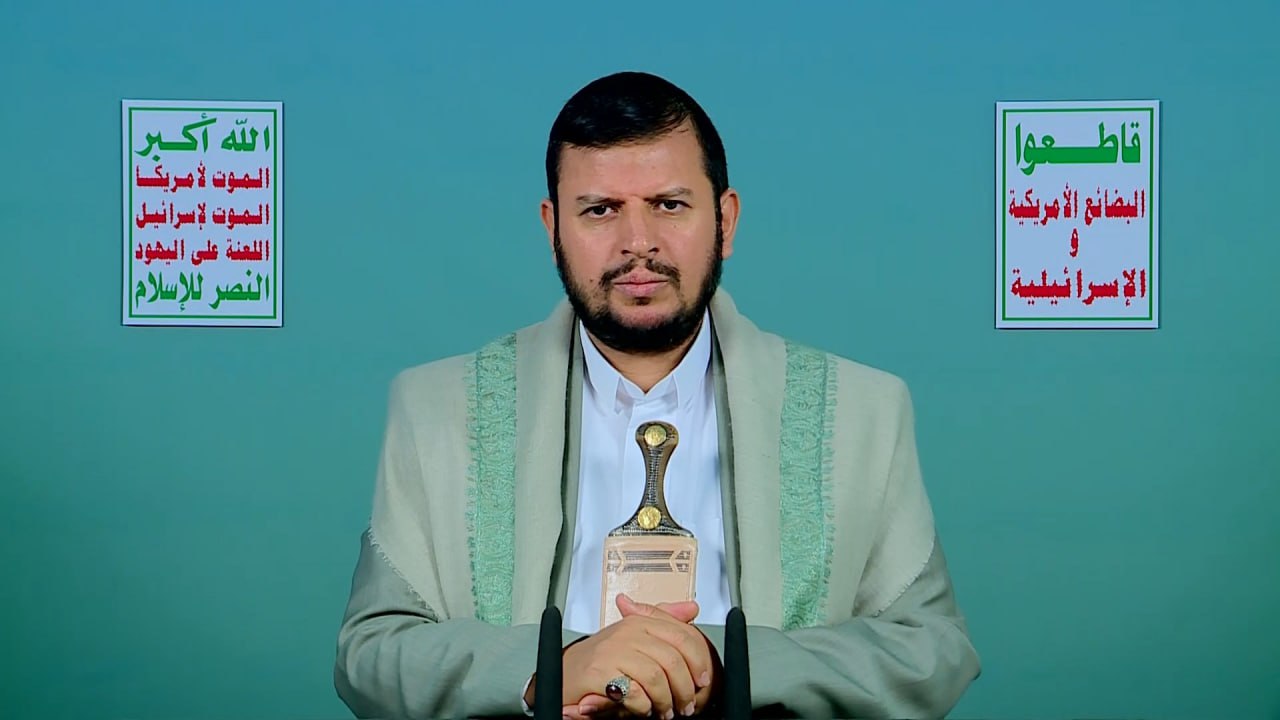
Ramadan Lecture Series 1447 A.H.
Presented by Al-Sayyid Abdul Malik Badruddin Al-Houthi
Lecture Eight
Wednesday, 8 Ramadan 1447 A.H. (25 February 2026 A.D.)
COURTESY TRANSLATION
IN CASE OF DISCREPANCY, THE ORIGINAL TEXT PREVAILS.
I seek refuge in Allah from Satan, the outcast.
In the name of Allah, the Compassionate, the Merciful.
Praise is to Allah, Lord of the Worlds. I believe that there is no god but Allah, the Sovereign and the Manifest Truth, and that our master Muhammad is His servant, Messenger, and Last Prophet.
O Allah! Confer Your salat and blessings upon Muhammad and the Family of Muhammad as You conferred Your salat and blessings upon Ibrahim and the Family of Ibrahim. You are Owner of Praise, Owner of Glory! And be pleased with Muhammad's good companions and all Your righteous servants and mujahidin.
O Allah! Guide us and grant us acceptance, for You are the Hearing, the Knowing; accept our repentance, for You are the Relenting, the Merciful.
Brothers and sisters, peace be upon you and the mercy of Allah and His blessings.
In yesterday’s lecture, as we discussed the story of Prophet Musa (PBUH) in light of the blessed verses of Surah Al-Qasas, we came to the verse describing what occurred after he reached Firaawn’s palace and the anxiety, distress, grief, and fear that overwhelmed his mother. We also reflected on how she sent his sister to find out what had become of him, and how Musa’s sister carried out this task with remarkable success. She reached Firaawn’s palace and came up with a solution for the problem, as they had fallen into a serious difficulty because Musa—still an infant—refused to accept nursing from any woman they brought to him. This was itself part of the divine arrangement preparing for his return to his mother. {'So his sister suggested, “Shall I guide you to a family who will bring him up for you and look after him with good will?”'}—this is how she guided them to the solution.
We reflected on this matter: {'Thus did We return him to his mother so that she might delight her eyes '}. Firaawn’s people readily agreed and sent for Musa’s mother to be brought—most likely through his sister—without realising that she was his mother. When she arrived, he nursed from her, bringing great relief to them, particularly to Firaawn’s wife. In this way, the crisis was resolved.
Allah returned Musa to his mother out of His mercy for her. This stands among the manifestations of divine care. As we have seen in the blessed verses, when believing men and women respond to Allah, He showers them with His care. He does not forsake them, especially in difficult and complex tasks, where they are in urgent need of divine reinforcement to strengthen their inner state and enable them to carry out their practical responsibilities.
{'Thus did We return him to his mother so that she might delight her eyes .'} They entrusted him to her as his nurse and caregiver and made the necessary arrangements for his upbringing. So they even took on the financial burden of his maintenance and living needs. All of this was taking place while they were killing all other male infants of the oppressed to prevent the emergence of this very child! This is among the most striking manifestations of the divine declaration: {'Allah’s will always prevails'}. Indeed, His will always prevails: Whatever the policies of tyrants, whatever their cunning and precautions, whatever their schemes and preparations, and however vast the power they accumulate—military, security, and otherwise—relying on it as though their dominion would last without end, their designs still fail before Allah’s wise planning. And that planning may unfold—as we have said—even through the oppressed themselves, cutting through every capability and barrier.
Allah (Glory be to Him) thus showed great care for that believing mother who carried out her task out of faith and trust in Him. Hence, He said, {'so that she might delight her eyes '}—that her sorrow, anxiety, and inner turmoil might give way to joy and relief. For even if Musa had remained safe in Firaawn's palace, far from her, she would still have been grieved. After all, a nursing mother shares a profound bond with her infant. Although all mothers are deeply attached to their children, this attachment reaches its most tender and intimate form during the nursing stage. It is difficult for a mother to be separated from her infant for long. This demonstrates the immensity of divine care. Indeed, it is a profound lesson that reveals the greatness of Allah’s providence and the vastness of His mercy.
The Quranic expression {'so that she might delight her eyes '} conveys deep joy and inner contentment. Her emotional state was transformed into one of happiness and relief; the immense anxiety, heavy worry, and intense psychological turmoil she had endured all disappeared once she was reunited with her infant. She embraced him, nursed him, and was then formally appointed as his nurse and caretaker. It was decisively arranged that she and her family would assume full responsibility for him. In other words, he would be entrusted to them and grow up within their own household and under their care, marking a complete transformation and even ensuring a safe setting. She had passed beyond even the stage of fear and danger. So we can only imagine the depth of joy, reassurance, and peace she must have felt. At the same time, this stands as a remarkable sign—one of the clear manifestations of the verse: {'Allah’s will always prevails'}.
{'And not grieve'}—for Allah attended even to her inner emotional state. Had her son remained in Firaawn's palace, she would have continued to grieve over that, even if she had been assured of his safety. Allah spared her from falling into enduring sorrow. She had been distressed, and would have remained so had he stayed apart from her. Therefore, that she should be the one to nurse and raise him was, for her, a source of profound joy and comfort. This too was part of Allah’s care.
Devine care manifests itself in the lived reality of believing men and women—those who respond to Him and place their trust in Him and His true promise. It encompasses both their inner state and the outward circumstances of life, as Allah changes conditions. People pass through difficult stages and even severe psychological distress, as was the case with the mother of Musa. Her emotional turmoil, intense anxiety, and overwhelming pressure reached the point described in the Holy Quran: {'that she was about to disclose his case'}. She nearly revealed the truth. Indeed, she nearly cried out and declared that he was her son, asking about his condition and pleading to have him back. She reached a state of extreme distress. However, Allah (the Almighty) provided her with care, so her state changed. He strengthened her heart and gave her resilience. Then, He transformed the entire situation, creating changes in her favour as a mother and as a believer in Him, the Almighty.
This care from Allah addressed her psychological state, her family circumstances, and most importantly, her steadfastness in faith, which is a crucial aspect for any believing man or woman.
What matters greatly is not the psychological state in isolation, but continuity in one’s faith-based commitment and steadfastness in faith. This is essential because if a person were to lose his faith in exchange for temporary psychological comfort or partial short-term gains in his personal circumstances, his loss would be immense. This is because the loss of faith is one that cannot be compensated by anything a person gains—not even by acquiring the entire world. Likewise, temporary psychological ease cannot replace the value of faith—nothing can make up for faith. Losing faith is, without a doubt, the most profound loss.
Thus, the care Allah grants to His believing servants—both men and women—encompasses the spiritual dimension, allowing them to remain steadfast and preserve their faith. Faith, in its essence, is deeply connected to a person’s psychological state. For example, the state of trusting in Allah’s true promise is one that originates in a person’s inner conviction, within the depths of his heart, and manifests practically in his reality through his actions, behaviour, and stances.
Therefore, Allah (Glory be to Him) says, {'and that she would know that Allah’s promise is true'}. And in the preceding verse, He says, {'Had We not reassured her heart in order for her to be among the believers'}. Here Allah says, {'and that she would know that Allah’s promise is true'}—that is, to make her fully aware and certain that this promise will be fulfilled. This is the important state of faith that believers, both men and women, should attain: to enhance their knowledge of this fact—{'Allah’s promise is true'}—to a level of certainty and not merely harbour uncertainties or possibilities, as if Allah’s promise might or might not be fulfilled. Indeed, Allah's promise is true and will come to pass, as He is the Wise and the Almighty—along with His other Most Beautiful Names. Furthermore, no one can hinder Allah from fulfilling His promise; no one can stand between Allah and the realisation of His promise.
In the story of Musa, we observe how all the precautionary measures and stringent procedures imposed by Firaawn and his soldiers were rendered ineffective through extraordinary means and within a truly remarkable divine plan. They were overcome by divine planning carried out by the oppressed in a truly astonishing manner.
{'And that she would know that Allah's promise is true'}: The expression {'that Allah's promise is true''} is emphatic. Such knowledge must rest upon certainty—upon firm and enduring conviction. This is of profound spiritual importance. Indeed, one of the clearest signs of our belief in Allah (Glory be to Him) and one of the core principles of faith in Him is an unwavering conviction that His promise is true, that it will assuredly come to pass, and that no power in this world—tyrants, despots, or oppressors, however immense their resources and however vast their capabilities—can stand between Allah and the fulfilment of His promise.
{'But most people do not know'}: The problem here lies in profound ignorance of this truth. That is to say, it is not merely that they disbelieve; the verse does not say, 'but most people do not believe.' Rather, in that era, in earlier times, in later times, and even in our present age, most people remain unaware of the reality {'that Allah's promise is true'} and that what Allah has promised His oppressed servants will certainly be fulfilled. Such a promise is, {'But it is Our Will to favour those who have been oppressed in the land'}. This promise is not confined to a particular era or to a single nation in that specific historical moment; rather, it is a divine promise that spans all ages and applies to all who are oppressed. However, it is vital for the oppressed to turn to Allah (Glory be to Him), who opens the doors of His mercy, no matter how difficult the situation, how great the challenges, or how vast the power and resources of tyranny may be.
Ignorance of this truth and lack of knowledge regarding it have harmful consequences in reality. It is one of the greatest sources of despair for many among the oppressed, since the majority of people, in truth, belong to that category. However, as previously mentioned, according to the Quranic classification, some of the oppressed enter into a state of total allegiance and attachment, becoming wholly absorbed in loyalty to tyrants and despots. They submit to them and fall into complete subjugation, doing so with loyalty and pleasure. This includes many of those who enlist themselves in the service of tyranny and falsehood. Although in reality they may be oppressed, they willingly devote themselves to serving tyranny and falsehood—with loyalty, consent, and wholehearted willingness—thereby becoming enslaved to them and completely immersed in that allegiance.
Although others are in a different situation, they live in a state of utter despair, total resignation, and complete submission—though not out of loyalty. They have no hope that circumstances might change, nor that they might escape the condition in which they find themselves. They come to regard their surrender as the solution and their complete submission as wisdom. They see any move beyond that as misguided—incapable of producing results or bearing fruit. Instead, they believe it would lead only to negative consequences and serious harm. The situation is different. However, the correct path lies in the awareness of the means of salvation and turning sincerely to Allah (Glory be to Him).
In previous lectures, and in the light of the Quranic verses, we have discussed the grave consequences and dreadful dangers faced by the first category of the oppressed—those who lose themselves in submission to tyrants, serve the forces of oppression, and enlist with oppressors and tyrants with full consent, submission, and complete conviction. Their final abode is the Hellfire, where they will plead with the arrogant to take a portion of their torment: {' when they will dispute in the Fire, and the lowly will appeal to the arrogant , "We were your followers, will you then shield us from a portion of the Fire?" The arrogant will say, "We are all in it! Allah has already passed judgement over servants"'}. They implore them to bear even a portion, however small, or any amount of the torment on their behalf, so as to alleviate at least part of their suffering and misery. This is because they endured great dangers and reached tremendous suffering in the service of those oppressors.
As for the second category, Allah says about them, {'It is they who will have Hell as their home—what an evil destination!'}. This indicates an extremely grave condition. Even if they were to offer their state of oppression as an excuse, it would avail them nothing when the angels question them, {'What was wrong with you?" they will reply, "We were oppressed in the land" '}.
The exception is for those who are entirely powerless in the state of their lives: {'Except helpless men, women, and children who cannot afford a way out—it is right to hope that Allah will pardon them'}
As for the path of salvation for the aware oppressed (those who turn to Allah and are keen to be delivered from their condition), Allah prepares for them a path of salvation.
Knowledge of this truth—{'that Allah's promise is true'} and that it will indeed be fulfilled—is among profound matters of faith, foremost among them is true knowledge of Allah (Glorified be to Him), namely knowing Him through what He has revealed for us about Himself: that He is the Almighty, the All-Wise, the Compeller, the Sovereign, the Most Holy, and the rest of His Most Beautiful Names. Indeed, He is Dominant over His affair, the All-Strong, the Mighty. Many are His Most Beautiful Names, and when we come to know Allah through them and believe in Him accordingly, we attain certainty that His promise is true, that He will not abandon His servants, and that He did not create this earth to be a playground for tyrants, wrongdoers, criminals, the arrogant, and those who show reckless disregard for human life. Rather, He has ordained the laws that govern this life in terms of causes and consequences. At times, the difficulty faced by the oppressed stems from their own neglect of these essential laws established by Allah (Glory be to Him) and from their failure to uphold the principle of taking the necessary means in accordance with them.
Ignorance of this reality results in many mistakes in people's lives and in the positions they adopt. That is because a state of ignorance leads to a state of despair. From such ignorance, some people are driven towards allegiance to the arrogant—those who have strayed from the path of Allah and are too proud to follow it, as well as tyrants, despots, and wrongdoers. Others remain in their condition in a state of complete surrender and submission to them: Even though they are not loyal to them, they make no effort and take no practical steps towards adopting the necessary means of freeing themselves from their tyranny, injustice, and oppression.
For this reason, when we reflect on the reality of our Muslim Ummah, especially its peoples, we find that they may be in a state of weakness—one they have brought upon themselves, even though they possess energies, capabilities, and means of strength that could completely transform their condition if they were to embrace them, make use of them, and put them into effect. It is truly regrettable to describe an Ummah of two billion Muslims as weak and oppressed, while they possess such vast resources, capabilities, tools, and means. However, the problem is that they have not moved to benefit from any of them. This is because they are in a state of disorientation, which is deeply saddening. Indeed, this is a condition of wandering, heedlessness, and utter loss.
But at the forefront of what benefits people most is that they address their ignorance of this reality and firmly establish their faith in Allah's true promise. In doing so, they can properly engage with Allah's explicit and clear promises to this Muslim Ummah in His Holy Book, which is a revelation from Him to His servant and Messenger Muhammad (PBUH&F), the Seal of the Prophets and the Master of the Messengers. He revealed it to him and included within it those explicit, clear, and significant promises.
For example, regarding the conflict with the Israeli enemy—the arrogant Jewish, Zionist, Israeli enemy—its elevation, rebellion, arrogance, tyranny, and criminality have reached terrifying levels in this era. Indeed, according to what history records and what the Quran mentions, we find that they have surpassed Firaawn. Allah said about Firrawn, {'Indeed, Firaawn arrogantly elevated himself in the land '}. This means that he transgressed, acted arrogantly, and reached a very evil extent in doing so. However, regarding the Israeli enemy, He said, {'and you will become extremely arrogant'}. The Quranic expression indicates that their arrogance is even greater than that of Firrawn. Arrogance itself implies great tyranny and pride—yet it is further described as {'extremely arrogant'}.
So, what did Allah say alongside that when He (Glory be to Him) spoke about their elevation, tyranny, corruption, and arrogance? He mentioned an end to that elevation and rebellion: About the first instance, He has said, {'And it was a promise fulfilled'}. Their tyranny and arrogance had indeed taken place, as Allah had declared that it would occur {'twice'}. He then sent against them servants endowed with great might, who inflicted upon them devastating destruction. Most historians and scholars of historical accounts hold that this refers to the time when Allah empowered the Babylonian Empire over them, crushing and destroying them and reducing them to the state to which they were brought—Allah knows best.
As for the second time, He says, {'Then when the final promise came, they would disgrace your faces and to enter the mosque as they entered it the first time, and to destroy what they had taken over with destruction'}.
He then establishes this as an enduring divine law, applicable to any renewed return to that same tyranny, arrogance, corruption, and criminality, saying, {'But if you return, We will return'}.
These are explicit promises and affirmed truths in the Book of Allah (Glory be to Him), clear and manifest. They are intrinsically linked to Allah’s justice, His wisdom, and His might. He is the Almighty, and by virtue of His might, He will not allow them to persist indefinitely in a state of extreme tyranny and horrific criminality. The situation they have reached is itself the consequence of this Ummah's serious neglect in fulfilling its great and sacred responsibilities—a profound failure and a severe deficiency in its religious and spiritual commitments. As a result, tyrants were able to rise to the position they have reached, and this is among the means made available to them, as Allah says, {'except through a rope from Allah and a rope from the people'}. Yet the truths of the Quran remain clear and unequivocal, as do Allah’s promises and His warnings. His explicit verses, revealed in His Noble Book to His Prophet, speak plainly about these truths. What, then, is lacking on our part? It is true faith in this truth: to be deeply and firmly aware of it; to perceive it with true knowledge; and to possess complete trust and certainty in it—ensuring that we do not reduce it to mere possibility or assumption, nor, worse still, lapse into ignorance of this fundamental reality.
When certain regimes and governments pursue what they term 'normalisation' policies—policies that, in reality, amount to aligning themselves with the Israeli enemy, submitting to it, acquiescing in its dominance over the region, and complying with its policies, dictates, and imposed demands—despite the fact that its aggression and criminality are flagrantly and brutally evident, this approach is rooted in despair and in a denial of the clear truths of the Quran. They argue that the Israeli enemy’s dominance has become an inescapable reality from which there is no hope of deliverance, and that all that remains is for people to learn how to adapt to it, accept it, submit to it, accommodate themselves to it, and organise their affairs on that basis. They then regard those who place their trust in Allah and in His true promise as lacking political experience and understanding. More than that, they portray them as foolish—people who deny realities and refuse to acknowledge what is obvious. Yet in truth, it is they who are utterly foolish and profoundly misguided, because they are ignorant of major realities—historical truths and transformations throughout the ages—and they assess matters in an entirely superficial manner. They fail to recognise that this brutal and criminal entity is, in itself, built on foundations that are neither sound nor capable of lasting. This fact is acknowledged even by many within the enemy entity itself.
Moreover, they are ignorant of the laws of Allah. Ignorance of Allah—of His divine laws and of His Most Beautiful Names—has extremely serious consequences, for it gives rise to misguided positions, misplaced loyalties, and eventually submission and allegiance to an enemy who is profoundly malicious and, in truth, the worst of all enemies—one that has reached the most extreme level of allegiance to and attachment with Satan, of criminality, of brutality and of sheer wickedness. In fact, there is absolutely nothing that could justify—or even encourage—allegiance to such an enemy, the pursuit of so-called 'normalisation' with it, or anything of that kind. It is a very dangerous situation, for it involves an enemy characterized by killing, criminality, and tyranny. Its entire orientation and belief system is founded on the basis of dominating this Ummah and annihilating its societies. It does not even regard these peoples as fully human, nor does it recognise them as belonging to humanity at all. Rather, they regard them as animals— and they do say so openly! Those occupying positions of so-called ministers within the enemy entity, as part of its cadre of criminal leaders, articulate this worldview as reflected in their Talmud, in their schools, in their culture, and in their media: They do not consider Arabs or Muslims to be human beings; rather, they see them merely as animals in human form—utterly vile and subject to violation in every respect, including killing and annihilation of even children and women. Even Jewish rabbis openly declare that killing children and women is religiously permissible. In fact, the deeply rooted psychological complex and its intense malevolence attributed to the Jews is what enables such behaviour. That is, they are devoid of even the slightest trace of human feeling: Both male and female conscripts in the Israeli army boast of the children they have killed. Even female soldiers in Israeli gangs—referred to as an army—openly brag about killing Palestinian children, taking pleasure in it and sharing video footage of their atrocities.
These days, the Israelis have even prevented copies of the Holy Quran (the Book of Allah) from entering the Gaza Strip. They kill people on a daily basis, and their horrific crimes in Lebanon continue unabated. There are further incursions and ongoing efforts to tighten control and impose total violation upon the people of this Ummah—violating their lives, their honour, their property, their sanctities, and everything else.
In the face of such tyranny and criminality, this Ummah must return to Allah and believe that His promise is true. It must rise to confront their oppression with strong hope and with unwavering confidence in Allah’s promise, fully aware that Allah will fulfil His word and bring that tyranny down. However, this Ummah has obligations—both practical and faith-based. It must set its affairs aright according to these obligations and act in accordance with Allah’s guidance and His teachings so that it may move in complete alignment with His plan, standing with Allah and thereby receiving His support.
There are explicit promises provided by Allah (Glory be to Him) in His saying, {'It is He Who has sent His Messenger with guidance and the religion of truth to manifest it over all religion, even to the dismay of those who associate others with Allah'}, in His saying, {'And Allah will surely grant victory to those who stand for Him. Indeed, Allah is Powerful and Mighty'}, and in His saying, {'O you who have attained faith, if you stand for Allah, He will grant you victory and strengthen your foothold'}. He also explicitly says, {'Allah has promised those of you who believe and do good that He will certainly make them successors in the land, as He did with those before them, and that He will surely establish for them their religion which He has chosen for them, and will indeed change their fear into security'}.
The promises of Allah are explicit—they are promises from Allah Himself—and they are all true and certain to be fulfilled. Therefore, we must act within the framework of divine planning and guidance, and not lose ourselves by following the path of our enemies. The Arabs exert themselves relentlessly in pursuit of America’s favour, despite the fact that it provides unconditional support to the Israeli enemy, adopts its agenda, aligns with the Zionist orientation, and stands as a complicit in all its crimes, aggression, policies, and the very objectives it openly proclaims.
We shall conclude our lecture today with this.
We ask Allah (Glory be to Him) to grant us success in seeking what pleases Him. O Allah, have mercy on our virtuous martyrs, heal the wounded among us, set free our captives, and grant us victory. You are the Hearer of Prayer!
Peace be upon you and the mercy of Allah and His blessings.