
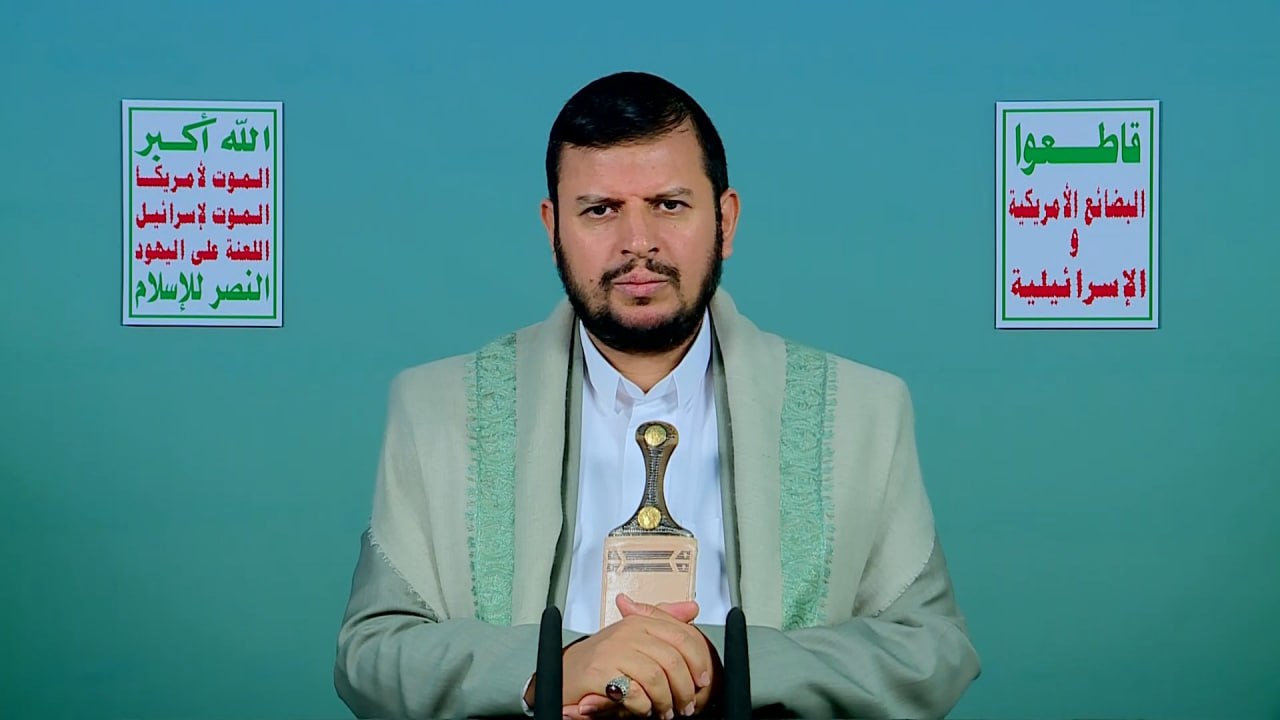
Ramadan Lecture Series 1447 A.H.
Presented by Al-Sayyid Abdul Malik Badruddin Al-Houthi
Lecture Fourteen
Tuesday, 14 Ramadan 1447 A.H. (3 March 2026 A.D.)
COURTESY TRANSLATION
IN CASE OF DISCREPANCY, THE ORIGINAL TEXT PREVAILS.
I seek refuge in Allah from Satan, the outcast.
In the name of Allah, the Compassionate, the Merciful.
Praise is to Allah, Lord of the Worlds. I believe that there is no god but Allah, the Sovereign and the Manifest Truth, and that our master Muhammad is His servant, Messenger, and Last Prophet.
O Allah! Confer Your salat and blessings upon Muhammad and the Family of Muhammad as You conferred Your salat and blessings upon Ibrahim and the Family of Ibrahim. You are Owner of Praise, Owner of Glory! And be pleased with Muhammad's good companions and all Your righteous servants and mujahidin.
O Allah! Guide us and grant us acceptance, for You are the Hearing, the Knowing; accept our repentance, for You are the Relenting, the Merciful.
Brothers and sisters, peace be upon you and the mercy of Allah and His blessings.
In light of the blessed verses of Surah Al-Qasas that relate the story of Prophet Musa (PBUH), we concluded the previous lecture by reflecting on the incident that resulted in the killing of one of the criminals who was assaulting one of the oppressed. We discussed how Prophet Musa (PBUH)—before his divine mission—intervened to rescue that oppressed person. He struck that arrogant aggressor, as Allah says: {'So Musa punched him'}—that is, he hit him with his fist. The consequence was that the aggressor died, though Musa did not intend to kill him. Indeed, all he wanted was to rescue the oppressed man.
We then considered what followed from that event and the position in which Musa (PBUH) found himself: a new and sensitive phase, and a complete rupture with the tyranny of Firaawn and his people and those aligned with him. We saw how Musa took pride in the just stance he had taken. He did not regret it despite the imminent threats to his life and potential harm to his interests, as commonly expressed in such circumstances. Rather, he affirmed, {'My Lord, for the favour You have bestowed upon me, I will never be an assistant to the criminals'}.
Furthermore, we spoke about how keen he was to seek forgiveness and to ensure that his conduct remained free of mistakes, even unintentional ones. He prayed to Allah, saying, {'My Lord! I have definitely wronged my soul, so forgive me.” So He forgave him, He is indeed the Forgiving, the Merciful'}. We reflected on these verses in the previous lecture, and we will proceed, in light of the verses that follow, to continue the discussion.
Allah (the Almighty) says, {'And so Musa became fearful, watching out in the city'}. This was because the incident that resulted in the death of one of the arrogant oppressors was not an ordinary one in such circumstances. It also involved the oppressive elite, and they had their own calculations in dealing with such incidents and with Prophet Musa (PBUH). So he was fully aware of the sensitivity of the situation and the likely backlash from Firaawn and his henchmen. For that reason, he remained in the city, yet he was fearful, moving with caution and alertness, expecting pursuit and being attacked—{'Musa became fearful, watching out.'}
It is certain that news of the incident would spread widely, given its strong reverberations. It took place in the city, and incidents in a city and its roads quickly become known. Moreover, the one killed belonged to the arrogant class, and the incident was therefore deeply sensitive for them—especially in view of the system they had established to subjugate the oppressed, to the point that no one would dare to take even the smallest step against their tyranny. Their grip of control and the fear that accompanied that control among the oppressed—together with oppression, humiliation, and enslavement—had reached such extremes that even when the tyrants slaughtered their male infants, the oppressed were unable to respond, out of overwhelming fear, powerlessness, and coercion.
The situation they had created was one of complete and absolute control, where none of the oppressed dared to take a stand, no matter how horrific the crimes those criminals committed against them were. The oppressed lived in a state of complete vulnerability and subjugation, coupled with total surrender—this was the reality then. Indeed, the tyrannical people of Firaawn and their henchmen wanted this situation to persist—one that they sought to keep dominant and firmly established. Their aim was to ensure that the oppressed remained a humiliated, violated, and powerless group, subjected to policies that pushed them towards annihilation while remaining completely passive and unable to stand against the atrocities inflicted upon them.
However, Musa (PBUH) changed the entire order, and for this reason, his stance was extremely sensitive in their eyes. After all, they were arrogant, and the one who had been killed was one of them; at the same time, they viewed that oppressed group as a class that should never respond to anything done to it, never retaliate, and never act at all. In their eyes, these people were nothing but a lowly class that could be violated with impunity.
This is the new order the Zionist Jews seek to impose upon our Islamic Ummah: to make us like the oppressed, violated, and subjugated people during Firaawn's time. They seek what Firaawn himself once sought—that no reaction or resistance would arise in response to anything inflicted upon the oppressed.
What Prophet Musa (PBUH) did was a major breach of the reality they had established and imposed within society. The incident itself was highly sensitive. As we see in our contemporary reality, for instance, regarding the oppressed, such as in Palestine or in any Islamic country in the Arab world and elsewhere, news of killings often appears as just another routine report announcing the killing of so-and-so or a number of people. So this becomes regular news that people hear, to the point where they become accustomed to it. Moreover, the way of presenting these reports often makes them seem like ordinary news that people had become accustomed to, treating them as just another everyday occurrence.
However, when a Jewish or American soldier is killed, even the media frames it as an extraordinary event—significant, sensitive, and serious. It is surrounded by an atmosphere of intimidation, exaggeration, and alarm—treated as a dangerous and disturbing development. This is something we can plainly observe in our own time.
In that era—during the days of Firaawn—the killing of hundreds of infant boys in a single day would pass as routine news: that a large number of male infants were slaughtered in this or that area. It was the kind of report people had grown accustomed to hearing, treated as ordinary—neither shocking nor provoking indignation, mobilisation, or any meaningful response. Yet when a single individual belonging to the arrogant and criminal elite was killed, the world was turned upside down. Such is the way of tyrants and arrogant oppressors in every age and every land.
The incident spread swiftly, with its strong reverberations and its sensitivity, since it had ruptured the status quo and challenged the prevailing order. Added to this was the reach and vigilance of Firaawn's security and intelligence apparatus, which would pursue even male infants, identify them, and have them killed. Thus, the news of the incident spread throughout the city; it was accompanied by propaganda, and it became an exceptional and highly unusual event.
For this reason, Musa (PBUH) was in a state of fear. He remained in concealment during that interval—up to the following day—moving cautiously as he anticipated a hostile response from Firaawn's people and considered how he should respond. As he walked through the city on the second day, wary and apprehensive, he was suddenly confronted with a new problem. The very man he had rescued the previous day—for whose sake Musa had already fallen into serious trouble—was once again embroiled in conflict. {When suddenly the one who sought his help the day before shouted to him for help'}—previously, he {'called to him for help'}, but now he {'shouted to him for help'}. The latter conveys a more desperate and urgent appeal, suggesting that his plight was even more severe—perhaps that he was being assaulted with greater violence. The expression captures the intensity of his cry for rescue, as he urgently called upon Prophet Musa to intervene once again and rescue him.
Prophet Musa (PBUH) was taken aback when he found him involved in a new dispute on the second day. He realised that the man was acting recklessly and handling matters improperly under those very circumstances and in that sensitive stage. Therefore, before stepping in again to rescue him, he criticised him: {'Musa rebuked him, "Indeed, you are clearly a trouble-maker"'}. He reproached him for his recklessness and for handling matters in such a way that repeatedly opened up the same problem and provoked a personal confrontation at an inappropriate time, in a manner that did not serve the broader cause or the greater stance. He was not taking into account the overall circumstances, nor what would advance the collective cause. Instead, he was acting impulsively according to his personal calculations and partial, individual concerns. Such behavior was wrong because it stemmed from an individualistic impulse—confined to personal considerations and a limited outlook—and did not serve the wider cause or the rightful position. Thus, his conduct amounts to misguidance as it is contrary to what is right and lacking sound judgement. That is because it failed to support the general cause; rather, it is driven by purely personal considerations.
This kind of situation often arises among certain followers within the course of the Prophets' mission (PBUT) and that of the devoted allies of Allah, along the path of truth. There are usually certain individuals among the followers—just as in the case of Prophet Musa: {'from his people'}—who are impulsive, agitated, and hasty. They act according to their personal temperament and private calculations, getting involved in personal conflicts—a state that does not serve the broader cause, nor align with the overall direction. For example, the direction led by Musa was focused on rescuing the oppressed and serving their cause, following an approach suited precisely to those particular circumstances. Yet this man, for instance, independently decided to engage in confrontation or combat at a time when such action was neither required nor appropriate. Behaviour of this kind—lacking prudence and careful calculation to serve the wider situation—is often initiated by individuals who are reckless, impulsive, and undisciplined, failing to act within the framework of a nation, a public cause, or a major collective stance.
This is a matter of great importance; indeed, it contains a profound and highly significant lesson. It also has its parallels in the history of Muslims, and the Holy Quran addresses it in Surah An-Nisa and Surah Al-Baqarah, referring to certain Muslims during the time of the Messenger of Allah (PBUH&F). These Muslims were impulsive and unwilling to exercise discipline, adhere to the priorities of each stage, properly determine positions, or operate within the framework of direction set by the Quran and embodied by the Messenger of Allah (PBUH&F)—through revelation, guidance, and instruction from Allah. Instead, they wished to act according to their personal impulses and personal perspective. One of them would take a personal dispute—even with a rival over something trivial, such as firewood—and try to turn it into a major issue, as if it were the defining matter of the twenty-first century, or of whichever century he happens to live in, using our present time merely as an example.
Some individuals, for instance, turn their personal problem into a major cause, handling it recklessly in a manner that negatively affects more important issues, broader orientations, and well-considered practical plans that take circumstances, stages, and priorities into account. That also affects those who are far more concerned, far more cautious, and far more attentive to significant matters and major causes. For example, the Prophet of Allah Musa (PBUH)—even at that early stage before being commissioned with the divine message—was far more concerned than that troublemaker who seemed to find himself in conflict day after day. Indeed, he was more devoted and more earnest in striving to rescue the oppressed, in confronting the tyranny of Firaawn and his people, in standing against that injustice, and in resisting the criminal practices carried out by Firaawn and his people. Musa was greater in caution, deeper in concern, and far stronger in his sense of responsibility—immeasurably so. In fact, Allah had granted him sound judgement and knowledge, and thus he acted rightly, guided by the judgement, knowledge, and elevated qualities bestowed upon him. He was wise, and his conduct was correct, effective, and far more fruitful. By contrast, that troublemaker behaved recklessly, away from the instructions of the Prophet Musa (PBUH), even though he was expected to rely upon his instructions and move within his framework, as one counted among his supporters: {'The man from his people called to him for help '}. Indeed, this lesson is profoundly significant.
We live in an age marked by immense challenges, confronting tyrants whose oppression surpasses even that of Firaawn. In such a time, every person committed to the righteous stance, just causes, and the striving, believing Ummah should ensure that his actions are measured within the framework of the Ummah, its priorities, and its major causes. He must beware of reckless actions rooted in personal affairs, calculations, interests, and issues, for acting on such a basis can negatively impact major causes, undermine wise planning, and divert the broader strategic direction. This category was referred to as 'the impetuous'—those who act purely on impulse—in one of the lectures delivered by the Martyr of the Quran (May Allah be pleased with him). They are impulsive and easily provoked, reacting according to their emotional response and impulsive agitation, without sound judgement and without consideration for the collective stance. This is a truly significant lesson. Anyways, the Prophet Musa told him, {'Indeed, you are clearly a trouble-maker'}. In other words, you are plainly misguided, and you act in a way that is wrong and lacking sound judgement.
{'Then when Musa was about to lay his hands on their foe'}: Although Prophet Musa (PBUH) rebuked his companion and reproached him for his wrongful conduct—repeatedly causing trouble and handling matters recklessly—he sought to rescue him, for he was, in truth, an oppressed man. He turned to confront the one who was an enemy to them both. That is, rescuing that troublesome yet wronged man from the grip of that arrogant enemy required forceful intervention. He moved to lay his hands on their foe—intending to confront him forcefully and deliver that oppressed man from his grasp.
In that situation, when he moved to rescue him in that manner—even while rebuking him for his undisciplined, wrongful, and reckless conduct—the arrogant aggressor said, {'O Musa! Do you intend to kill me as you killed a man yesterday?'}. Some assume that it was the oppressed man himself who uttered these words, thereby exposing Musa. Nonetheless, the incident had already spread, and the news concerning Musa (PBUH) was widely known. Thus, in this very incident, it was the arrogant aggressor who spoke. He said this to protect himself from Musa. When Musa approached him, he feared that the Prophet of Allah would strike him with a fatal blow like the previous man. Hence, he spoke in this way to avoid being struck or seized by force.
{'Do you intend to kill me as you killed a man yesterday? '}: This indicates that news of the previous day's incident had indeed spread, as we have explained. He uttered these words because he feared that Musa might strike him, and at the same time, he desisted from attacking that oppressed man—that is, he forsook the one who had cried out to Musa and earnestly sought his help. He then addressed Musa with those words. He also said, {'You only want to be a tyrant in the land. You do not intend to make peace!'}.
The first accusation voiced by that arrogant man was: {'Do you intend to kill me as you killed a man yesterday? '}. This claim was made despite the fact that Musa left him unharmed, for his sole aim had been to rescue the oppressed person who had desperately cried out and earnestly appealed to him for help. Although Musa refrained from striking the arrogant man once he desisted from attacking the oppressed individual, the man immediately accused Musa, thereby portraying him as a murderer. He was undoubtedly repeating propaganda that had been circulated as news of the previous day's incident spread, with the aim of defaming Musa—despite the fact that, in that incident, Musa had not intended to kill at all. However, those criminals slaughtered even nursing infants in great numbers—so what, then, of others besides them? How many of the oppressed did they kill for the most trivial of reasons, for the slightest of causes, in numerous situations? It is certain that they killed adults as well, not only infants, for the most insignificant pretexts. Here, we see in the way he addressed Musa that he was echoing propaganda disseminated in tandem with the spread of news about the incident the day before. In fact, tyrants are adept at using their propaganda machinery to vilify anyone who adopts a righteous stance, and their influence extends even to the oppressed, shaping their views. Thus, the arrogant man cast Musa as a murderer, portraying him solely as someone who takes life, in a deliberate attempt to discredit him and undermine his rightful position
The second accusation was when he said, {'You only want to be a tyrant in the land. You do not intend to make peace!'}. This too forms part of the propaganda that was promoted and spread in parallel with the incident. The event had been deeply disturbing to Firaawn and his people—to those tyrants—because, as we have said, it disrupted the equation they had carefully constructed and broke through a reality they had forcibly imposed. Accordingly, they launched a propaganda campaign to accompany the circulation of the news, which had been sudden, shocking, exceptional, and unprecedented: that one of those arrogant criminals had been killed. For this reason, they mobilised media efforts to defame the Prophet of Allah, Musa (PBUH). Among their tactics were casting doubt upon his intentions—what he wanted and what he was striving for—and distorting his efforts to rescue the oppressed and to confront tyranny and persecution.
They accused him of the very traits that defined them: {'You only want to be a tyrant in the land'}. They themselves were the true tyrants. Yet they accused Musa of tyranny and propagated this narrative throughout society as the news of the previous day's incident spread. Thus, they blatantly claimed that he was exercising tyranny, resorting to violence, stirring unrest, and seeking to impose his will upon people by force—while in reality, they were the ones exercising brutal tyranny, injustice, and arrogance in an utterly heinous way, on a wide scale, and on a daily basis.
This pattern of distortion also extends to another calculated accusation: {'You do not intend to make peace!'}. In other words, they exploited that unintended incident—even though the person who was killed was himself a criminal—and seized upon the smallest incident, or the slightest mistake, even if it is merely an error in method or tactics, in order to discredit Musa's entire course of action and undermine the whole stance. Such has always been the approach of arrogant tyrants throughout history. In our own time, however, they possess vastly greater resources and capabilities than they did in the era of Firaawn.
Thus, in their propaganda campaign against the Prophet of Allah, Musa (PBUH), they sought to recast his actions—undertaken under the banner of reform and the confrontation of corruption and tyranny—as grounds for accusations against him. The man who spoke was not presenting a personal view; rather, he was merely echoing propaganda that had already been widely disseminated, repeating what was being said about Moses' movement and activities during that phase. This propaganda even targeted the oppressed themselves, aiming to confuse them and distance them from the one striving to rescue and deliver them.
In our present time, for example, we see many of the oppressed responding to the propaganda of the arrogant powers, forgetting the crimes those powers themselves are committing. While America and Israel kill millions of people and the Zionist Jews commit the most horrific crimes imaginable, these same powers are quick to label even the smallest incident by the oppressed as a violation of human rights. At times, they even describe those who defend themselves and their legitimate causes—causes that are clear and just—as terrorists, as is the case in their designation of Palestinian mujahidin. Meanwhile, the most atrocious crimes committed by those same powers are justified and legitimised, with their media mouthpieces—even those drawn from among the oppressed—echoing and reinforcing these narratives. In contrast, any action by the oppressed is immediately portrayed as wrongful, exploited to cast doubt upon the very foundation of their orientation and stance, and used to tame people, subjugate them to the arrogant powers, and distance them from those who are striving for their salvation and deliverance.
Thus, we see that the campaign against the Prophet of Allah, Musa (PBUH), was not aimed solely at taking his life. Rather, Firaawn and his tyrannical people also sought to target him through propaganda, intending to discredit him and distort his orientation—an orientation grounded in benevolence and in the rescue of the oppressed. Although the problem with that arrogant individual in that particular incident had come to an end, the overall situation remained perilous for Musa (PBUH).
{'And there came a man, rushing from the farthest end of the city. He said, “O Musa! The chiefs are actually conspiring against you to put you to death, so leave . I really advise you ”'}. From this point, a new phase began in the life of Prophet Musa (PBUH), leading him to leave Egypt and the regions under Firaawn's control in fear and apprehension.
We shall, Allah willing, discuss this in the next lecture in the light of the blessed Quranic verses.
We ask Allah (Glory be to Him) to grant us success in seeking what pleases Him. O Allah, have mercy on our virtuous martyrs, heal the wounded among us, set free our captives, and grant us victory. You are the Hearer of Prayer!
Peace be upon you and the mercy of Allah and His blessings.