
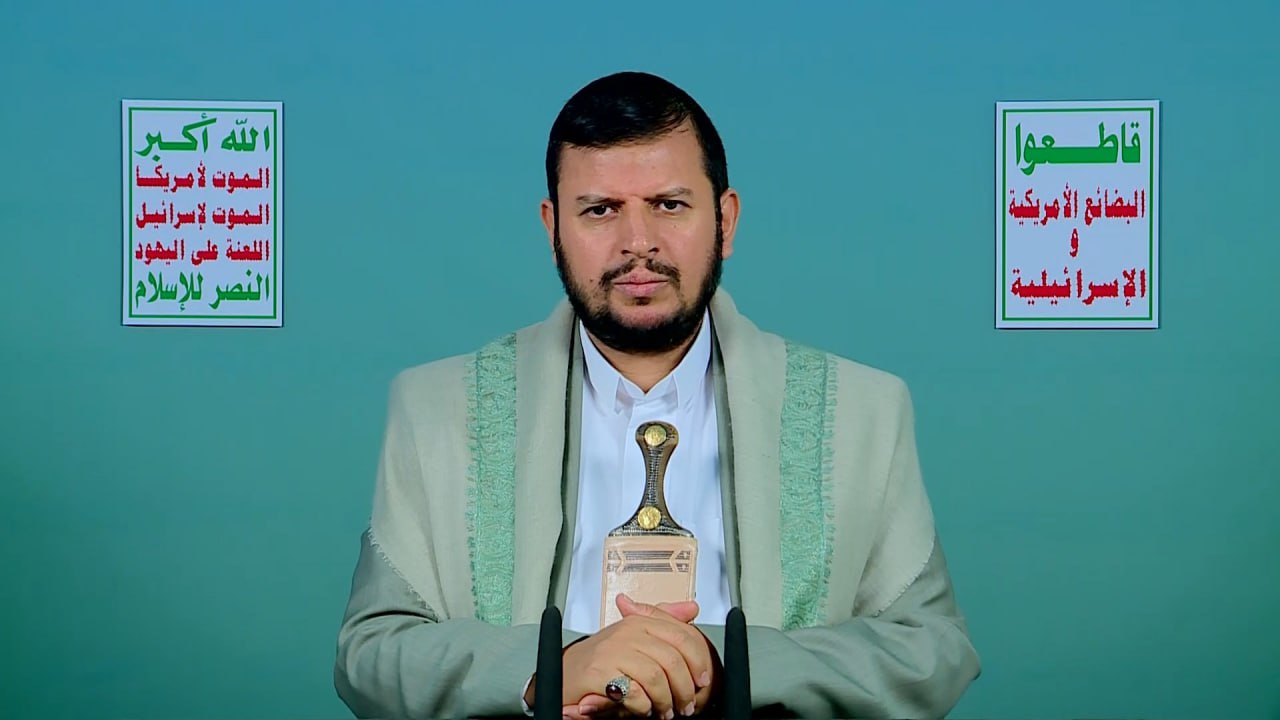
Ramadan Lecture Series 1447 A.H.
Presented by Al-Sayyid Abdul Malik Badruddin Al-Houthi
Lecture Twenty-One
Tuesday, 21 Ramadan 1447 A.H. (10 March 2026 A.D.)
COURTESY TRANSLATION
IN CASE OF DISCREPANCY, THE ORIGINAL TEXT PREVAILS.
I seek refuge in Allah from Satan, the outcast.
In the name of Allah, the Compassionate, the Merciful.
Praise is to Allah, Lord of the Worlds. I believe that there is no god but Allah, the Sovereign and the Manifest Truth, and that our master Muhammad is His servant, Messenger, and Last Prophet.
O Allah! Confer Your salat and blessings upon Muhammad and the Family of Muhammad as You conferred Your salat and blessings upon Ibrahim and the Family of Ibrahim. You are Owner of Praise, Owner of Glory! And be pleased with Muhammad's good companions and all Your righteous servants and mujahidin.
O Allah! Guide us and grant us acceptance, for You are the Hearing, the Knowing; accept our repentance, for You are the Relenting, the Merciful.
Brothers and sisters, peace be upon you and the mercy of Allah and His blessings.
In our discussion of the story of Prophet Musa (PBUH) based on the blessed verses of Surah Al-Qasas, we have come to his return from Midian to Egypt and how, during that journey, he was entrusted with the divine message from Allah, Lord of the Worlds. We reflected in light of the blessed verses: {'When Musa had completed the term and was travelling with his family, he spotted a fire on the side of Mount Tur. He said to his family, "Stay here, I have spotted a fire. Perhaps from there I can bring you some directions or a torch from the fire so you may warm yourselves." But when he came to it, He was called from the tree in the blessed spot to the side of the auspicious valley: "O Musa! It is truly I. I am Allah, the Lord of all worlds"'}
We also discussed the blessed verse from Surah An-Naml and noted how this immensely significant event—the commissioning of Prophet Musa (PBUH) with the divine message—is mentioned in the Holy Quran across multiple surahs according to different contexts. For example, one surah may present a particular part of the story and what Allah said to Musa (PBUH) as required by the context of that surah, while another surah may present a different part of the story. This is because the Holy Quran focuses on the lessons of the story that are most relevant to a given context, in order to establish and affirm certain truths and to provide guidance concerning many aspects of human life.
Thus, we discussed the blessed verse from Surah An-Naml: {'But when he came to it, he was called , "Blessed is whoever is in the fire and whoever is around it! Glory be to Allah, the Lord of all worlds. O Musa, the fact is that I am Allah, the Mighty, the Wise"'}. Thus, in Musa's return journey from Midian to Egypt, we see how his path with Allah was an upward journey towards fulfilment. He returned carrying the divine message and was tasked with the great mission of saving the oppressed, within his role as a messenger.
He had left Egypt, {'fearful, watching out in the city'}, and arrived in Midian with nothing. Then, by the grace and favour of Allah (Glory be to Him), he was granted care in Midian. And now he returns from Midian with his family, and according to narrations and historical accounts, with his livestock and sheep as well. On his way back to Egypt, he was entrusted with the divine message. This is nothing less than an upward journey towards fulfilment under divine care. Among the greatest manifestations of that divine care, and among the greatest signs that Allah does not forsake His devout servants, is that he received the mission on the way and entered Egypt as a messenger from Allah. The very cause that had once weighed heavily upon him and for which he had emigrated, he now returns to advance and fulfil at the highest level.
The Quranic verses detail the sacred and blessed atmosphere surrounding the commissioning of Musa with the divine message. This is because the very act of sending a messenger is one of the most sacred and momentous events to occur on the earth. It is directly connected to Allah (Glory be to Him)—to His lordship, His might, His wisdom, His mercy towards His servants, and His sovereignty. Therefore, it is a truly tremendous matter in view of the sanctity of the mission and its connection to Allah (the Almighty), as we said—to His sovereignty, His governance of His servants' affairs, His providence, His justice, His might, and His wisdom. At the same time, it is of immense importance to human life, signifying a great honour bestowed upon mankind and clarifying the immense responsibility humans bear on this planet. This is why they have always maintained a connection to the teachings and guidance of Allah (Glory be to Him) through the messengers and prophets (PBUT).
The divine message, therefore, is a sacred and momentous mission for many reasons:
- its connection to Allah, to His sovereignty, His mercy, and His governance of His servants' affairs;
- its content and substance;
- its profound impact on the course of people's lives, shaping human reality and providing immense opportunities for happiness, success, and salvation; and
- its critical importance for humanity in this world and the next, for their temporal life and their eternal future.
Therefore, it is a tremendous matter, one of the great matters ordained by Allah (Glory be to Him), and part of His wondrous, great, and momentous governance of His servants' affairs.
Consequently, the very first act of commissioning a messenger and the initial descent of revelation with that message is a great, sacred, and momentous event.
A vivid illustration of this is found in the story of Prophet Musa (PBUH), when he reached Sinai beside Tur Mount—Tur being one of the mountains of Sinai. It was a dark, bitterly cold night, and he appears to have been travelling with his family along that route, or in that area, perhaps having strayed from the usual route. Then he saw a fire, at a time when he was in urgent need of it. He needed it to warm his family, and he also knew that, by custom, there must be people nearby who had lit that fire. In some lands, people would light fires specifically to be seen by travellers—by strangers who might need hospitality, news, or shelter. Seeing the fire, he felt a wave of relief, for he was in need of both warmth and information.
{'He spotted a fire on the side of Mount Tur. He said to his family, "Stay here}—that is, to remain in that place until he returns to them—{ I have spotted a fire. Perhaps from there I can bring you some directions"'}. We also addressed the information Musa (PBUH) needed regarding the route and its conditions: He was returning to Egypt, while at the same time his problem still remained unresolved. {'Or a torch from the fire so you may warm yourselves'})—that is, to seek warmth.
When Prophet Musa (PBUH) went there and found no one near the fire, he then heard the magnificent call come from Allah, the Almighty: {'But when he came to it, He was called from the tree in the blessed spot to the side of the auspicious valley: "O Musa! It is truly I. I am Allah, the Lord of all worlds"'}. The psychological and spiritual impact of hearing this divine call on Prophet Musa (PBUH), as he was one of Allah's devotees, at that moment, under those specific circumstances, and in that state, was certainly immense—one that is far beyond our imagination and comprehension. In fact, we possess no words that can truly convey or express the magnitude of that moment. It was something truly tremendous. The call was an audible sound. That is, Musa heard the voice that was created by Allah (the Almighty), originating from the tree situated in that blessed spot in the valley beside Mount Tur. This magnificent sound, which Allah (Glory be to Him) brought into being, may be illustrated by the rough comparison we mentioned in the previous lecture: when we hear sounds coming from a radio or a television screen. In the same way, the sound came forth from that tree, and Musa (PBUH) heard it.
We spoke about the beginning of the call to Musa (PBUH) in light of the blessed verse from Surah An-Naml: {'But when he came to it, he was called , "Blessed is whoever is in the fire and whoever is around it! Glory be to Allah, the Lord of all worlds. O Musa, the fact is that I am Allah, the Mighty, the Wise"'}. The opening was one of blessings—Allah (the Almighty) blessed that spot, the fire, and all those surrounding it from the angels, who were surely present. These blessings also extended to Musa (PBUH) in that great moment and sacred encounter.
Then we moved on to Surah Taha, as it provides further details concerning that encounter and that great and sacred moment, offering more details about its content. Allah says in Surah Taha, {'So when he came to it, he was called, "O Musa, it is Me, your Lord, so remove your shoes; you are in the sacred valley of Tuwa '}. We also observe, for example, in that blessed and great call from Allah (Glory be to Him) mentioned in the blessed verses of Surah Al-Qaṣaṣ, Surah An-Naml, and Surah Taha a clear clarification of the source of that call. That is, we find statements such as, "{'it is Me, your Lord'}, {'the fact is that I am Allah, the Mighty, the Wise'}, and, {'O Musa! It is truly I. I am Allah—the Lord of all worlds'}.
Thus, within the call itself, there is a clear clarification to Musa (PBUH&F), while he was in an atmosphere entirely filled with sanctity—an extraordinary and miraculous setting, beyond what is ordinary or familiar. In such circumstances, these truths became evident to him: that he was in the presence of the commissioning with the divine message and the reception of divine revelation. Accordingly, we find, for example, a clear indication of the source of the call in verses such as, {'it is Me, your Lord'}, {'the fact is that I am Allah, the Mighty, the Wise'}, or {'O Musa! It is truly I. I am Allah—the Lord of all worlds'}. Thus, there is a clear clarity in the revelation itself: clarity regarding its source, the duty, and the sacred and spiritual atmosphere surrounding it.
This is what we ought to have a clear vision and sound understanding of: how the process of the beginning of revelation with the divine message takes place for the Messengers of Allah, and in what kind of atmosphere it occurs. This is particularly important because there are many narrations that are incorrect in the books of Prophetic Biography that documented the life of the Seal of the Prophets and the Master of the Messengers: the Messenger Muhammad (PBUH&F). Many of them contain false narrations, while others are incomplete, distorted, or fabricated, presenting a serious misrepresentation of how revelation began to the Seal of the Prophets and the Master of the Messengers: the Messenger of Allah Muhammad (PBUH&F). What is very saddening is that some of those narrations have even become officially accepted accounts. They are relied upon in universities and taught in schools across various parts of the Islamic world, thereby presenting a deeply misleading perspective. First, such accounts depict a scenario entirely devoid of sanctity. Second, they are surrounded by doubt and suspicion, raising questions, such as 'What is this? What is happening? Some scholars, writers, and historians have even claimed that, at the beginning— such circumstances and manner in which revelation occurred—the Prophet (PBUH&F) did not understand the true nature of what was happening and that the matter was not clear to him: what was required of him, what was intended for him, and what was expected from him. This represents a very serious problem, and its underlying cause is the distance from the Holy Quran and the failure to evaluate historical reports and narratives in the light of the Holy Quran.
Here, we can clearly see how the matter of revelation begins in a manner that is first and foremost profoundly sacred, majestic, and sublime, completely unlike what is narrated in some of these accounts. For example, some accounts claim that the Angel of Revelation suddenly appeared to the Messenger of Allah Muhammad (PBUH&F) in the cave without any prior indication, and commanded him to 'Read!' The Prophet is said to have responded, 'I cannot read', and then the angel allegedly pressed him tightly, choking him. Some narrations even claim this happened three times, so violently that he almost died; then the angel finally said, {'Read with the name of your Lord who created (everything)'}. After that, the angel left him, and he returned to his home bewildered, asking himself, what that had been, what had occurred, why this sudden attack had been carried out in such a manner, and why he had been chocked. He went here and there, consulting Waraqa ibn Nawfal and others, and ultimately learned from Waraqa that this was the Great Law of Revelation—the same that had come to Musa and to Isa—and that he was a Messenger of Allah. According to this account, Waraqa mentioned that he initially doubted that Muhammad (PBUH&F) would be a prophet. This entire portrayal, however, is flawed, weak, and completely incorrect
Indeed, the atmosphere of revelation is sacred and magnificent. It shares in the sanctity of the message itself and is filled with its blessings and spiritual presence. It is a time of connection with Allah (Glory be to Him), the reception of guidance from Him, and the receiving of something immense and sacred from Allah: the Divine Revelation.
Thus, we find here what rectifies our understanding of this matter, so that we may adopt the proper perspective. There is absolutely no ambiguity in it. That is to say, the commissioning with the divine message does not come about in an atmosphere saturated with confusion, devoid of sanctity, and filled with harsh circumstances and very strange actions. In fact, if people were to see a teacher treating a student in such a way, they would find it strange and unacceptable.
Here, regarding the method of revelation to Prophet Musa (PBUH), it was through direct speech: Allah spoke to him, as stated in the blessed verse, {'And Allah has spoken to Musa verbally'}. In fact, this is one of the methods of revelation from Allah to the messengers and prophets (PBUT)—that He speaks to them directly, as was the case with Prophet Musa (PBUH).
In the blessed verse from Surah Al-Baqarah, Allah (Glory be to Him) says, {'We have favoured some of those messengers over others. Among them, there are ones to whom Allah spoke (directly), and He raised some of them steps higher '}. Another verse in the Holy Quran clarifies the nature of divine revelation, {'It is not possible for a human being that Allah speaks to him, except by way of revelation, or from behind a curtain, or that He sends a messenger, and he reveals, with His permission, what He wills. Surely, He is All-High, All-Wise'}. In fact, in most cases, commissioning with the divine message takes place through angels—most often through the Angel of Revelation, Gabriel (PBUH). Allah sends them to His Prophets and Messengers—people whom He entrusts with the message or with prophethood—and they convey to them His revelation. This is one of the most common forms of divine revelation. There are also other forms of revelation, but this is not the context for discussing all the details related to that.
Why, then, was Musa (PBUH) addressed in this way—with Allah speaking to him directly—when this is such an exalted degree of revelation and such a great honour and distinction?
Prophet Musa (PBUH) was entrusted with an extremely difficult mission, one that involved great challenges. This particular manner of revelation to him had an important impact on his psychological state, granting him an immense moral impetus. For he was to go forth to confront the greatest tyrant on the face of the earth—Firaawn—without an army, without resources, and without a supportive community. Rather, he himself would strive to rescue that oppressed community, which was powerless and subjected to severe subjugation. Therefore, he was in great need of a tremendous moral reinforcement in his mission to convey the divine message, to save those oppressed people, and to confront the greatest tyranny existing on the face of the earth.
Therefore, it truly had great significance in providing him with a tremendous moral boost and a profound sense of reassurance so that his confidence, composure, and certainty would be exceptionally high.
We also observe, regarding the prophetic mission and the sanctity with which Allah (Glory be to Him) surrounds it, that this sanctity extends even to places: They become landmarks and sacred sites. For instance, concerning that valley, the Quran refers to it, saying, {'in the blessed spot to the side of the auspicious valley'}. That valley is described in these verses as {'auspicious'}, which is said to convey the sense of divine blessing, while {'in the blessed spot'} describes the blessedness and the blessings that Allah (Glory be to Him) has placed therein.
This fact is also affirmed in other Quranic verses. For example, Allah (Glory be to Him) says, {'Blessed is whoever is in the fire and whoever is around it'}, and He also says in Surah Taha, {'So when he came to it, he was called, "O Musa, it is Me, your Lord, so remove your shoes; you are in the sacred valley of Tuwa"'}. In these verses, we find a clear affirmation of the sanctity of the place.
The sanctity of places connected with the divine Message and revelation comes from Allah Himself. It is He Who has accorded them that sacred status, for they are landmarks associated with the inception of the prophetic mission and the revelation of the divine message, among other reasons. In the same way, Allah has bestowed immense sanctity upon His mosques—His houses—and above all upon the honoured Kaaba, the Sacred House of Allah, which holds the highest degree of sanctity among all sacred places.
Sacred landmarks are described in the Holy Quran with terms denoting holiness, such as {'in the sacred valley '}, and they are also described with terms of blessing, such as {'in the blessed spot'}. These expressions—'blessed' and 'sacred'—are deeply significant, because they point to an important aspect of our religion: sacred places and holy landmarks. They possess profound sanctity and immense importance: Allah has made them sacred symbols of His religion and landmarks for His servants. For this reason, they should hold a place of reverence and veneration within our faith, within our hearts, and within our conscience: Allah says, {'Having said that, if one observes the sanctity of the symbols of Allah, then such things emanate from the piety of the hearts'}.
The false notions that takfiri groups attempt to promote among people—portraying reverence for Islamic landmarks and sacred sites as polytheism, disbelief, falling outside the fold of Islam, or worshipping other than Allah—are utterly false; they are nothing but baseless claims. The matter also has roots in intelligence operations and has been engineered through Jewish, British, and Zionist orchestration. In fact, Islamic landmarks and sacred sites are deliberately targeted by the enemies of Islam because they recognise the profound religious value these places hold in people's lives—in shaping their commitment to their faith and strengthening their sense of religious identity.
This is part of the wisdom of Allah (Glory be to Him): that He has established for His servants sacred symbols and landmarks on the earth that are endowed with sanctity. As sacred places, they possess a religious significance in acts of worship—for example, the special virtue of worship performed there and the great merit of drawing closer to Allah within them. They are not idols; the matter is clear. Muslims do not turn towards them as gods other than Allah, but rather as places to which Allah Himself has granted religious sanctity.
If we consider, for example, the valley known as Tuwa, the Holy Quran affirms that it is a sacred valley and describes it with this great designation: {'the blessed spot'}. Similarly, our Islamic sanctities—the Kaaba, the Al-Aqsa Mosque, and other sacred landmarks and symbols associated with the religion, its rites, and acts of worship—derive their sanctity from the sanctity of the religion itself. Therefore, we must realise their importance to us as sacred landmarks on this earth, so that people develop a living relationship with them. This relationship is one of faith—a religious bond. Such reverence and veneration are for the sake of Allah (Glory be to Him), due to their connection to His command, His religion, and the means of drawing closer to Him. This is indeed a very important subject; discussing it in detail would take considerable time; perhaps, Allah willing, we may return to it and discuss it further on another occasion.
Indeed, we see this principle in the story of Prophet Musa, in the story of Prophet Ibrahim and the building of the Kaaba, and in the accounts of a number of prophets and messengers (PBUT). Takfiri groups wage war against Islamic landmarks and sacred sites precisely because doing so serves the interests of the Jews.
One of the first objectives of the Jews is to erase all Islamic landmarks, so that no tangible signs of Islam remain—nothing people can see or with which they can connect emotionally, spatially, or historically. They therefore endeavour to obliterate all Islamic landmarks and heritage sites. The Wahhabis adopt this very approach under the pretext of condemning polytheism, disbelief, and apostasy from Islam. At the same time, they spread false propaganda and accusations against Muslims to legitimise the shedding of their blood and to pave the way for demolishing and destroying these sacred sites— ultimately preparing the ground for the demolition and destruction of the Al-Aqsa Mosque. This is what they are working towards.
Returning to these blessed verses concerning Allah's call to His servant Musa (PBUH), Allah addressed him, {'So remove your shoes; you are in the sacred valley of Tuwa'}. This command was given as an expression of sanctification and reverence for that place, instructing Musa to remove his shoes so that he might settle himself and listen attentively to the revelation and instructions of Allah. The emphasis in the words {'you are in the sacred valley of Tuwa'} is an emphatic statement that also implies a reason. Sometimes a form of emphasis in the Quranic expression also conveys a sense of explanation—almost as if it were saying, because you are in this sacred valley, a place that must be honoured, revered, and treated with due respect even in one's conduct there, to the point that one removes his shoes rather than entering such a sacred place wearing them. {'So remove your shoes'}—this indicates that reverence for sacred landmarks in Islam extends even to the manner in which they are approached and treated with respect: A prophet of Allah—indeed a messenger at the very moment of receiving his mission— is commanded to remove his shoes and not enter that sacred place wearing them, as an act of reverence for the place and humble submission to Allah (Glory be to Him), so that he may devote himself fully to listening to the revelation of Allah and His instructions.
Allah then said to Musa, {'I have chosen you, so listen to what is revealed'}. Here, Allah (Glory be to Him) addresses him with this great statement: {'I have chosen you'}. That is, Allah (Glory be to Him) selected him for prophethood—for a momentous and sacred mission: the message of Allah. Within it lies a sacred and profound purpose—to rescue a nation that had been oppressed, subjugated, wronged, and persecuted. We observe that this also occurs within the framework of Allah's justice, mercy, and wisdom. As the One Who upholds justice among His servants, He does not leave them indefinitely in suffering. Rather, from the very beginning, He prepares for them the means of deliverance, success, and salvation. Later, even in difficult and painful circumstances, guidance reaches them, and the doors of mercy and deliverance are opened before them.
Here, in Allah's words {'I have chosen you'}, we see that the selection of messengers and prophets belongs entirely to Allah. It is He Who chooses, as He says, {'Your Lord creates what He wills and chooses. Choice is not theirs'}. He selects and prepares them for this mission, which is immense and requires divine preparation to a lofty level of excellence befitting the sanctity, greatness, and importance of Allah's message. Indeed, the message of Allah is a sacred and momentous mission.
Therefore, when Allah (Glory be to Him) reminded him of this, it served as a reminder of the favour Allah had bestowed upon him and, at the same time, a reminder of the responsibility that comes with this choice. In other words, Allah had chosen him for the message—for something great and momentous. This is a great, weighty, and sacred responsibility that requires the guidance and teachings of Allah. At its core, Allah's message is founded upon the revelation and guidance of Allah.
Allah says, {'So listen to what is revealed'}. The command {'So listen'} comes even though, at that very moment, Musa was already directing his full attention—indeed his whole being, his mind, his thoughts, and his focus—towards listening. The atmosphere itself, the situation itself, and the entire scene would seize a person's complete attention and awareness. From the very moment he realised that the One speaking to him was Allah, how intense must his attentiveness, absorption, and concentration have been. Yet despite all this, Allah says to him, {'so listen to what is revealed'}. This draws our attention to the importance of Allah's guidance, for what is revealed to the prophets and messengers consists of divine teachings and guidance from Allah, which reach people through them. They are the link through which Allah's guidance and teachings are conveyed to humanity. Therefore, listening to it attentively, focusing upon it, and giving it the importance it deserves is essential, because its source is Allah (Glory be to Him). This is something extremely important for an individual to internalise within himself.
That concludes our lecture for today.
We ask Allah (Glory be to Him) to grant us success in seeking what pleases Him. O Allah, have mercy on our virtuous martyrs, heal the wounded among us, set free our captives, and grant us victory. You are the Hearer of Prayer!
Peace be upon you and the mercy of Allah and His blessings.