
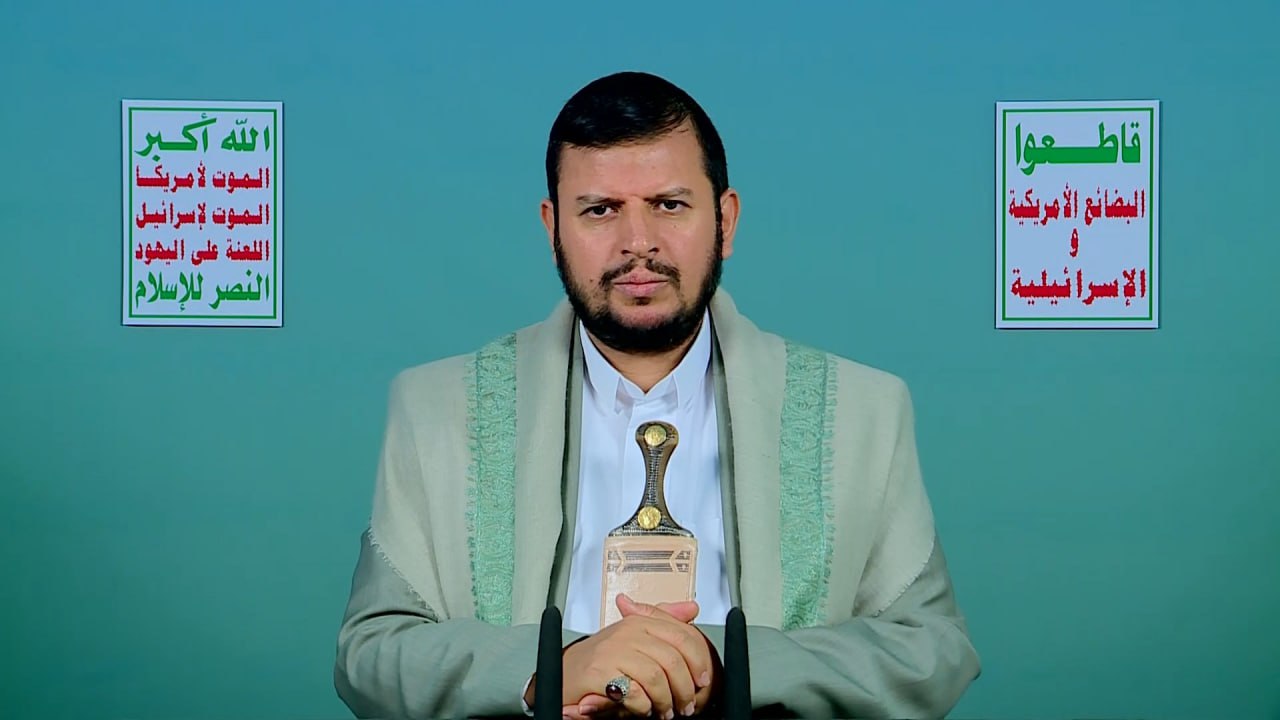
Ramadan Lecture Series 1447 A.H.
Presented by Al-Sayyid Abdul Malik Badruddin Al-Houthi
Lecture Twenty-Four
Saturday, 25 Ramadan 1447 A.H. (14 March 2026 A.D.)
COURTESY TRANSLATION
IN CASE OF DISCREPANCY, THE ORIGINAL TEXT PREVAILS.
I seek refuge in Allah from Satan, the outcast.
In the name of Allah, the Compassionate, the Merciful.
Praise is to Allah, Lord of the Worlds. I believe that there is no god but Allah, the Sovereign and the Manifest Truth, and that our master Muhammad is His servant, Messenger, and Last Prophet.
O Allah! Confer Your salat and blessings upon Muhammad and the Family of Muhammad as You conferred Your salat and blessings upon Ibrahim and the Family of Ibrahim. You are Owner of Praise, Owner of Glory! And be pleased with Muhammad's good companions and all Your righteous servants and mujahidin.
O Allah! Guide us and grant us acceptance, for You are the Hearing, the Knowing; accept our repentance, for You are the Relenting, the Merciful.
Brothers and sisters, peace be upon you and the mercy of Allah and His blessings.
In our previous lecture, we had reached the supplication of Prophet Musa (PBUH) and what he asked of Allah (Glory be to Him) after He sent him with the message and entrusted him with this sacred mission to Firaawn, his people, and the Children of Israel—in the face of Firaawn's tyranny. At the forefront of that supplication, {'He said, “My Lord, put my heart at peace for me"'}.
We spoke about the importance of this quality as one of the foremost things a person needs in major tasks and all responsibilities: to exercise forbearance and avoid impatience. In all that he was about to face—whether from Firaawn and his people at the outset, or later from the Children of Israel—Musa was in great need of great forbearance and tremendous inner endurance.
We also spoke in the previous lecture about the importance of this, especially in many delicate responsibilities, in which a person may fall into injustice if he behaves according to his emotional state—driven by impatience, agitation, harshness, anger, or feelings of resentment and sorrow.
For when a person begins to act under the sway of his emotional state, this can affect his sound judgement and make him fall into wrongdoing. This can also affect his moral standing and his relationship with the people around him. Therefore, this issue has harmful consequences in many ways.
We arrived at the verse: {'And make my task easy for me'}. Musa (PBUH) is seeking ease in the tasks and responsibilities that he will undertake under difficult, complicated, and intense circumstances. He needs the help and guidance of Allah (Glory be to Him), Who is the Almighty, the Generous, and the Merciful. He has power over all things, easing what is difficult and preparing relief for a person in every difficult situation and hardship. That is why turning to Allah is extremely important. Even when a person moves forward with this hope and trust in Allah while carrying out his duties and responsibilities—especially when those responsibilities are great and significant, such as striving in the path of Allah or serving His creation—he must always turn to Allah, asking Him to ease what is difficult and to grant relief from every hardship and distress.
{'And remove the knot from my tongue, so that they may understand my speech'}. He likened the difficulty in pronouncing certain letters to a knot in the tongue. Regarding the figurative image conveyed here—{'And remove the knot from my tongue'}—it is said that he had a speech impediment and found it difficult to pronounce some letters.
He was keen to be granted a high degree of fluency and eloquence by Allah, for that is important in conveying the message clearly, persuading and influencing others, and establishing the proof. This is indeed a matter of real importance: the power of expression. The more capable a person is of explaining and clarifying, and the greater his eloquence in speech and expression, the greater his effect will be in persuasion, in establishing the proof, in making matters understood, and in serving the cause he stands for. This makes him capable of making the truth plain, exposing oppression and injustice, and setting out the proof clearly. This aspect is of very great importance.
In this age, it is extremely important to give due attention to this aspect. To do so, one first needs to turn to Allah and seek His help; and with that, he must pursue the necessary practical means to acquire the power of clear expression—whether in preaching, cultural and educational work, or in media activity. What is needed is the ability to make the truth clear, to expose falsehood, and to refute fabrications, specious arguments, and false claims.
This is of immense importance in our time, for it is a fundamental arena—indeed, it is the primary arena of conflict. That is why Allah (Glory be to Him) says of the enemies of Islam, foremost among them the People of the Scripture, {'They want to extinguish the light of Allah with their mouths'}. Through propaganda warfare, specious arguments, misleading narratives, methods of misguidance, and means of deception, they seek thereby to extinguish the light of Allah. Therefore, striving to acquire the power of expression and to utilise and employ it fully in the service of the truth is something of the utmost importance.
Some people, for example, may indeed possess eloquence and a remarkable ability to express themselves. However, due to the corruption, malice, and wickedness within them, they may devote that ability entirely to the service of falsehood, to oppressing others, or to unjustly harming the servants of Allah. This is a very serious state.
In this age of social media and other such media outlets, a person must recognise the moral, spiritual, and religious responsibilities attached to his words, and remember the divine reckoning and reward connected with his speech: what he says, how he uses the blessing of eloquence, and the causes for which he uses it.
Some individuals turn into defamers, fault-finders, fabricators, and offenders, and they may employ even their eloquence—perhaps gained through education, such as graduating from a media college—in the service of falsehood. This is a serious state.
Prophet Musa (PBUH) was keen to ask Allah for the gift of fluency and eloquence, recognising its critical role in serving the truth, delivering the divine message, clarifying things, persuading others, and establishing the proof. As we have mentioned earlier, this matter is of great importance in this era.
{'And make for me a minister from my own family—Harun, my brother. Enhance with him my strength, and make him share my task, so that we glorify You much and remember You much. You are certainly watchful over us'}. Here, he also asks Allah (Glory be to Him) to appoint for him a minister—a helper who will aid him in carrying out this task. A person who plays an essential role in giving support is called a minister because he carries part of the burden and thus lightens the load.
{'And make for me a minister from my own family—Harun, my brother. Enhance with him my strength, and make him share my task, so that we glorify You much and remember You much. You are certainly watchful over us'}. Given the immense scale and complexities of his mission, Musa (PBUH) asked Allah to appoint a minister for him, someone to assist him in conveying the message and undertaking the task. He specifically names this minister as Harun, his brother.
According to historical accounts, Harun was the older brother of Musa (PBUH). He was born during a period before Firaawn's decree to slaughter the male children of the Israelites had come into effect. Some narrations state that Firaawn would order these killings during specific seasons and spare the children at others.
Harun was known for his eloquence. In another verse, Musa (PBUH) says, {'And my brother Harun is more fluent than me in speech'}. He possessed the eloquence, trustworthiness, and suitability essential for this role. This was in addition to the divine support he would receive from Allah (Glory be to Him) in his mission: guidance, success, and a form of divine care that builds and refines the human soul. Indeed, Allah intervenes even in the nurturing of souls. However, there is no doubt that Harun was already a man of exceptional noble character and well-suited for this task; it was for these reasons that Musa specifically asked Allah to make him his assistant.
He said, {'Enhance with him my strength.'} He asked Allah to make Harun a true source of strength and genuine support for him. For some people can be true helpers and a source of strength and support in undertaking tasks and responsibilities. Such a momentous mission demands this kind of role; it requires having someone who offers genuine and effective assistance.
Musa also asked Allah to let Harun share in his mission, to be his partner in conveying the divine message and in executing its practical demands. The sheer scale of his mission was immense, considering the challenges, burdens, and pressures facing him. From this, we see his profound dedication to serving the divine message and the cause he championed. We witness his complete selflessness, utterly free from any trace of ego and personal interests. His sole concern was the service of the message and the cause he was dedicated to, with no room for personal interests or motives whatsoever.
This is one of the foremost qualifications for undertaking great responsibilities. That is, it applies not only to the level of the message and prophethood, but also to other practical tasks of moral and religious significance and of human value. Such responsibilities require that those engaged in them be completely free from selfishness, personal calculations and considerations, and aggrandisement, and that they be wholly devoted, with all their focus directed towards serving the mission.
To illustrate, when some people see a task as honourable and of high standing, they may be inclined to ensure that no one rivals them or shares the spotlight with them—that is, in practical terms, as a partner in the task. Rather, they regard this as deeply upsetting, something that provokes resentment, heightened sensitivity, and inner discomfort. They are consistently keen to present themselves—alone and exclusively—as the one who achieved, as the central figure, and as the one responsible for the task, allowing no one else to appear alongside them in it. This is one of the afflictions that can affect people in positions of responsibility, whether in public roles, in responsibilities related to jihad, or across various types of duties. This flaw appears in many cases and has a negative impact on the work itself and on the effective fulfilment of tasks and responsibilities, undermining what would otherwise be highly beneficial.
Some individuals descend to troubling levels as a result of selfishness and personal calculations, thereby harming the work and undermining the very causes they seek to serve. Concern then becomes purely personal, shaped by individual calculations and considerations, and the result is betrayal—betrayal of the work and of responsibility. This occurs when a person's focus turns inward, centred on their own ego, and they no longer focus on serving the cause.
Another flaw can also be observed in some individuals. Some may be free from arrogance and personal calculations, yet they may believe that the work is best served if they personally control every detail and take on as many tasks and responsibilities as possible, even beyond their capacity and capability. They therefore attempt to take charge of all aspects of the work, but this ultimately causes them to fall short, with much escaping their grasp. This is because a person's abilities and practical capacities are inherently limited. Whatever exceeds those limits inevitably falls outside their scope of attention—not by choice, but by necessity. As a result, many matters unintentionally pass them by, and they fail to fully grasp numerous aspects, leading to deficiencies and faults in the work. Even though they may be deeply committed, exerting their utmost effort, and dedicating themselves fully, personal effort alone is insufficient. No matter how sincere, devoted, or attentive they are—when operating individually within the scope of major responsibilities, extensive tasks, and heavy workload—they inevitably overlook many elements. This leads to shortcomings and faults, for which they ultimately bear responsibility. This flaw occurs across many fields of work.
For this reason, this lesson holds broad relevance across different situations and considerations. Despite the immense honour of the message, Musa (PBUH) was wholly concerned with what would serve the mission. Thus, he rose above all personal considerations and calculations, to the extent that he said, {'And my brother Harun is more fluent than me in speech, so send him with me as a helper to bear me out. I am afraid they may accuse me of lying '}. He also said, {'And make for me a minister from my own family—Harun, my brother'}, emphasising, {'Enhance with him my strength, and make him share my task'}. In making this profound request to Allah (Glory be to Him), he seeks only what serves the message and the cause to which he is devoted.
Here we also observe the wise management of Allah (Glory be to Him), that even in prophetic missions there was a clear complementarity of roles—one role operating within another. Harun (PBUH) is a messenger of Allah and a prophet, yet his role operated within that of Musa (PBUH). Musa held the primary role, and Harun's role was situated within Musa's, not separate from it nor independent of it. He served as a minister to him, while at the same time being a messenger alongside him and a partner in this matter: the prophethood, the message, and the mission in all its various details.
We also observe additional roles within this divine order among the messengers and prophets, as seen in the account of Prophet Yahya, the son of Prophet Zakariya (PBUT), alongside the Messenger of Allah Isa (PBUH). Regarding Yahya (PBUH), Allah says, {'who shall come to confirm a word of Allah'}. Even when the glad tidings were given to Zakariya (PBUH), it was mentioned that, {'So then, when he stood praying in the place of worship, the angels called out to him saying, “Allah gives you the good news of Yahya who shall come to confirm a word of Allah and shall be a chief, abstinent (from women), a prophet and one of the righteous"'}. The phrase {'who shall come to confirm a word of Allah '} refers to confirming Isa, and this confirmation was expressed through support, assistance, and moral backing among the people—calling them to believe in him and to stand in his support. Thus, although he was a prophet, he also undertook a supporting role alongside the Messenger and Prophet of Allah Isa (PBUH).
We find another example in the story of the Prophet of Allah and His Messenger Lot (PBUH). He was also a messenger and a prophet, yet his role operated within that of Ibrahim—the Prophet of Allah, His close friend, and His Messenger (PBUH). That was why, in certain instances, the angels would first pass by Ibrahim and then proceed to Lot, as in the account of the divine punishment , when they informed Ibrahim first. Lot was among those who believed in Ibrahim and affirmed his truthfulness. At the same time, although he was a messenger, he remained closely associated with him; that is, his relationship with Ibrahim continued as one of following and support.
This role, as we have mentioned, comes within the framework of Allah's way of the complementarity of roles: a role within another role and a role that complements another. This applies at the level of prophethood and message delivery, as well as within the various levels of guidance.
Then, as we move to other levels—those of public responsibility—we find that they too are grounded in the complementarity of roles and in cooperation, given that they are collective tasks that require collaboration. Indeed, elsewhere in the account of the Children of Israel, Allah appointed from among them twelve leaders to assist Musa in executive and practical functions. Such a role, when structured in an organised manner, falls within the broader framework of cooperation in fulfilling major responsibilities and tasks.
Hence, a person must remain mindful in matters of responsibility and duty, recognising that they are based on the principle of the complementarity of roles and that one cannot do without others or their roles. In addition, a person should not assume that his own role alone will suffice, thereby adopting the notion of monopolising all responsibilities while dispensing with others. At the same time, one must strive to rid oneself of all forms of selfishness and the harmful tendencies and ill-feelings of self-centredness. Such a state is extremely dangerous for a person, as it undermines his faith, his relationship with Allah (Glory be to Him), and his sense of servitude to Him. Consequently, he starts treating his own self as an idol, and he begins to revolve around it, in a way that negatively affects his duties, his work, and other considerations.
This is a very important lesson—a lesson on the importance of cooperation in collective tasks and responsibilities, as well as being cautious of another pitfall, taking on burdens beyond one's capacity. This can stem from a kind of eagerness, but without awareness—the eagerness of someone who has high confidence in himself but lacks trust in others. As a result, he assumes that the solution is to take control of all tasks and responsibilities, even beyond his own ability and capacity.
Here, for example, we find one of the fruits of cooperation, when Prophet Musa (PBUH) said, {'And make him share my task, so that we glorify You much and remember You much'}. Here, we observe one of the most beautiful and refined expressions concerning the duties and responsibilities of the divine mission, particularly in terms of their core goals. In other words, he spoke about them regarding their outcomes, results, and intended goals—the very goals for which he strives.
All the responsibilities related to the divine message draw people closer to Allah (Glory be to Him). Even those that take the form of acts of worship—such as the obligation of prayer and other devotional practices—or practical faith-based commitments in human dealings and everyday conduct all lead to outcomes that draw a person closer to Allah (Glory be to Him). They testify to the greatness of Allah, to His transcendence, and to His sanctity. Indeed, the law of Allah, His guidance, and His teachings all bear witness to His perfection and majesty. Thus, they all draw people towards Allah (Glory be to Him) and connect a person to Him throughout the course of life.
For this reason, it is important to recognise this truth: Whatever practical matters occupy us, we should not become mentally or emotionally detached from their intended fruits and their real objectives—those that keep us connected to Allah (Glory be to Him): a connection of magnifying Him, declaring His transcendence, sanctifying Him, bearing witness to His perfection, remembering Him, and being drawn towards Him. This expression is profoundly refined, as it links practical responsibilities—in all their details—to the glorification and sanctification of Allah and to drawing nearer to Him while keeping that focus central. It also emphasises abundance in remembrance itself: remembrance that is connected to action, and glorification that is tied to practical responsibilities—not separated from them but intertwined with them and, indeed, embodied through them. It also shows the extent of Musa's concern to realise such outcomes, as reflected in the emphasis on {'much'}: {'so that we glorify You much and remember You much. You are certainly watchful over us'}. In other words, this is one of the fruits of cooperation: When the two of them work together, the outcomes become greater and their manifestations more abundant.
{'You are certainly watchful over us'}—that is, You are fully aware of our condition and what we face in terms of difficulties, challenges, obstacles, complications, and all else besides. You are the One Who never becomes weary of managing our affairs and facilitating our matters. At this point, the supplication reached its completion.
Elsewhere—for example, in Surah Al-Qasas—Musa also presented to Allah a concern that could pose an obstacle to his prophetic mission and therefore required resolution: {'He said, “My Lord, I have killed a person from them, therefore I fear that they will kill me'}. That is, he feared that when he went to them to convey the message, they might not tolerate his arrival and might hasten to kill him before even listening to what he had come to deliver.
{'And my brother Harun is more fluent than me in speech; so send him with me as a helper to bear me out. I am afraid they may accuse me of lying. He said, “We will strengthen your arm with your brother”'}—that is, Allah will strengthen and support him through his brother Harun. {'And we will give both of you such a power that they cannot reach you. With Our signs, you and your followers will be the victors'}: This is a clear glad tiding of victory and triumph.
Here, in the context of the blessed verses of Surah Taha, once Musa had completed his request and supplication, Allah (Glory be to Him) responded: {'You have been granted your request O Musa'}. That is, everything he asked for in his supplication was granted: bringing peace to his heart, easing his task, granting him eloquence and clarity in speech, and appointing his brother Harun alongside him as a minister, messenger, prophet, and helper. Allah granted him all of these requests.
As we have mentioned earlier, we see here the importance of the role of sincere, righteous, and devoted assistants—those who are fully committed to the responsibility—who truly constitute a source of strength and support, as expressed in {'We will strengthen your arm with your brother'}. They truly become a supporting arm in the fullest sense of the word.
This also reminds us, within this same context, of the well-known and widely transmitted hadith among the Muslim Ummah known as 'Hadith Al-Manzila', in which the Messenger of Allah (PBUH&F) said to the Commander of the Believers, Ali ibn Abi Talib (PBUH), 'You are to me as Harun was to Musa, except that there is no prophet after me.' This text is agreed upon and widely affirmed as authentic across the various Islamic schools of thought and among the hadith scholars of the Muslim Ummah. It is a highly significant hadith because it first clarifies the great role played by the Commander of the Believers, Ali (PBUH), in supporting and assisting the Messenger of Allah (PBUH&F). It also clarifies his position and the level of that role—one from which prophethood and messengership are excluded. In other words, he was not a prophet, whereas Harun himself was a prophet in his mission alongside Musa (PBUH). As for the Messenger of Allah, Muhammad (PBUH&F), he is the Seal of the Prophets and the culmination of the line of messengers; that is, there will be no prophet or messenger after him. For this reason, the exception appears in his statement: ' except that there is no prophet after me.'
We now return to the context of the blessed verses. Following Allah's words, {'He said, “You have been granted your request O Musa"'}—which represents immense support and a very great blessing—He then said, {'And We had bestowed Our favour on you another time, when We revealed to your mother what was to be revealed'}. That is, Allah granted him this favour on this occasion by fulfilling his request, and He reminds him of a previous favour bestowed upon him—namely, a great blessing that Allah granted him in his early childhood, shortly after his birth, at a stage when he was in utmost need of full care and protection.
{'And We had bestowed Our favour on you another time, when We revealed to your mother what was to be revealed, that is, "Put him in the chest, then put it into the sea. The sea will wash it ashore, and he will be taken by an enemy of Mine and his." And I endeared you with love from Me so that you would be brought up under My Eye. when your sister came along and said, "Shall I lead you to one who nurses him?" Thus, We brought you back to your mother, so that her eyes might have comfort and she might not grieve. And you had killed a person, then We brought you out of the trouble, and We tried you in various ways. Then you lived a number of years amidst the people of Midian. Then you came here as pre-destined, O Musa!' }. We previously discussed these blessed verses in earlier lectures up to His saying: {'And you had killed a person, then We brought you out of the trouble'}. The phrase {'Then We brought you out of the trouble '} means that Allah saved him from what could have befallen him as a result of that incident—namely, the punishment he might have faced from Firaawn and his people, along with the consequences that would have followed. Thus, Allah saved him, pardoned him, and delivered him from that difficulty through the way He prepared for his migration to Midian and the care he received there.
{'And We tried you in various ways'}. That is, Allah (Glory be to Him) prepared him to endure hardships through the difficult circumstances he experienced, the challenges he faced, and the various trials he underwent—experiences that moulded him in such a way that he became capable of bearing all kinds of hardships and difficulties.
{'Then you came here as pre-destined, O Musa!' }. That is, by Allah's divine arrangement; it was He Who prepared and brought about Musa's return at exactly that appointed time.
We ask Allah (Glory be to Him) to grant us success in seeking what pleases Him. O Allah, have mercy on our virtuous martyrs, heal the wounded among us, set free our captives, and grant us victory. You are the Hearer of Prayer!
Peace be upon you and the mercy of Allah and His blessings.