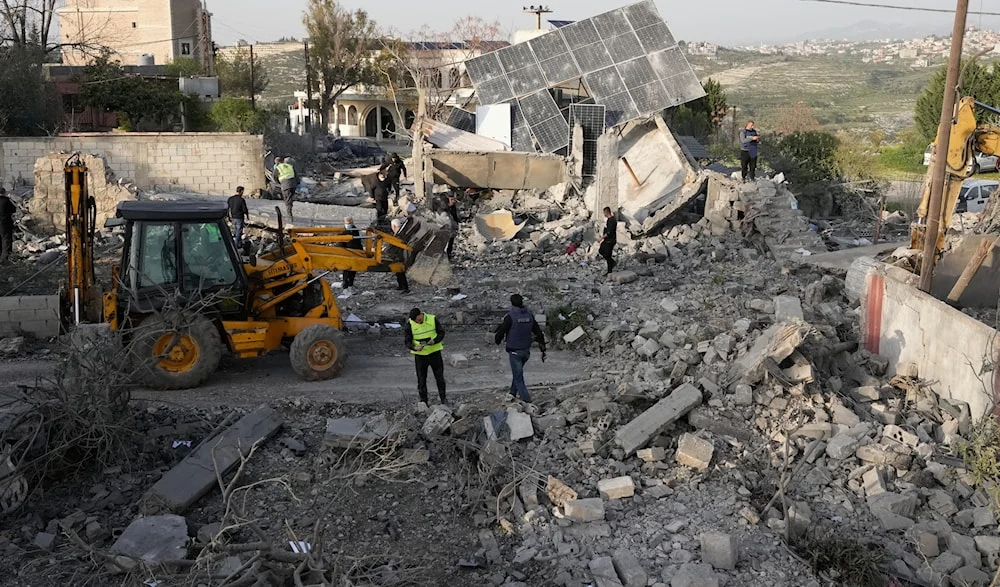
The widespread Israeli destruction seen in one town is mirrored across much of southern Lebanon, a fertile region of rolling landscapes, where Israeli occupation forces have systematically carried out mass demolitions on the border with the occupied Palestinian territories. An investigative report by The New York Times indicates that these actions appear aimed at preparing the ground for a broader, long-term military presence.
Israeli Security Minister Israel Katz confessed that the strategy draws directly from methods previously used in Gaza, where entire neighborhoods, buildings, and streets were reduced to ruins by Israeli forces.
Following the resurgence of Israeli aggression in early March, "Israel" moved to establish a so-called “buffer zone” extending several kilometers into Lebanese territory. Israeli officials maintain that this "zone will remain under Israeli control until Hezbollah is no longer considered a threat."
Satellite evidence reveals scale of destruction
Satellite imagery analysis, combined with verified photos and videos reviewed by The New York Times, highlights the vast reach of the Israeli systematic destruction. At least two dozen towns and villages near the border with the occupied Palestinian territories have experienced extensive demolition, impacting not only residential areas but also public infrastructure, such as government offices, schools, hospitals, churches, and mosques.
Entire communities have been reduced to indistinct stretches of ash, with the pale remnants of rubble marking what were once populated towns.
“I feel like I am going to break from anger and sadness,” said Nabil Sunbul, 67, a bakery worker from Bint Jbeil who was forcibly displaced to Beirut carrying only a few possessions.
Satellite images indicate severe destruction in the area where he lived and worked.
Mounting casualties and humanitarian impact
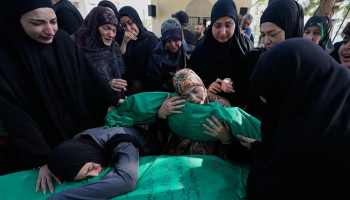
Since the Israeli aggression began, more than 2,600 people, mainly women and children, in Lebanon have been killed by Israeli strikes, according to the country’s Health Ministry. The casualties include journalists and healthcare workers, while key infrastructure, such as bridges and fuel stations, has also been heavily damaged. Over one million people have been forcibly displaced.
The Israeli aggression has continued despite a ceasefire mediated by the United States, which has been extended through mid-May.
Legal concerns over civilian infrastructure
Legal specialists and human rights advocates argue that attacks on civilian infrastructure may constitute war crimes. They have also raised alarms about Israeli officials’ stated intention to replicate Gaza-style tactics in Lebanon, citing the scale of destruction and civilian casualties seen there.
“Deliberately and extensively destroying civilian objects or property, absent any military justification for wanton destruction, is a war crime,” said Ramzi Kaiss, the Lebanon researcher at Human Rights Watch.
Controversial incident involving solar infrastructure
A video verified by The New York Times showed an excavator destroying solar panels near the village of Debl in late April. According to Lebanon’s state news agency, these panels provided electricity and powered a local water station.
The Israeli forces acknowledged the assault.
Large portions of southern Lebanon had already suffered extensive damage during the 2024 Israeli aggression. Amnesty International reported that over 10,000 structures, including homes, mosques, and parks, were damaged or destroyed across at least 26 municipalities.
Current satellite imagery suggests that the level of destruction has since intensified, with fresh debris covering vast areas.
“Our home was the fruit of our lives’ work,” said Fatima Abdallah, 46, a mother of five from Houla, now living in a tent in Beirut. Satellite images indicate her town has been heavily impacted, and her home, built with her husband over two decades, has been destroyed.
Footage shows Israeli forces employing tactics similar to those used in Gaza, including systematic demolitions. In these operations, soldiers enter buildings to place explosives before detonating them from a safe distance.
Barbara Marcolini, a visual investigator with Amnesty International, explained that such blasts send clouds of dust and debris into the air, leaving entire streets resembling barren landscapes of shattered concrete and white rubble.
Additional visual evidence, including images captured from the side of the occupied Palestinian territories, shows bulldozers and excavators carrying out demolitions in already heavily damaged zones.
Experts say these atrocities reflect a broader strategy previously observed in Gaza, where extensive destruction rendered large areas unlivable and hindered forcibly displaced residents from returning.
“This is basically the same pattern that we documented back in Gaza, then in southern Lebanon. And now it’s southern Lebanon again,” Marcolini told The New York Times. “It is a strategy that they have, and they have been doing this consistently throughout the region.”
Source:Websites