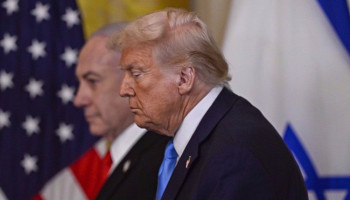

Two new polls of US voters indicate declining public support for "Israel" and emerging divisions within the Republican Party over President Donald Trump’s approach to the issue. The findings suggest that Israeli policy is becoming a growing point of political debate not only between parties, but also within Republican voter groups, Forward reported.
A New York Times/Siena poll found that 38% of potential Republican voters want the next Republican presidential candidate to take a "new direction" on "Israel", rather than continue following Trump’s approach.
The same poll found that nearly one-third of Republican voters believe Trump has been "too supportive" of "Israel", based on a survey of 1,500 US voters conducted this month, with a margin of error of 2.8 percentage points. The results suggest increasing internal debate within the Republican electorate over foreign policy priorities.
The poll findings also indicate that "Israel" is emerging as a dividing issue within both major US political coalitions. While traditionally less publicly divisive among Republicans, the issue now appears to be gaining traction as a point of disagreement alongside long-standing divisions on the left.
MAGA vs. non-MAGA Republicans split on 'Israel' support
A separate poll conducted by Politico in partnership with Public First found notable differences between MAGA-aligned and non-MAGA Republican voters.
Just over half of Trump voters identify with the MAGA movement, according to the survey of 2,035 US adults conducted online from April 11–14.
Key findings include:
- Nearly 50% of MAGA Trump voters support “Israel” and approve of its government’s actions;
- 29% of non-MAGA Trump voters express the same view;
- 41% of MAGA voters believe "Israel" is justified in its Gaza war, compared to 31% of non-MAGA voters;
- Opinions also differ on Israeli influence in US foreign policy and AIPAC’s role in elections.
These results point to a widening ideological gap within Trump’s voter base.
The New York Times/Siena poll also found that Trump’s overall approval rating stands at 37%.
On foreign policy, 64% of US voters said they believed Trump made the wrong decision in entering the Iran war, while 70% of Republicans said they supported his decision.
The same New York Times–Siena poll found that 57% of Democrats now sympathize more with Palestinians than with "Israel", compared to only 19% who sympathize more with "Israel". This marks a clear divergence in sentiment within the Democratic electorate.
A separate Pew Research Center survey conducted in March found that 80% of Democrats and Democratic-leaning independents hold an unfavorable view of "Israel". The data reinforce a broader trend of declining favorability and increasing criticism among Democratic-leaning voters.
Taken together, these surveys indicate a measurable shift in US public opinion, particularly among Democrats, toward reduced support for aid to "Israel", increased sympathy for Palestinians, and growing unfavorable views of "Israel" over time.
Growing divide in US Congress over 'Israel' funding
On a related note, Axios reported last month that support for "Israel" among Democrats in the US Congress deteriorated, with an increasing number of lawmakers openly opposing continued military aid, including funding for air defense systems, such as the Iron Dome.
According to the report, positions that were once considered politically marginal within the Democratic Party are now becoming increasingly mainstream, reflecting a broader shift in attitudes on Capitol Hill.
Several Democratic representatives told Axios they no longer support additional US military aid to "Israel", citing concerns over accountability and the direction of Israeli policy under Israeli Prime Minister Benjamin Netanyahu.
Rep. Jim McGovern (D-Mass.) said he "cannot support more military assistance," noting that although he previously backed Iron Dome funding. In turn, Rep. Jared Huffman (D-Calif.) said opposition to such funding is no longer unusual within the party, arguing that it reflects growing acceptance of critical views toward US policy.
Source:Websites