Numbers alone cannot encapsulate the tragedy of a nation, but they sometimes serve as the sole witness when the world fails to look into the eyes of the victims—because the perpetrator is Saudi, gorged on oil, and American, dominating international decision-making.
In a press conference held by the "Eye Humanity Center for Rights and Development" in Sanaa under the slogan "Continuous Aggression and Blockade," the curtain was raised on a human rights report acting as a document chronicling a systematic destruction that has targeted Yemen’s land and people in a war entering its twelfth year with no end in sight.
The report—the summary of relentless monitoring and documentation—presents figures and translates them into the stories of millions of human beings who lost their loved ones, livelihoods, health, and dreams, painting a complete picture of a country subjected to the most heinous aggression in modern history.
The Economy: A Lifeline Deliberately Severed
War is not limited to the sound of cannons and airstrikes; there is another, more dangerous war waged in silence, targeting the breath of the economy to claim people's lives away from the noise of battles. The report documents how aggression and the blockade turned into a tool for the systematic destruction of the entire Yemeni economic infrastructure—from factories and commercial facilities to ports, airports, transport, energy, and communications networks, and even oil and gas resources that were once a hope for the nation's renaissance.
The figures in this aspect are staggering in their magnitude, but most dangerously, they represent dried-up livelihoods, darkened homes, and starving children. Losses incurred by the agricultural and livestock sector (the backbone of millions of rural families' livelihoods) due to the Saudi-American aggression exceeded $111.2 billion, while the fisheries sector (the haven for coastal residents) lost over $12.6 billion. The transport sector, connecting the country's arteries, saw losses reaching $13.6 billion, whereas the electricity sector (the lifeblood of daily life, hospitals, and schools) suffered heavy losses amounting to $23.7 billion. The telecommunications sector was not spared either, with losses exceeding $6.7 billion up until 2022, further isolating Yemenis from the world at a time when they desperately needed their voices heard.
As for the industrial and private sectors, the Saudi-American enemy intentionally destroyed them completely, with losses reaching around $75 billion for each, while the oil and gas sector (the wealth of future generations) lost over $57 billion. Added to this are direct and indirect losses exceeding $123 billion according to official estimates, alongside looted oil and gas revenues that were supposed to fund public sector salaries, medicine for the sick, and notebooks for school children.
These astronomical figures did not remain confined to accounting ledgers; they leaked into basic livelihoods, translating into collapsed public revenues with losses reaching nearly 8 trillion riyals (equivalent to $30 billion), and a gross domestic product (GDP) that lost 59.4 trillion riyals (around $276.5 billion). The direct outcome: poverty affecting over 85% of the population, and unemployment soaring among the hardest-hit groups to over 90%, alongside the halting of hundreds of development projects and the disruption of dozens of engineering firms and thousands of their workers—summarizing a whole country's transformation from the ambition of building to the struggle for survival, for no reason other than satisfying a Saudi-American criminal instinct.
Meanwhile, financial and banking measures, which began with the transfer of the Central Bank, constituted another painful chapter of the economic war. Foreign reserves were frozen, depriving the economy of financing essential imports, unleashing foreign currency speculation, and plunging the general budget into a dark deficit. The banking sector sank into a suffocating crisis due to the halt of oil and gas exports and the dwindling of financial transfers and foreign grants. The picture was completed by widening exchange rate gaps, rising customs tariffs, printing large amounts of currency without economic backing, and financial transfer commissions between provinces soaring to over 150%—an indicator that the Yemeni has become a stranger in his own homeland even when transferring what little money he has left.
Victims: When Death Takes Faces, Names, and Young Ages
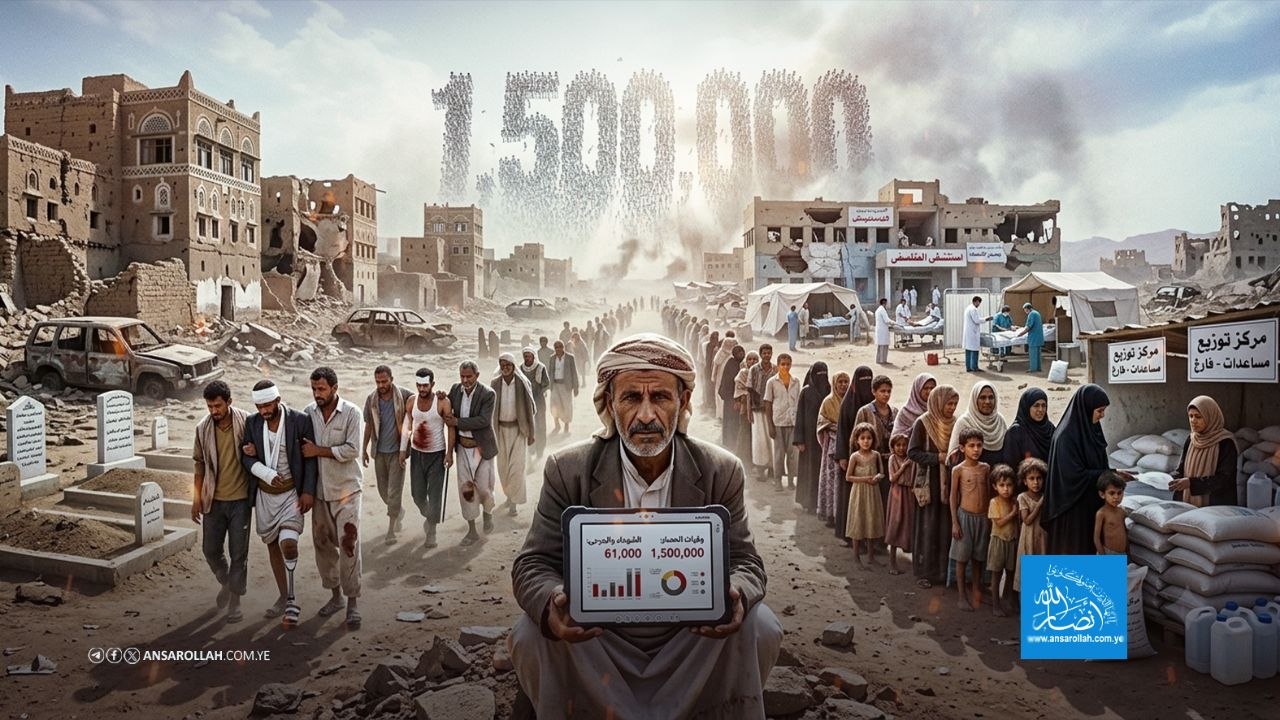
However grim the economic figures may be, they pale in comparison when approaching the human toll, where statistics turn into faces of children who had dreams, women who raised generations, and men who supported families. The report presents a terrifying total: over 61,000 civilians fallen by Saudi-American fire, including more than 24,700 martyrs and 36,200 wounded, bearing the pains of war in their bodies and souls. Within these bleak numbers, the wounded faces of childhood and womanhood stand out, as 4,365 children and 2,653 women were martyred during the years of American-Saudi aggression.
If this is the tally of direct death, slow and silent death was far more brutal. The report documents more than 1.5 million indirect deaths up to March 2026—deaths that did not occur under direct Saudi bombardment, but in hospital beds empty of medicine and in the huts of the hungry who found nothing to satisfy their children's hunger. Among these, the report records nearly 835,000 children who died silently—victims of malnutrition, chronic diseases, and the collapse of health services—children who knew nothing of life beyond its first breaths before leaving it prior to learning how to pronounce the names of things. This is how the Saudi enemy perfected its crafting of the Yemeni scene.
There is another face to the tragedy: patients trapped between life and death. Over 120,000 patients died simply because they could not travel abroad for treatment in a country where the Saudi enemy closed off air, land, and sea ports, turning the needs of patients into a journey fraught with impossibilities. Meanwhile, 1.2 million patients are still waiting for a miracle to travel abroad, counting down days as their bodies deteriorate—hostages to the geography of death.
In another corner of this complex tragedy, the report addresses the suffering of 2.9 million malnourished children, with around 400,000 children under five dying due to severe acute malnutrition. Those who were supposed to represent Yemen's future were buried in small mass graves because their bodies could not endure the absence of milk and medicine. The suffering extends to 5.5 million pregnant and lactating women suffering from malnutrition, in a vicious cycle where exhausted mothers give birth to children carrying the legacy of hunger from the very first moment. The report recorded 350,000 miscarriages and more than 22,000 fetal malformations. Thus, the Saudi-American enemy wiped out both crops and progeny in the Yemen of faith.

Health Sector: Collapse Where Need Is Dire
In times of war, hospitals are the last sanctuary for life, but in Yemen—due to Saudi-American criminality—they became part of the destroyed landscape. The report reveals that more than 1,500 hospitals and health facilities were damaged or forced out of service, including kidney dialysis centers and blood banks that form the last line of defense for thousands of lives. Today, only about 45% of health facilities operate at a minimal level of service, while 55% have completely ceased operations, as if the entire country has turned into a broken intensive care unit.
In this catastrophic reality, chronic disease patients face a tragic fate; the lives of over 40,000 thalassemia patients and 5,000 kidney failure patients are threatened at every moment—not because of their illnesses, but because their medicines are missing and dialysis machines are silent. While these diseases claim lives quietly, epidemics returned to sweep across Yemen as a heavy guest of death, with over 22,700 suspected cases of epidemic diseases recorded, resulting in more than 11,000 deaths.
The Search for a Livelihood
Food security stands at the heart of the humanitarian tragedy created by the American-Saudi aggression coalition in Yemen. The report issued by the Eye Humanity Center documents that more than 24 million Yemenis suffer from food insecurity—nearly three-quarters of the population—including 13.4 million in severe need of food, while 20.6 million people require urgent food assistance. In some areas, famine has reached advanced stages where residents have resorted to eating tree leaves and sharing dry crusts of bread. In the background, destroyed agricultural fields tell a parallel story: hundreds of thousands of farms were damaged, grain production fell by nearly 60%, and the production of coffee and honey—once symbols of Yemeni quality—declined, while vast agricultural areas became contaminated with landmines and ordnance, robbing the land of its fertility and the people of their right to farm.
The ruin extends to the sea, where report pages document the grounding of over 4,500 fishing boats, depriving more than 50,000 fishermen of their income source inherited across generations. Meanwhile, the marine environment was polluted, ports were damaged, and most workers lost their jobs, transforming fishermen from producers to needy individuals.
Water and Education: The Right to Life and Knowledge Under Siege
In a country battered by the schemes of Saudi-American hatred, water becomes a distant dream. Over 20.5 million people need water and environmental sanitation services, with water networks and tanks damaged and need levels rising above 80%, driving women and children to walk arduous distances in search of often contaminated water vessels. This tragic reality has forced over 6 million people into displacement, leaving behind their memories, homes, and dreams to live in camps lacking the most basic elements of life.
In the education sector, the war stole the dreams of an entire generation. Over two million children dropped out of school, while 4.4 million male and female students stopped studying, carrying with them the silence of illiteracy and the noise of child labor. Since 2016, 196,197 male and female teachers are still waiting for their cut-off salaries, while hundreds of schools and university facilities turned into rubble, and the educational system failed to print textbooks—affirming the Saudi-American intent to push Yemen back into ignorance and backwardness.
Infrastructure: Saudi Persistence in Destroying Life Essentials
A reader can glimpse the map of destruction taking shape through the report's numbers: 16 airports bombed by Saudi-American enemy aviation, 17 ports destroyed, over 9,000 roads and bridges severed, 492 power stations shut down, 720 telecommunications facilities silenced, and 3,609 water facilities taken out of service. On the residential front, brutality reached its peak with the destruction or damaging of over 623,000 homes, leaving entire families out in the open. Factories were not spared (470 destroyed), nor were commercial facilities (16,798 damaged), markets (739 left empty), or food trucks, fuel stations, thousands of agricultural fields, and transport vehicles—in a systematic targeting of everything related to the daily life of the Yemeni citizen.
The Blockade: A Policy of Collective Punishment in Three Stages
The blockade imposed on Yemen by the Saudi-American enemy developed across three successive stages: beginning as a military pressure tool, turning into a systematic method targeting the economy, financial sector, and public services, before settling as a continuous policy aimed at sustaining economic and humanitarian pressure by restricting ports, trade movement, travel, and the entry of medicines and essential supplies. By this description, the blockade shifts from a war measure to a collective punishment affecting civilians in their food, medicine, and air, deliberately suffocating the daily lives of millions.
Crimes Unwaived by the Statute of Limitations
At the conclusion of this humanitarian record, the "Eye Humanity Center" stresses that crimes resulting from the war and blockade are war crimes and crimes against humanity that do not lapse with the statute of limitations, demanding legal accountability for all perpetrators. The Center holds the international community, the US administration, and coalition countries responsible for the repercussions of the blockade, calling on media outlets and human rights organizations to intensify efforts to document violations and highlight their humanitarian and economic impacts.
These figures and testimonies remain as witness to a tragedy that affected all segments of the Yemeni people. The Saudi-American enemy committed all these crimes without a deterrent, and throughout 12 years, neither the United Nations nor the Security Council could stop this tragedy—rather, they worked to legitimize it. But in the dictionary of the Yemeni people, these crimes will not go without response, punishment, and accountability. The Yemeni people have begun actual and serious action to extract their rights from the hands of the executioner, initiating military operations along a long path whose first steps are breaking the blockade imposed on the country by imposing a naval and air blockade on the Saudi enemy, and executing military operations against its oil and vital facilities. At the same time, the Yemeni people send a message to all UN organizations and bodies to maintain their stance of silence; if they wish to continue supporting the aggressors against Yemen, that is their usual business and behavior throughout their history, but they must realize that no one in this world can prevent the Yemeni people from securing their full, undiminished rights.