Ansar Allah website - Report -16 Rabi' al-Thani 1448 AH
As field developments escalate and military statements by the Armed Forces continue to follow one another, the latest of which involved a large-scale preemptive operation using dozens of ballistic missiles and drones targeting command and control rooms, weapons depots, and positions of the Sixth Emergency Division in Al-Tuwal, as well as launch platforms at Al-Daghareer Camp and other positions in Jizan, alongside strikes on sensitive targets in the enemy’s capital, “Riyadh,” and Aramco in “Yanbu,” Saudi Arabia is entering a phase of slow exhaustion. This places it before highly complex military, economic, and political consequences at a time when its room for maneuver is steadily narrowing and the effectiveness of international and regional protection umbrellas is receding.
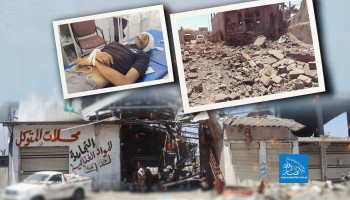
This conclusion is shared by many observers at the international level, while Riyadh attempts to absorb the effects of this reality without being forced to concede that it may have lost the battle. In parallel, it continues to escalate its aggressive conduct and launch daily airstrikes, which have reached 1,059 airstrikes since the beginning of the escalation through Saturday, using F-15 and Typhoon aircraft as well as missiles, targeting the governorates of Marib, Saada, Hudaydah, Taiz, Al-Jawf, and Al-Bayda. These attacks have left martyrs and wounded, including women and children, and caused extensive damage to civilian infrastructure.
However, this tactic appears to offer no prospect of an end on the terms of the Saudi-American calculations. This is due to the flexibility of the national side’s field response and its operational development, which have enabled it to absorb those strikes and turn them into a greater impetus to test its capabilities and wide-range, high-precision deterrence systems. Accordingly, the equation is no longer assessed through the extent of the damage caused by airstrikes on the Yemeni governorates, but rather through the ability to make a tangible difference by neutralizing their impact and reaching, through counterstrikes and retaliatory attacks, the vital facilities and military concentrations that represent the backbone of the Saudi state.
Operational Paralysis and Exposure on the Ground
The Armed Forces’ continued execution of preemptive strikes against Riyadh’s military buildups confirms its complete control over the situation. This goes beyond responding to the Saudi enemy’s ongoing airstrikes on the Yemeni governorates, taking its place as a tactic aimed at dismantling and paralyzing its ability to mobilize or rebuild offensive lines and imposing a state of comprehensive exposure on the ground.
In this context, the strike on Al-Tuwal and Al-Daghareer Camp came with profound military dimensions that outline the features of the next phase. The sensitive strike targeting command-and-control centers, operations rooms, weapons depots, and military concentrations through combined attacks involving ballistic missiles and drones, which resulted in the deaths and injuries of hundreds among the enemy’s military buildups, including Yemenis and Sudanese, as well as dozens of Saudi officers and personnel, and the destruction and burning of a number of weapons depots, undoubtedly pushes its forces into a state of confusion and complicates their ability to carry out any offensive plans or even maintain defensive cohesion.
This operational paralysis leaves the enemy’s forward defensive lines exposed to more painful strikes and transforms the military presence in those areas from a pressure card into an increasing logistical and security burden.
According to military doctrine, continued airstrikes against infrastructure and civilian areas in Yemen completely lose their military value when they are answered with accurate strikes targeting the artery of the Saudi economy and decision-making centers. They also reinforce the equation of imposing confusion on the Saudi scene and enforcing “siege for siege” and “escalation for escalation” until the aggression is halted and the siege is lifted.
Striking the Depth and the Collapse of the Bet
There is also no doubt that the Armed Forces’ move toward this development by striking the Saudi depth through attacks on Riyadh and Aramco in Yanbu requires the authorities in Riyadh to look at these operations with awareness and responsibility and pause for a comprehensive review of their vision and calculations regarding the futile campaign of aggression they are waging against the Yemeni people.
The ambition to build a new economic model based on attracting investment and transforming the region into a global center for trade and tourism cannot be reconciled with a fragile security reality in which ballistic missiles and drones fly over the capital of the state and its oil and maritime facilities. This requires Riyadh to fulfill the prerequisites for creating an environment in which such ambitions can move forward—above all, sustainable stability and security. Any disruption means driving foreign capital toward hesitation or flight, placing major development projects before an existential dilemma.
In addition, the maritime blockade imposed by the Yemeni Armed Forces has emerged as a decisive element in this confrontation, amid a complete inability to bring it to an end. Developments have demonstrated, through the expansion of the prohibition map, that the umbrella of military alliances and the accompanying airstrikes cannot protect waterways or secure the movement of supplies unless the direct roots of the war are addressed.
Moreover, this international inability to protect ships that are partners of or linked to Saudi Arabia sends a clear message to Riyadh that relying on external protection is no longer effective. Added to this is the fact that this international failure leaves Saudi Arabia in a state of strategic retreat after its traditional partners recognized the enormous costs of direct involvement in confronting Yemen and chose to distance themselves from an open-ended war that offers no guaranteed military horizon, particularly as the experience of the battle has given Yemen an advantage and tipped the balance in its confrontation with the colonial powers that insist on keeping the region in a state of sustained tension because of their continuing ambitions.
Political Predicament and No Negotiating Leverage
These field developments, with their growing impact, undoubtedly place the Saudi leadership in a severe political and economic predicament. Betting on time to absorb the shocks only deepens the predicament and gives the Yemeni Armed Forces greater space to consolidate more painful rules of engagement and develop the range and effectiveness of their weapons.
This is not remedied by the continuation of daily airstrikes on facilities and civilians in Yemen, which provide Riyadh with no field gains so much as they give Yemen’s military operations clear legitimacy and growing momentum to expand the scope of targeting to include vital projects.
On the diplomatic and negotiating fronts, this predicament is evident in the conflicting options available to decision-makers in Riyadh. On the one hand, officials understand that continuing the war entails a continuous drain on the economy and national security. On the other hand, ending it requires substantial concessions relating to halting the aggression, lifting the siege, reconstruction, and compensation.
This hesitation in making a decisive political decision means greater Yemeni determination to impose a new reality through the battlefield, causing Riyadh’s negotiating value to decline with every new strike targeting its depth.
Nor should it be absent from the calculations, based on the course of events, that the Yemeni presence has transformed into a factor shaping the sovereign and security reality in the region. Possessing the initiative on the ground and implementing the equation of “escalation for escalation” confirms that the old deterrence equations have come to an end irreversibly, and that speaking of stability in the waterways or security for economic facilities deep inside Saudi Arabia now requires an explicit acknowledgment of the new balances.
Imposing a Comprehensive Deterrence Equation
Saudi Arabia has gone to extremes in adhering to traditional concepts of confrontation and warfare, relying on the possession of advanced and high-cost weapons. Yet this has proven incapable of confronting unconventional strategies based on will, field adaptability, and geographical control.
This has reached its peak today and is now placing Saudi Arabia under mounting pressures of exposure and risks threatening its future. This requires it to move from a doctrine of dictates to a doctrine of acknowledging its inability to change the reality and searching for fundamental solutions that guarantee everyone’s interests on the basis of equality and sovereignty.
In their analyses, observers affirm that the successive Yemeni military operations, including the imposition of a blockade on Saudi maritime traffic, demonstrate that the ability to create an impact and deliver strikes at the appropriate time and place has become the actual determinant of the course of this confrontation. Betting on international cover or sheer air superiority is no longer sufficient to protect strategic interests in the face of a field-based will possessing the vision and capability to impose and execute its choices.
The ongoing transformation in the nature of the battle imposes the reality that the maritime blockade, striking vital arteries deep inside the country, and shelling command centers and military buildups along the border have now, collectively, become the pillars of an integrated Yemeni deterrence equation.
No regional or international power will be able to strip Yemen of these cards except through what Yemen itself has defined: meeting all the requirements for genuine stability—ending the aggression, fully lifting the siege, and recognizing Yemen’s influential presence as a key actor in shaping the security and stability of the region.