What drives the Saudi regime, in a repeated and more brutal version of its barbaric aggression against Yemen, to revive the folly of deadly airstrikes on civilians and civilian objects? The din of airstrikes grows louder by the day, while the toll of martyrs and wounded rises in an endless sequence of bloodshed. What accumulated in Riyadh’s stockpiles during the years of the alleged “de-escalation” of instruments of death has now returned to continue its policy of killing and destruction and to eliminate what remains of life, after eight continuous years of bombardment and unjust siege.
In military convention and the laws governing confrontation—and even in the most basic notions of chivalry and the human conscience—there is not an ounce of courage or any display of strength in targeting a school sheltering children, a market crowded with innocent people, or a communications tower. Rather, it is military bankruptcy in its most striking form, and the complex of shame when it is transformed into tyranny that takes pleasure in the ruins of walls and the blood of innocents.
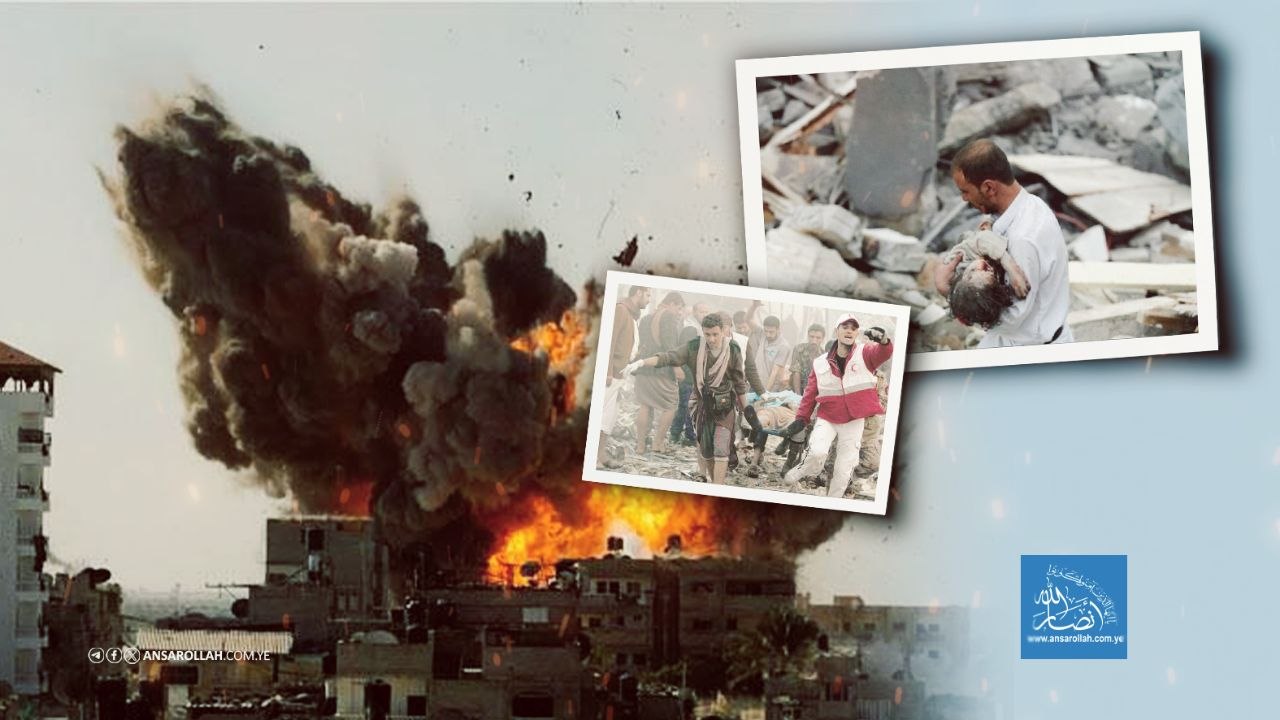
Mounting field evidence confirms that the current wave of hysteria is completely devoid of any military objective. The hell of bombardment has been directed—clearly and deliberately—toward homes, schools, markets, and various civilian objects, in an explicit trampling of international humanitarian law and, before that, a blatant assault on Islamic and moral values that prohibit the targeting of non-combatants. It is the same bloody spectacle that exposes the aggressive conduct of the Saudi regime against the people of Yemen.
Killing Civilians Does Not Conceal the Shame of Failure
This confusion, and the mad movement of bombs and missiles from one province to another, reflects nothing but a futile insistence on the same strategy based on excessive bloodshed and destruction. Looking back at the conclusions of international assessments and studies of Riyadh’s performance in this war, it becomes abundantly clear that it stands completely exposed, as developments have demonstrated its absolute field incapacity to make any strategic difference or to bend the course of the battle. The brutality inflicted upon civilians has therefore become merely a “compensatory alternative” to conceal the state of defeat suffocating the Saudi regime.
The attacks have recently reached their peak of escalation, to the point that observers have come to read this empty persistence in killing without any military gain as a state of extreme inability to devise any new scenario for the aggression, an escape from acknowledging reality, and from the fact that the false aura surrounding a regime that has long presented itself as the most formidable regional power through displays of its enormous modern arsenal has fallen.
Yet the dust of missiles will not conceal the shame of failure, and the rubble of demolished homes will not manufacture victory for an army that substitutes battlefield coercion with the blood of children and women. The will of peoples cannot be buried beneath the rubble, and the costs of this tyranny will inevitably accumulate until they reach their inevitable reckoning.
Confused Calculations and Exposed Options
According to the field data, what Saudi Arabia is accumulating is nothing but disappointments and the depletion of capabilities, not to mention the enormous humanitarian cost in the blood of children, women, and innocent civilians. Riyadh is racing against time today as it finds itself in a complex predicament. The siege and pressure on its maritime shipping, along with the continuing bleeding that has struck its economic artery, “Aramco,” as a result of direct strikes by Yemeni missiles and drones, now threaten a sharp downturn in its economy and the erosion of the excessive prosperity it has long boasted about.
Riyadh is attempting to turn back the clock to the period before the stages of de-escalation, when it enjoyed a state of euphoria and received international support and cover whenever it intensified its strikes on Yemen. Today, as it faces its predicament alone, it is seeking, through an arsenal of American and Western weapons, to reimpose the “deterrence equation” through excessive force by expanding the scope of airstrikes and intensifying bombardment of civilian objects and infrastructure across various provinces, particularly in Taiz Province, where Mokha and Bab al-Mandab are located.
Yet this insistence on continuing the same pace and methodology of aggression and siege no longer provides any military or political gains, as much as it deepens Saudi Arabia’s strategic failure in the face of the Yemeni people’s resilience and their growing military capabilities. The bet on intensifying airstrikes and targeting civilians will not redraw the battlefield rules in Saudi Arabia’s favor. Rather, it will be met by a stronger Yemeni drive to build new deterrence equations capable of thwarting all aggression plans and compelling its leadership to submit to the legitimate national demands of the Yemeni people.
Comprehensive Targeting and Battlefield Inability
The targeting map encompassed the provinces of Saada, Hudaydah, Ma’rib, Al-Jawf, Hajjah, Sana’a, the capital district, Amran, and Taiz. This geographical breadth, extending from the far north to the western coast and the central regions, demonstrates that the Saudi air campaign—as usual—is incapable of identifying military lines of contact or direct confrontation fronts, and instead turns to killing women, children, and unarmed civilians.
The manifestation of this inability extends to service facilities, residential communities, communications networks and towers, economic activities, and citizens’ sources of livelihood, within a systematic pattern of conduct that it has followed since March 2015 and which aims to multiply the humanitarian suffering and bring the foundations of the Yemeni people’s daily life to a complete standstill.
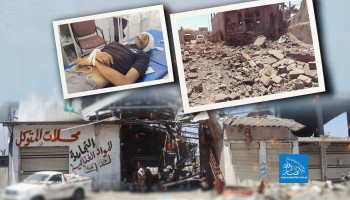
Within this field context, its latest crimes in Taiz came as a direct continuation of a series of ongoing attacks that had previously struck the rest of the free provinces. In Taiz, the Saudi enemy’s aircraft launched a direct airstrike on the “Mafraq Mawiyah” commercial market, crowded with civilians, traders, and visitors. Because the target was purely civilian, the purpose of targeting it was nothing other than to inflict the greatest possible human losses among civilians, terrorize those frequenting markets and civilian objects, and destroy their sources of livelihood.
The result was a horrific massacre that left 50 citizens dead or wounded—seven martyrs and more than 40 wounded. This represented a blatant assault on a vital economic artery upon which thousands of citizens depend for their daily livelihoods, whether through trade or shopping.
Only hours later, Saudi aircraft again targeted residential homes in the Al-Ma’afer District of the same province, carrying out an airstrike on the home of a peaceful civilian that resulted in the martyrdom of three women and an elderly man and the wounding of three others. This coincided with the renewed targeting of Al-Rawdah School in the Al-Rubai’i area of Al-Ta’iziyah District for the third time, resulting in the complete destruction of what remained of its infrastructure after it had previously sustained partial damage in an earlier bombardment.
In addition, the enemy’s airstrikes struck Amran Province, injuring three citizens to varying degrees, alongside a series of intensive strikes that have continued since September 3 and targeted communications networks and service facilities in Saada, Hajjah, Hudaydah, Ma’rib, and Al-Jawf.
Methodology of Destruction and International Complicity
This deliberate repetition in the bombardment of civilian objects, crowded markets, homes, and facilities that had previously been destroyed completely rules out the hypothesis of technical errors or accidental incidents. Assessments issued by rights bodies and official institutions—including the Ministries of Education and the Economy and Industry, the Eye of Humanity Center, and Intisaf Organization for Women and Child Rights—confirm the existence of a systematic and calculated targeting policy aimed at destroying the education sector, paralyzing economic activity, and stripping people of the means of a dignified livelihood.
Official data from the Ministry of Education and Scientific Research reveal that over the course of twelve years, the aggression targeted more than 2,775 educational and academic facilities, with an unprecedented escalation since the beginning of September in the targeting of schools, universities, communications networks, and popular markets.
Official and human rights condemnations have placed full legal and criminal responsibility on Saudi Arabia for these crimes and the resulting deaths and destruction of property. They have also strongly criticized the complete silence of the United Nations, the Security Council, and the international community, considering it a form of political and implicit cover and an indirect partnership that encourages the aggressor to continue violating the rules of international humanitarian law, the four Geneva Conventions, and international conventions prohibiting the targeting of civilians and civilian facilities during armed conflicts.
Western Admissions of the Tactical Predicament
Nevertheless, it does not appear difficult to observe Saudi Arabia’s recognition of the tactical predicament it faces in managing the confrontation on the ground. This was clearly reflected in assessments by the retired American Army Colonel Lawrence Wilkerson, who revealed—based on his direct experience in previously training members of the Saudi and Yemeni armies—that years of intensive American arms supplies to Saudi Arabia, its reliance on F-15 fighter jets, Joint Direct Attack Munitions, intelligence support and other forms of military assistance, as well as its enormous military spending, had not given Riyadh the ability to settle the confrontation or break the military power of the Yemeni forces.
Wilkerson explained that the Yemeni fighter comes from an environment characterized by resilience, social cohesion, and high morale, and possesses military and tactical intelligence in the field as well as strategic thinking that exceeds all expectations. This makes any direct ground confrontation with them a catastrophic and impossible option for the Saudi army, which, in the American officer’s words, would be “devoured” on the battlefield.
Wilkerson also stressed that Mohammed bin Salman’s decision to enter this war was a major strategic mistake, pointing out that Saudi Arabia’s predicament is no longer confined to its inability to achieve a military victory, but has come to threaten, in the future, the stability of Saudi Arabia and its regime itself. He placed the chances of its survival in its current form at 50 percent, while stressing that Riyadh’s continued survival has become dependent on obtaining permanent external support and protection from an international military power in the face of the rise of Yemen’s defensive and offensive military capabilities and its ability to transfer the impact of the confrontation into Saudi Arabia’s own strategic depth.
The Deterrence Equation and the Accumulation of Consequences
These testimony and Western assessments intersect with the comprehensive sovereign and military vision presented by Deputy Prime Minister for Defense and Security Affairs Lieutenant General Jalal Al-Ruwaishan, who affirmed that Yemen has been waging a legitimate self-defense battle for twelve years in the face of external aggression and a comprehensive siege.
Al-Ruwaishan explained that the Saudi role in this war is a functional role serving, primarily, Western and Zionist agendas in the region. He also affirmed that the reality on the ground confirms the safety and security of commercial shipping and maritime traffic through Bab al-Mandab and the Red Sea for all countries of the world, refuting the Saudi narrative that attempts to portray Yemen as a threat to international navigation in order to incite international powers and summon foreign military interventions.
These field and political factors together confirm that expanding the scope of Saudi airstrikes, targeting civilian objects in Saada, Hudaydah, Ma’rib, Al-Jawf, Hajjah, Amran, and Sana’a, and intensifying crimes in Taiz will not achieve any battlefield victory or political gain for Riyadh. Rather, it will increase the price to be paid and provide the Yemeni people, its leadership, and its army with the full legal and legitimate cover to exercise their rightful defense of themselves and respond firmly in the geographic and economic depth of Saudi Arabia.
There is no doubt that this battlefield equation once again places the Saudi regime before the necessity of recalculating the cost of escalation and its direct impact on its internal security, economic and developmental stability, and investment projects listed under Vision 2030.
The options of continuing aggression and siege remain nothing more than an erosion of Riyadh’s future and regional standing, while the new battlefield reality lays bare a fact that remains constant: the only balanced way out lies in completely ending the aggression, lifting the comprehensive siege, responding to humanitarian and economic obligations, and dealing with Yemen as an independent and fully sovereign state and as a regional power that cannot be bypassed or subordinated.