How Did Riyadh Move from the Roadmap to Direct Military Intervention?
In December 2023, negotiations over Yemen reached understandings that included a ceasefire, the payment of public-sector employees’ salaries, the resumption of oil exports, the opening of roads, and the easing of restrictions on Sana’a Airport and Hudaydah Port, paving the way for a Yemeni political process. These provisions were not separate measures; they addressed the causes that had kept the war going despite the decline in the pace of military confrontation since 2022. Salaries and resources are linked to Yemenis’ right to an economy that works for them, while the airport and port are connected to freedom of movement and trade, and a ceasefire presupposes a transition in relations with Saudi Arabia toward a situation that goes beyond temporary de-escalation.
Riyadh was a principal party to this process by virtue of its leadership of the aggression, its role in imposing the siege, and its political and military influence over the mercenary government and the forces affiliated with it. For this reason, implementation of the roadmap was tied to its actual position on the economic files, border crossings, and ending the war.
Saudi Arabia welcomed the understandings, but the commitments remained suspended. The siege continued, salaries and resources remained subjects of dispute, and the operation of Sana’a Airport remained subject to restrictions until it was completely shut down. Riyadh gained the benefits of de-escalation, which reduced the cost of direct confrontation for it, while retaining the tools of pressure that the agreement was supposed to address.
Time itself became an element in Saudi policy based on procrastination. Every month that passed without implementing the economic provisions prolonged their impact on society and left the national authority in Sana’a facing the responsibilities of administering the state amid restricted resources and limited access points. During this period, Riyadh was able to keep talk of a settlement alive in its diplomatic contacts, while postponing the decisions that would give it practical substance. Thus, the impasse became part of conflict management, and the roadmap gradually lost its function as an entry point to ending the war, becoming instead a framework to which Saudi Arabia could return whenever it deemed that the balance of power allowed it to extract better terms.
The environment surrounding the negotiations changed after the expansion of the confrontation linked to Palestine and the Red Sea. During 2024 and 2025, Yemen was subjected to repeated U.S. and British strikes, while the confrontation with “Israel” expanded in the context of the Yemeni Armed Forces’ support for Palestine. Sana’a found itself facing powers possessing significant air and naval superiority, while Riyadh followed the development of this confrontation from the position of a party that did not bear its direct military costs. It likely calculated that the continuation of the strikes would exhaust Sana’a’s capabilities, weaken its position in the negotiations, and reduce its ability to demand the full implementation of the previous understandings.
This assessment helped explain the continued suspension of the roadmap, but it encountered limits revealed by events. Sana’a maintained its political and military capabilities throughout the years of strikes, and the external confrontation did not lead to imposing a settlement on terms favorable to Riyadh. Saudi Arabia also remained concerned about avoiding a return of large-scale operations to its territory. Accordingly, during an earlier phase, it preferred to benefit from American, British, and Israeli pressure while keeping its direct military intervention at a lower level.
The Saudi calculation was based on the expectation that external actors would weaken Sana’a and that the results of this attrition would give Riyadh an opportunity to return to negotiations from a stronger position.
At the same time, developments in the south reshaped Riyadh’s instruments inside Yemen. The confrontation with the Southern Transitional Council exposed contradictions within the camp opposed to Sana’a and the impact of Saudi-Emirati competition in shaping local forces and authorities. Following the removal of the Transitional Council leadership from its position within the authority backed by Riyadh, Saudi Arabia sought to expand its supervision over political and military decision-making in the areas under its influence and reorganize the formations that could be used against Sana’a.
The interests and disagreements of these forces remained in place, but Riyadh became more capable of directing a larger portion of their movements.
This change affected Saudi Arabia’s position toward the settlement. The roadmap—as presented at the end of 2023—envisioned a gradual transition toward addressing economic issues, ending the war, and then opening the political process. The reorganization of forces affiliated with Riyadh, however, opened another option before it: using field pressure to alter the terms of negotiation before returning to it.
The objective did not necessarily have to be achieving a comprehensive military victory. In the Saudi calculation, it was sufficient to improve the positions of its allies, engage the Yemeni Armed Forces on multiple fronts, and prevent Sana’a from consolidating a political and military reality that would strengthen its economic and sovereign demands.
This transformation continued to accumulate within an ambiguous situation: official rhetoric speaking of peace, a suspended roadmap, an ongoing siege, and expanding military preparations.
Then came the incident at Sana’a International Airport on July 13, 2026, revealing what Saudi policy had come to. An Iranian civilian aircraft was en route to Sana’a Airport on a flight that broke the restrictions imposed on Yemen’s air connection with the outside world. The runway was bombed to prevent the aircraft from landing, prompting the plane to divert to Hudaydah. Thus, a political dispute over Sana’a’s right to receive the flight was settled through the use of force against a civilian facility, the easing of restrictions on which had been one of the provisions of the previous understandings.
The strike carried a message that went beyond the Iranian aircraft and the delegation aboard it. Riyadh acted on the basis that the operation of Sana’a Airport and the national authority’s external relations remained subject to its approval, and that departing from this restriction warranted military intervention.
This was precisely the issue that Sana’a had sought to address through negotiations: the continuation of the war in the form of a siege and tutelage over access points, resources, and political decision-making. Therefore, the bombing of the runway became a sign of the transition from a dispute over implementing the roadmap to a direct confrontation over sovereignty and Yemen’s right to determine its own relations.
The choice of the airport also carried a social impact. Every strike hitting its runway affects the travel of patients, students, and stranded passengers, as well as the possibility of operating civilian flights on a stable basis. When this facility is used as a means of political pressure, society bears a broad share of the cost of the military decision.
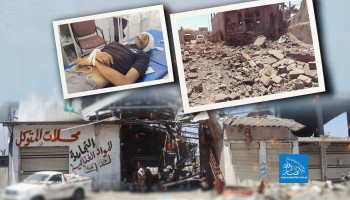
The July 13 bombing revealed an aspect of the policy that would later expand through the targeting of roads, bridges, and markets: inflicting harm on the civilian sphere in a manner that compounds the pressures imposed on the national authority in Sana’a.
After the airport bombing, Yemeni-Saudi relations gradually moved beyond the limited de-escalation that had prevailed since 2022. Airstrikes and aerial violations increased, while Saudi Arabia’s support for its affiliated forces on the fronts intensified.
With the beginning of the western-coast battles in September and the liberation of Mokha on September 10, Riyadh faced a development that affected the position of its mercenaries on the Red Sea and expanded the presence of the Yemeni Armed Forces near Bab al-Mandab. The consequences of the battle went beyond the loss of military positions; they began to affect Saudi Arabia’s ability to use the coast as a bargaining card and to keep the conflict contained within Yemen while maintaining a less visible direct role.
Riyadh responded by expanding its military intervention. It used warplanes and missile bombardment, sought to activate other fronts, and supported the formations affiliated with it in an attempt to distribute pressure on the Yemeni Armed Forces and prevent them from capitalizing on gains along the western coast.
Field-monitoring reports showed successive airstrikes launched from Saudi bases and attacks targeting multiple provinces during the second half of September. Saudi Arabia’s direct military presence had become visible in the skies and along lines of support and mobilization, while its political discourse continued to present the confrontation to the outside world as a Yemeni affair in which Riyadh was bearing the burden of defending itself and its allies. Current reporting likewise documents Saudi-backed forces and Saudi airstrikes in the southwestern campaign area during September.
Through this trajectory, the sequence of Saudi decisions becomes clear. Implementation of the roadmap was suspended while the siege and economic restrictions continued; Riyadh then awaited the impact of external aggression on Sana’a and reorganized forces linked to it in southern Yemen before using force to prevent a civilian flight from reaching Sana’a Airport.
Following developments along the western coast, its direct intervention expanded in an effort to halt changes in the balance of power and raise the cost of Sana’a’s continued choices.
The settlement remained present in Saudi diplomatic language, while military and economic measures were being used to alter the conditions upon which that settlement could be based.
Note: The second installment will address the means and manifestations of this escalation on the ground: support for Saudi-affiliated forces on the fronts; airstrikes on civilians, markets, bridges, roads, and facilities; the use of the costs imposed on society to pressure the national authority in Sana’a; and Riyadh’s campaign concerning maritime navigation and Mecca, as well as the limits of the external support it mobilized.