Ansarollah Website | Report: Anas Al-Qadi
How does Riyadh Manages the Military, Political, and Media Escalation?
The first part addressed the stalling of the roadmap, the shifting of Riyadh’s calculations following external aggression against Yemen, developments in the south, the bombing of Sana'a International Airport on July 13, 2026, and the widening of direct Saudi intervention. In the subsequent weeks, the features of this intervention became increasingly clear: consecutive airstrikes on Yemeni governorates, support for Saudi-backed forces on the frontlines, and strikes targeting civilians, facilities, and roads—accompanied by a political and media campaign aimed at presenting Riyadh abroad as the party under attack and seeking support.
The Saudi military role manifested intensively during the battles along the West Coast and the surrounding mountain heights. The liberation of Al-Mokha and the advance of the Yemeni Armed Forces near Bab al-Mandab threatened the positions of the forces sponsored by Riyadh, diminishing their ability to use the coast as a bargaining chip in any future settlement. Consequently, Saudi Arabia moved to provide air support for these forces while reactivating other fronts in Ma'rib, Al-Jawf, and Al-Bayda in an attempt to distract the Yemeni Armed Forces and stretch their efforts. It also reorganized its affiliated formations after losing positions on the coast, attempting to prevent Yemeni field gains from translating into a stable political reality.
These maneuvers illustrate the functional role of Riyadh-backed forces within its calculations. They fight inside Yemen under slogans advocating for the state and the republic, while the decisions regarding their deployment, arming, and support remain tied to direct Saudi objectives: protecting the Kingdom’s borders, securing oil exports and associated navigation, and preventing Sana'a from establishing a stronger foothold on the Red Sea and in negotiations. The participation of these forces provides Riyadh with a means to keep the conflict contained within Yemeni territory, even as Saudi aircraft and command govern the management of the escalation. Meanwhile, local communities bear the brunt of frontlines opened or reactivated to serve the Kingdom’s position in the conflict.
The intervention was not limited to the frontlines. Field monitoring data records near-daily raids by F-15 and Typhoon jets, which launched—according to statements by the spokesperson for the Yemeni Armed Forces—from Khamis Mushait and Taif airbases. These strikes targeted Taiz, Hajjah, Ma'rib, Al-Jawf, Sa'ada, Al-Hodeidah, Al-Bayda, Amran, Ibb, and Dhamar during the second half of September. The data cited mounting figures for aerial and missile bombardment, reaching 1,123 raids and missiles by the evening of September 28 since the start of the escalation. While this figure combines two types of attacks into a single total, daily data sequences illustrate the extent of Saudi Arabia’s reliance on force within a short timeframe.
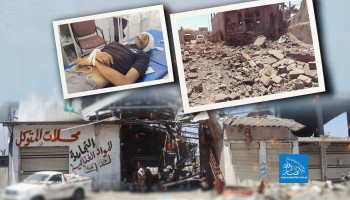
The bombardment extended beyond direct clash sites to target infrastructure critical to daily life, such as bridges, roads, schools, telecommunications networks, and civilian facilities, alongside airstrikes that caused civilian casualties and injuries.
On September 27, Mafraq Mawiyah market in Taiz was bombed, resulting in dozens of deaths and injuries according to initial tallies released that day. A market is a gathering place where people trade goods and secure daily needs; hence, the impacts of striking it do not end with the immediate victims, but extend to disrupting commercial activity and spreading fear throughout community spaces far removed from the frontlines.
The same applies to roads and bridges. A bombed bridge links villages, cities, markets, and healthcare facilities, while a damaged road increases the cost of transporting food and fuel, isolating communities from one another. As strikes on these types of structures recur, the impact of the war expands into the economy and daily life, shifting its burden onto the population. This pattern can be understood within the context of applying pressure on the national authority in Sana'a through the population under its jurisdiction; Saudi Arabia increases the operational burdens faced by the authority regarding services, transport, and civilian protection, gambling that these pressures will reflect on its political stance.
This policy raises questions regarding its actual outcomes. Inflicting harm on society may compound the economic and administrative challenges facing Sana'a, but it may also deepen the perception of Saudi Arabia as a direct threat to the lives of Yemenis. The more the effects of the bombardment appear in markets, homes, and infrastructure, the weaker Riyadh’s ability becomes to present its military intervention as support for Yemenis or a defense of their state. The pressure intended to pass through society to the authority could instead turn into a factor that increases social cohesion in opposing it. The ultimate outcome depends on the extent of the bombing, the capacity of local institutions and communities to manage its fallout, and the nature of the accompanying political discourse.
Here, the function of the Saudi media campaign becomes evident. Riyadh sought to shift the focus of external attention toward attacks by the Yemeni Armed Forces inside its territory, and to portray developments on the West Coast as a general threat to international navigation. Through this framing, it attempts to attract nations whose interests are tied to trade and energy, encouraging them to deal with Saudi Arabia as a partner in protecting maritime corridors.
Simultaneously, this diverts attention away from the bombing of Sana'a Airport, airstrikes inside Yemen, the continuation of the blockade, and the stalling of the roadmap. Thus, the media narrative becomes an integral component of war management, determining which events receive international attention and which are marginalized.
Following this came the campaign accusing Sana'a of targeting Mecca, aimed at broadening the circle of support beyond nations directly concerned with navigation. Invoking holy sites addresses Islamic governments and societies in a language distinct from that of energy security and commerce, placing those who refrain from condemning Sana'a under political and moral pressure. Statements of condemnation and solidarity with Saudi Arabia were indeed issued; however, this support remained—thus far—at a political and media level. Mecca campaign itself did not translate into collective military participation, nor is it accurate to categorize every statement of solidarity with Riyadh as a commitment to its war. Positions varied between those who adopted the accusation, those who limited themselves to expressing solidarity, and those who called for de-escalation.
Riyadh thereby combined two distinct discourses directed at two different audiences: in front of Western powers, it prioritized navigation, energy, and regional stability; in front of the Islamic world, it raised the issue of Mecca. Both discourses converge in requesting support and framing Yemeni operations as the source of escalation, while Saudi airstrikes, the blockade, and the bombardment of civilians are pushed to the margins of the discussion. This division grants Riyadh the ability to address parties with differing interests and sensitivities, but it also reveals the difficulty of obtaining broad, actionable commitments. Solidarity with holy sites or concern over navigation does not equate to a willingness by states to bear the cost of entering a new war against Yemen.
Nevertheless, potential external support is not limited to statements. Other levels of backing have emerged, including limited British support in aerial refueling, Turkish readiness to supply weapons to Saudi Arabia, and Saudi-Pakistani military contacts that open the possibility of a Pakistani technical role. These levels vary in significance and impact: providing aerial refueling or arms enhances Saudi Arabia's capacity to sustain operations, whereas discussions of direct Pakistani participation involve decisions and arrangements that remain unclear. Riyadh is working to gradually expand its support network without having secured the broad military alliance implied by its mobilization discourse.
These efforts face limits linked to the calculations of the allies themselves. The United States and European powers are concerned with navigation and energy security, but they calculate the costs of a wider war in the Red Sea and its connection to the regional confrontation with Iran. Turkey and Pakistan can offer political stances or forms of military cooperation, while the decision to engage directly in combat remains a separate matter. Therefore, these relationships afford Saudi Arabia diplomatic backing and additional capabilities, while the primary burden of managing the land and air war continues to rest on it and its affiliated Yemeni forces.
Current Saudi behavior is shaped by these combined elements: direct intervention to support mercenaries, preventing the consolidation of Yemeni gains on the coast, extensive bombardment of civilians and infrastructure to raise the cost on society and the national authority, a media campaign shifting international debate toward maritime security and holy sites, and external outreach to secure political and military resources for escalation. These elements serve a single goal: altering the balance of power before returning to any negotiations with Sana'a. Riyadh aims to halt the threat to its oil exports and territory, restore its allies' ability to control lost positions, and then approach a settlement while retaining stronger leverage.
However, continuing down this path increases its costs for Saudi Arabia as well. Direct intervention makes its responsibility for airstrikes clearer, turning its security and economic interests into part of the battlefield, while mercenary forces struggle to offset their deficiencies merely through intensified air support. External statements may offer political cover, but they do not rebuild destroyed bridges, erase the impact of market bombings, or decide the battle on the ground. It is likely that Riyadh will continue combining escalation with external mobilization attempts in the near term, while keeping the door to negotiations open if it believes military operations have improved its position.
In the end, across both parts, the matter returns to the roadmap that remains suspended. Saudi Arabia, which had the opportunity to address economic issues and lift restrictions on ports, chose instead to wait for a shift in the balance of power and then sought to impose it by force. The longer this policy persists, the deeper the impacts of the war will etch into Yemeni society, and the wider the gulf will grow between Riyadh’s rhetoric on peace and its actions on the ground. A lasting settlement begins by addressing the root causes of the confrontation itself: ending the aggression and blockade, terminating foreign guardianship over Yemen's ports and resources, and opening the way for a political process in which Yemenis determine their own future away from external dictation. Saudi Arabia will either accept this peacefully, or the Yemenis will seize it by force.