Ansarollah Website | Report: Ali Al-Darwani
Saudi policy toward Yemen represents a blatant model of intervention that has surpassed the boundaries of normal relations between two neighboring countries, turning into a fixed strategy based on keeping Yemen subordinate to influence and stripped of its sovereign decision-making. Historical milestones spanning more than half a century reveal that this hostile approach has excluded no segment of the Yemeni people, targeting all factions, components, and various governorates without distinction, within a vision that prioritizes control and influence while rejecting the existence of a strong and independent Yemen.
From the War on the Republic to Opposing Unity
This approach manifested early on in opposing the choices of the Yemeni people in both the North and the South. Following the 1962 revolution, Riyadh prolonged the civil war by supporting royalist forces against the republican regime, before moving to hollow the republic of its substance by buying the loyalties of prominent leaders and forming what became known as the "Special Committee" to hold political decision-making hostage. Riyadh found among certain republican forces a strong willingness to make concessions and accept a pivotal Saudi role that royalist forces would not have accepted in any form; the latter saw themselves as historic equals to the Kingdom of the House of Saud and took pride in their ruling legitimacy. For this reason, Saudi Arabia preferred to strike a reconciliation with republican factions, giving rise to a hybrid formula in governance and influence dubbed by critics and analysts as "Jumhlukiyya" (a blend of republic and monarchy). Through this, the republic was stripped of its emancipatory and sovereign content, transforming into a hybrid regime governed by networks of influence managed directly and fed financially and politically through Saudi Arabia.
The matter was no different in the South, where direct military confrontation emerged following the 18-day Al-Wadeiah War in 1969 through aerial bombardment and military targeting of the newly established regime at the time. With the declaration of Yemeni unity in 1990, Saudi fears were renewed regarding the rise of a unified state possessing a strategic location, a large population, rich civilization heritage, and immense resources capable of displacing Riyadh from its regional standing. It resorted to economic pressure through the mass deportation of more than one million Yemeni workers to destabilize the nascent state, and subsequently provided financial and political support to the secession project during the summer war of 1994 to undermine the pillars of the unified state from within.
The Policy of Temporary Employment and Ousting Allies
Relations with Yemeni political factions and figures were never built on partnership or respect, relying instead on temporary utilization and abandonment as soon as the objective was met or calculations shifted. Riyadh exerted pressure to weaken Ali Abdullah Saleh despite his adherence to its political dictates, and later worked to oust him in 2011 after decades of alliance, with hostility reaching the point of bombing his residences from the air in Sana'a and Sanhan in 2015.
It subsequently stripped Abdrabbuh Mansur Hadi of his powers, forcibly deposing him in April 2022 and imposing an alternative "Leadership Council." It utilized political parties and components—such as the Socialist Party and the Islah Party—as pressure cards and balance instruments before working to curtail them. Even components that sought assistance from Riyadh were not spared from its heavy-handedness; it transitioned to confronting the "Southern Transitional Council" (STC), bombing its forces in Hadramout and Al-Mahrah, as well as its network of influence in Aden, Lahj, and Al-Dhalea to assert absolute control.
Destruction of Human Life and Infrastructure without Exception
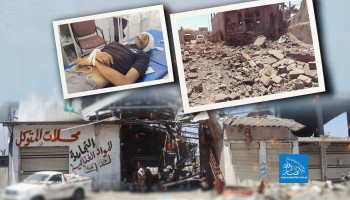
This hostility reached its peak with the launch of the comprehensive military aggression in 2015, the main objective of which was to abort the September 21 Revolution and restore Yemen to Saudi guardianship. In this war, no geography or Yemeni group was spared; aerial bombardment led to tens of thousands of deaths and injuries across various governorates, affecting all parties without exception. It targeted civilian facilities, markets, and residential neighborhoods in the Grand Hall and Faj Attan in Sana'a, the children's bus in Dhahyan in Sa'ada, Mastaba market in Hajjah, as well as Al-Hodeidah, Lahj, Taiz, and Aden. This coincided with the destruction of vital economic assets such as factories, ports, and infrastructure, the imposition of sovereign restrictions on exploration companies to prevent Yemen from exploiting its oil and gas wealth, and the bombing of Aden Airport just as Sana'a Airport, along with the destruction of Al-Hodeidah ports just like Aden ports.
Saudi Arabia: Creator of Crises and Threat to Stability in Yemen
This historical record, stained with interventions and wars, confirms a fundamental conclusion: the Kingdom of Saudi Arabia has never desired—and will never desire—the good or stability of Yemen. It treats the country as an open arena for influence and rivalries, viewing any Yemeni revival or stability as a classic threat to its regional calculations. Facts have proven that Saudi Arabia targets Yemen as an entity, identity, and people, and that an ally to Riyadh is merely a temporary tool discarded once its purpose is served. This makes building an independent and stable Yemeni state impossible without a complete separation from external hegemony and guardianship, and reliance on genuine national consensus far removed from Riyadh's ambitions, which history has proven to be—and remain—the primary creator of crises in Yemen.