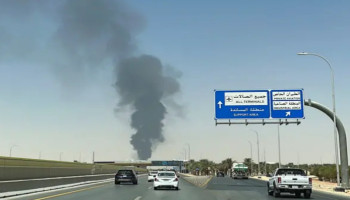
Yemen's expanding domestic weapons industry and increasingly sophisticated military capabilities have exposed major weaknesses in Saudi Arabia's US-backed defense systems, as Yemeni missile and drone operations continue to reach strategic targets deep inside the kingdom, according to an analysis published by Reuters on Thursday.
The analysis, written by John Davison on October 15, examined how Yemen's Armed Forces have developed the capability to target heavily protected Saudi installations, including Riyadh International Airport and the headquarters of Saudi oil giant Aramco, despite Riyadh's decades-long investment in advanced Western military technology.
Reuters identified several factors behind the effectiveness of Yemeni operations, including the development of indigenous weapons manufacturing, diversified supply networks, accumulated combat experience, and the depletion of American air-defense interceptors during the ongoing US-Israeli war on Iran.
The report also acknowledged that the Yemeni operations are undermining Saudi Arabia's efforts to present itself as a secure destination for foreign investment, raising questions about the kingdom's ability to protect critical infrastructure amid its continued military aggression against Yemen.
Yemen builds increasingly independent military capabilities
A central finding of the Reuters analysis concerns Yemen's growing ability to manufacture and develop its own military equipment, reducing its reliance on weapons supplied from abroad.
Although the report emphasized Iran's historical role in providing technical expertise and military assistance to Ansar Allah, experts interviewed by the agency acknowledged that Yemen has developed its own expanding base of engineers, technicians, and weapons specialists.
Andreas Krieg, a senior lecturer in security studies at King's College London, explained that the transfer of military expertise had contributed to establishing a sustainable Yemeni weapons industry.
"Tehran has not simply supplied the Houthis with weapons. It has helped create an indigenous military-industrial learning process that becomes progressively harder to dismantle, even if direct Iranian supply routes are disrupted," Krieg said.
According to the analysis, former Yemeni military engineers and a new generation of locally trained specialists have played an increasingly important role in developing missile systems and unmanned aerial vehicles.
Reuters also cited former political adviser to Iran's Islamic Revolution Guard Corps (IRGC) Hamid Nikou, who explained that technical training enabled Yemeni forces to assemble sophisticated weapons using components that could be obtained through alternative channels.
"Iran has basically taught the Houthis how to fish," Nikou said.
The findings point to a transformation in Yemen's military capabilities, with the development of local expertise making its weapons production increasingly difficult to disrupt through restrictions on foreign military supplies.
Source:Websites