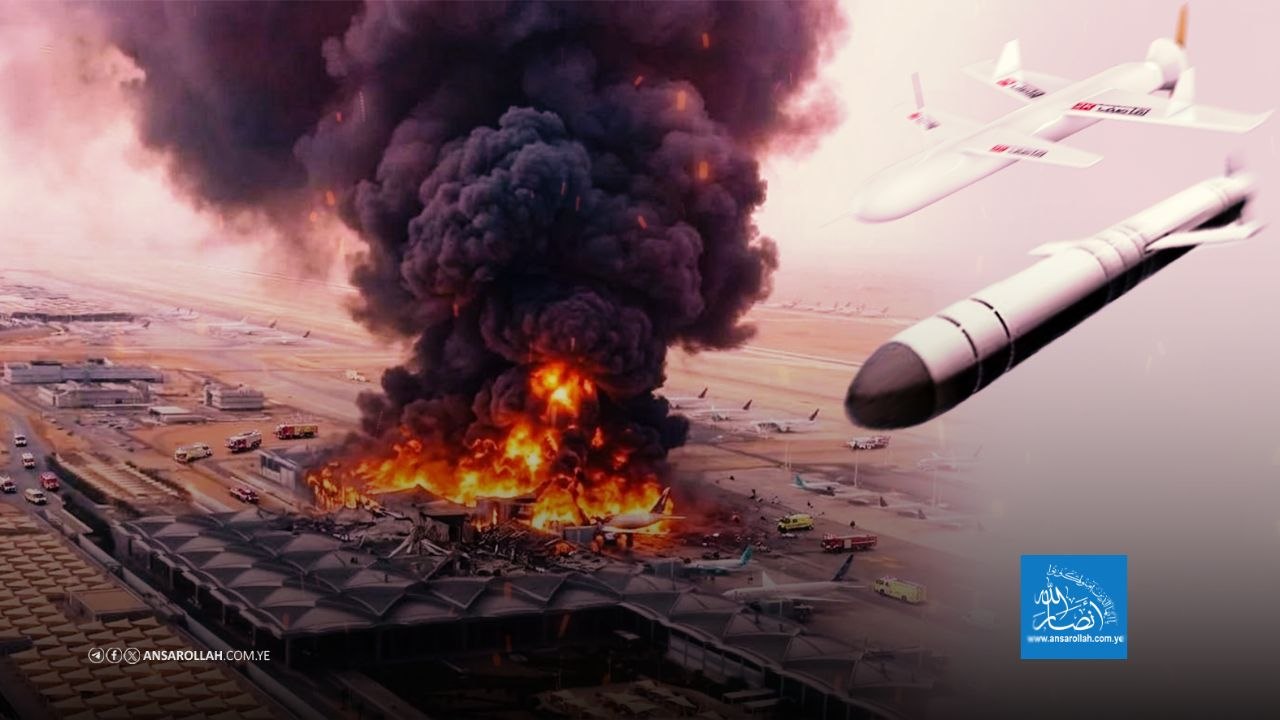
Reuters correspondent in Saudi Arabia, Timour Azhari, has revealed that many people in Saudi Arabia are now taking the road toward Dubai to avoid air travel following the Yemeni Armed Forces' qualitative operations, which led to the closure of Riyadh Airport and several other airports in the kingdom.
The correspondent noted that the Yemeni operations have damaged Saudi Arabia's status as a safe haven amid the conflict in the so-called "Middle East." In a video post, he said: "We are driving through the desert now, and I need to get to Dubai. Riyadh Airport is closed, and it turns out the shortest way is to drive to Bahrain and then fly to Dubai, accompanied by my colleague Hamad, who is driving. This is the view around us."
Azhari continued: "People are taking land routes to leave Saudi Arabia after the Houthi attacks on airports, including Riyadh Airport, Dammam Airport, and other airports in the south of the country. This is a major shift from what we saw in the early stages of the war, when Saudi Arabia became something of a haven for people fleeing Bahrain, Qatar, and Kuwait when those countries were subjected to the fiercest Iranian attacks. Now the situation has completely reversed."
He pointed out that the United States and companies are advising their citizens and employees to actually head to neighboring Gulf states and fly from there, noting that this is an indicator of the extent to which the war has reached inside the kingdom itself. He noted that travel by car takes varying times—4 to 5 hours if the trip is to Bahrain, more if traveling to Qatar and the UAE, and an additional two hours if traveling to Dubai.
Daily Life Disrupted
He explained that the war has already affected people's lives in Saudi Arabia. Schools have been relying on home education for about two weeks, and many offices in some key areas of the capital are also working from home. The events calendar, which usually sees significant activity during the autumn season in Saudi Arabia and across the Gulf—from tennis tournaments to car races, fashion week, and music festivals—has been affected. Many of these events, which had only begun to appear in the kingdom over the past 5 to 10 years, have now been canceled.
In a related context, six sources informed Reuters on Thursday that the giant Saudi oil company Aramco has asked its employees to evacuate its main headquarters in Dhahran.
The directives for employees to evacuate the building and work remotely come following a series of Yemeni operations on the kingdom, which targeted company facilities and Saudi airports. Aramco has not yet responded to a request for comment on the evacuation, which is the first of its kind according to Reuters.
Saudi Stock Market Falls
According to London Stock Exchange Group data, the main index of the Saudi market fell 2.5 percent on Thursday following the news related to Aramco. Oil prices also rose to their highest levels since May, driven by fears of escalating conflict in the Middle East and its impact on oil supplies from the region, which is a major exporter of crude worldwide.
Yemen's air blockade on Saudi Arabia and its strikes on Saudi airports, oil facilities, and military bases have disrupted air traffic, forced the cancellation of events, and raised concerns among international investors and companies.
Saudi Arabia is no longer being a safe haven marks a dramatic shift from the early stages of the conflict, when the kingdom was seen as a refuge for people fleeing instability in neighboring countries.