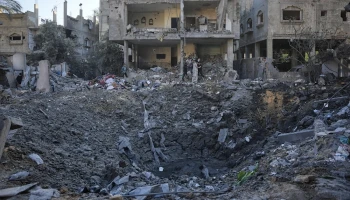

As part of their operations in defense of Lebanon amid ongoing Israeli aggression, fighters from the Hezbollah resistance movement have struck and destroyed technical devices belonging to Israeli occupation forces in southern Lebanon.
Hezbollah’s media bureau announced in a statement on Saturday that resistance fighters targeted the equipment with two kamikaze drones on the outskirts of the Jal al-Dei military post near the town of Aitaroun in Lebanon’s southern province of Nabatieh.
The statement added that Hezbollah fighters also destroyed an Israeli Merkava tank in the southeastern outskirts of the town of Yahmour al-Shaqif.
The statement added that the tank was struck and destroyed by an Ababil combat drone.
Separately, a position of Israeli occupation troops was detected and struck in the southern Lebanese city of Naqoura by two Hezbollah attack drones.
A gathering of Israeli army vehicles positioned near the town of Yahmour al-Shaqif was also targeted with artillery shells launched by Hezbollah fighters.
Furthermore, a multi-purpose Hummer military vehicle of the Israeli military was targeted by an attack drone of Hezbollah fighters in the heights of Hammamas south of the city of Khiam. A number of enemy forces were injured in the aerial operation.
A Hezbollah drone hit a military area in the Galilee region in the northern part of the Israeli-occupied territories as well.
Hezbollah’s First-Person View (FPV) drones are small, low-cost, explosive-laden “kamikaze” drones controlled by an operator wearing goggles. Their most critical feature is a physical fiber-optic cable (10–30 km long) that connects the drone to the controller.
Because this cable transmits video and commands without any wireless signal, the drones are effectively resistant to jamming by electronic warfare systems, allowing Hezbollah to bypass the Israeli military’s advanced and very expensive defense technologies.
These drones have caused significant casualties among Israeli occupation forces soldiers by accurately targeting troop gatherings, tanks, and other military assets while evading radar and heat detection.
The combination of extremely low cost and high effectiveness represents a major tactical shift for Hezbollah, moving away from sole reliance on anti-tank guided missiles while consistently inflicting losses on the occupation regime’s military.
UN Security Council slams killing of UNIFIL peacekeeper
Meanwhile, the UN Security Council on Friday condemned the killing of a Serbian peacekeeper from the UN Interim Force in Lebanon (UNIFIL), who was killed when mortar shells struck his position on June 4, with two other peacekeepers injured in the incident.
“The members of the Security Council condemned the killing of a Serbian peacekeeper from the United Nations Interim Force in Lebanon (UNIFIL) on 4 June,” the council said in a press statement.
The council expressed its deepest condolences to the families of the victims and solidarity with Serbia, while wishing a speedy recovery to those injured. It paid tribute to the dedication of all UN peacekeepers and expressed appreciation to UNIFIL’s troop-contributing countries.
The statement noted that seven UNIFIL peacekeepers have been killed in southern Lebanon since an escalation in hostilities began in early March.
Since March 2, Israel has been conducting an expanded offensive on Lebanon, killing at least 3,711 people, injuring more than 11,483 others and displacing over 1.6 million individuals.
Source: Press TV