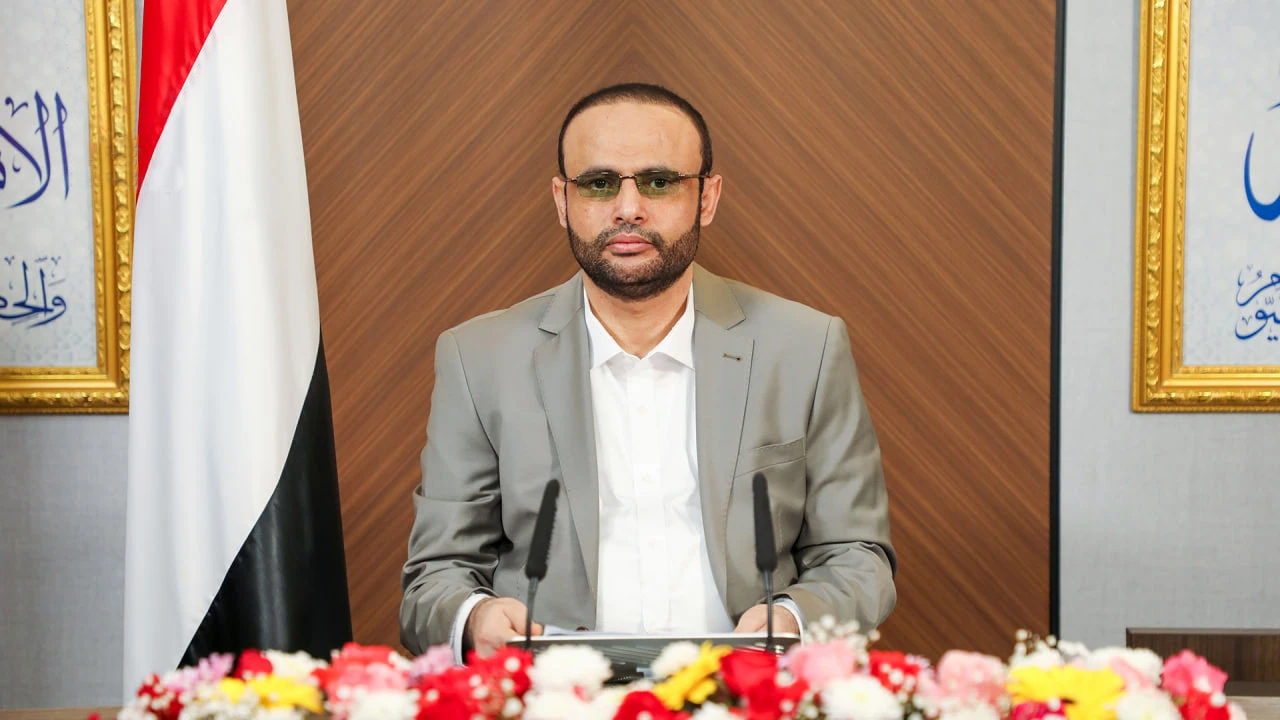
President of the Supreme Political Council, Field Marshal Mahdi Al-Mashat, affirmed that the October 14, 1963 Revolution, like all revolutions throughout history against foreign occupation, demonstrates that glory will forever belong to those who stand with their homeland and people, while shame will be the lot of those who sell themselves as mercenaries serving foreign aggressors.
In a major address delivered Tuesday evening on the 63rd anniversary of the October 14 Revolution, President Al-Mashat called on all Yemenis, particularly the descendants of the revolutionaries in the proud provinces whose people waged heroic struggles for liberation, made immense sacrifices against British occupation, and cleansed their land of its presence, to follow in their ancestors’ footsteps and rise up against what he described as the new occupation represented by the Saudi regime.
“We reaffirm to everyone that the battle uniting us today aims to end the unjust Saudi aggression and blockade imposed on our Yemeni people for 12 years, reclaim our national wealth, and expel every occupier from our land,” he said.
“We celebrate today the 63rd anniversary of the immortal October 14 Revolution, standing in reverence and admiration before a glorious chapter in our history. We proudly remember the struggles of our great people and the sacrifices of our fathers and grandfathers, who confronted the detested British occupation, its mercenaries, and its cheap proxies with determination and courage, refusing to submit to foreign tutelage or domination.”
He continued: “They endured hardship, persevered, and made immense sacrifices, offering wave after wave of martyrs and wounded until they won their freedom, expelled the British occupiers from their land, and preserved their people’s dignity. They proved that the will of peoples is stronger and more resilient than any occupying or tyrannical power.
“That is precisely the situation you face today, our Yemeni people. It is as though we are reliving the same scene from the past: just as our fathers confronted British occupation yesterday, their sons continue along the same path today, carrying the banner of October 14 and upholding its principles and values as they confront what we describe as the new occupation represented by the Saudi regime, which has waged aggression against Yemen for 12 years and seeks to occupy our land, subjugate our people, and plunder our wealth.”
President Al-Mashat warned the Saudi regime that any sensible party involved in the invasion of Yemen should have withdrawn before it was too late.
Addressing those he described as deceived individuals recruited by the Saudi regime into its mobilized forces, he said: “Just as history cast out the mercenaries of British occupation yesterday, it will inevitably cast you out today unless you come to your senses and return to the path of truth. Otherwise, history will curse you for all eternity.
“Every member of these Saudi-backed mobilizations should imagine dying while fighting to install a foreign agent as ruler of Yemen, leaving the country’s sovereignty exposed to foreign powers. That will never happen as long as Yemen has free men willing to defend it.”
President Al-Mashat said Yemen’s problem lay with what he called an illegitimate and coup-installed Saudi regime, claiming that Yemen would be in a better position were it not for this regime, which he accused of initiating the aggression and mobilizing militias to occupy and control the country.
“We are duty-bound to continue confronting it until it ends its aggression and blockade against our country,” he said, adding that Saudi mobilizations must be targeted to prevent the regime from achieving its repeatedly declared objective of occupying Yemen. “Anyone who turns against his own family, uncles, and cousins is not qualified to support legitimate governments; one who lacks something cannot give it to others.”
Al-Mashat condemned Saudi attacks on civilians and civilian infrastructure, which he said had killed women and children. He described the attacks as unrestrained crimes reflecting what he characterized as the brutality of a regime built on criminality and the killing of innocent people. He affirmed Yemen’s right to respond to these crimes in accordance with Islamic law and international law.
He also denounced what he described as the brutal execution of Yemeni Armed Forces prisoners by Saudi-backed militias on the outskirts of Dhubab district, where prisoners were allegedly shot and run over by American-made armored vehicles. He said the acts were incompatible with Islamic teachings, Yemeni values and traditions, and international conventions and laws. He held the Saudi regime fully morally and legally responsible and stressed that those responsible would not escape punishment.
The president reiterated that international shipping remained safe and that Yemen was committed to its international obligations regarding maritime navigation. He argued that the Saudi regime was threatening international shipping by turning the Bab al-Mandab Strait into a war zone, and called on the international community to condemn such actions.
Al-Mashat urged residents of what he described as occupied areas to raise their awareness and refuse to become involved in Saudi schemes, warning against allowing the country to be used as a staging ground for military mobilization or as a launchpad for aggression. He called on Yemenis to stand with the principles of the October 14 Revolution against occupation and colonialism, in honor of the sacrifices made by the revolutionaries.
He also renewed his appeal to certain Arab and Muslim governments not to allow the Saudi regime to draw them into the war against Yemen, arguing that they had nothing to gain from such involvement. He described efforts to drag them into what he called an unjust war against a fellow Arab and Muslim nation as an extension of American and Israeli efforts to target and weaken Muslim states and governments, embroil them in internal conflicts, and advance a project aimed at reshaping the Middle East and imposing Israeli hegemony over the region.