
Published: 21st of Jumada al-Akhira 1447 AH
In a spontaneous moment, one may find oneself observing the commotion of children as they leave school: quarrels, raised voices, and a rush to board buses heading home. Almost immediately, an impression forms, drawing the observer into conversation with one or more of them. It does not take long before memories of one’s own childhood begin to surface.
In an unfair comparison, the past is often granted the privilege of innocence and exceptionality. One recalls the traits that children of that era were believed to possess—greater flexibility, clearer minds, simpler behavior, and conduct that remained consistent with their age group.
Today’s child appears markedly different. Children have become bolder, more proactive, more ambitious, and more eager to acquire things. This, quite simply, is attributed to the multiplicity of choices now available to them, or rather to their ability to define specific decisions based on what their subconscious has stored from the vast amount of media they are exposed to daily, whether through children’s television channels or the abundance of content on the internet.
Turning the Problem into an Opportunity
Lingering on this issue as a dangerous problem that portends a bleak future for children, filled with injustice, is not a viable approach. A society in the third millennium—facing increasingly complex demands amid rapid scientific and technological advancements—cannot afford to treat this technological leap as a problem and then define its responses accordingly.
In essence, problems have always stemmed from the inability of educational guidance systems to balance a child’s need for play and exploration with empowering them to choose appropriate content or use technology in a beneficial way that also provides entertainment. This can include using technology to obtain images related to school subjects, expanding cognitive horizons, independently researching required topics, acquiring new information, and learning how to use modern devices such as tablets, laptops, and smartphones, while also rationalizing the use of electronic games. This responsibility squarely falls on parents, who must train children and adolescents in these practices.
Zionists Show Greater Interest
Total isolation is not possible, yet unconditional surrender to technological products—making them available without supervision, monitoring, or self-imposed and objective controls—is equally untenable. Parental supervision is essential, particularly in selecting age-appropriate games. Parental intervention becomes troubling for a child only when it takes the form of outright prohibition. Such a prohibition may result in negative consequences, such as children resorting to playing secretly or seeking opportunities outside the home with peers, thereby learning a dangerous habit: doing things in secrecy. By contrast, guiding children toward suitable games fosters trust.
It is widely understood that the major forces behind moral corruption worldwide—led by Zionists—are keen to invade societies through the digital revolution, with priority given to infiltrating the minds of children and adolescents. The aim is to shape their tendencies and orientations in ways that limit their potential to become independent, free-thinking individuals or effective actors capable of obstructing Zionist plans for global dominance.
Accordingly, institutions—whether Zionist or those aligned with the entity through shared interests—have continuously worked to develop and update these games. Their releases, including updates, have often contained numerous flaws, falling into which could lead to outcomes feared by many. This necessitates a high level of parental vigilance. Some games enable communication with strangers who may be unstable or dangerous. Others are laden with traps that begin innocently and later turn into blackmail schemes. Added to this are the psychological and physical health impacts of prolonged use of smart devices.
Experts in child and adolescent mental and behavioral health note that violent games can enhance a child’s self-confidence and help develop values if parents provide proper guidance. However, analytical and evaluative studies conclude that parental laxity in allowing unrestricted and undisciplined gameplay opens the door for those lurking behind these products to exploit opportunities to destabilize societies for long-term objectives affecting individuals, communities, and nations. These objectives have consistently revolved around religion, beliefs, morals, an individual’s relationship with their homeland and society, and undermining self-confidence. At the very least, these games are governed by the value systems of their producers.
Virtual Worlds and Unethical Signals
When discussing the potential risks of frequent and random exposure to electronic and computerized games—including violent and betting games—it becomes clear that many virtual worlds instill certain tendencies in children. These tendencies are often not hidden; they manifest clearly in behavior. Neglecting them allows them to become entrenched and grow over the years. Excessive and continuous use of such games may lead children to formulate internal frameworks shaped by these games, which eventually surface in ways inappropriate for their age group or contrary to the beliefs, values, and customs of their society.
Hidden effects are linked to a child’s psychological state. Some games contain unethical signals that vary in intensity, which undoubtedly constitute a psychological shock for children by imposing concepts they are not yet ready to process. This may generate feelings of hatred, with children imagining what they have seen or heard occurring within their family or social environment, directing hostility toward those around them. Experts have even warned that children may sometimes imitate these harmful contents, a behavior explained by their immaturity and inability to distinguish right from wrong.
Raising the Level of Parental Supervision
Safeguarding a child’s well-being and preventing them from slipping into the pitfalls of such games—especially those that alienate children from their reality and may shape a distorted culture disconnected from their land and identity—requires heightened parental supervision. This includes intervening in the selection of suitable games based on appropriate content, regulating time by allocating specific play periods, monitoring children during gameplay, and even participating with them. Such involvement builds a positive relationship and enables parents to understand the game and assess its risks.
Ensuring that children do not fall victim to schemes aimed at dilution, trivialization, or the distortion of their values and orientations necessitates continuous monitoring by parents. It also requires consistently reconnecting children with real life and preventing virtual worlds created by electronic games from dominating their impressionable minds, leading them to believe that their real world is—or should be—the same. While some games feature virtuous characters who defend justice and eliminate villains, even these should not escape parental oversight. Logic remains an issue, as these characters often bypass laws and grant themselves the authority to “correct” society without reference to legitimate legal frameworks responsible for such roles. Allowing children to fully immerse themselves in and identify with such characters—especially as they already embody them in gameplay—may push them toward blind imitation at the wrong time and place, including the misuse of weapons in ways that suggest they can become like those characters.
Consequences Emerging from Gaming Contexts
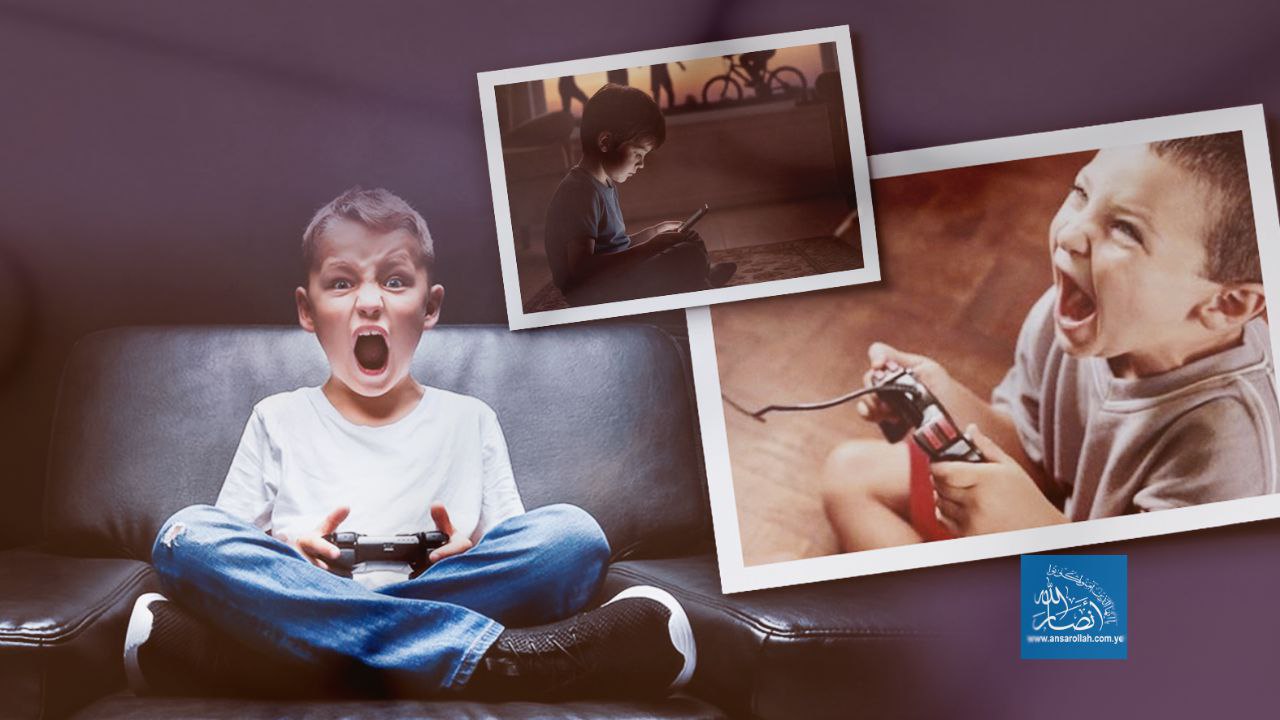
One manifestation of negative impact is a child’s tendency toward isolation and withdrawal. This often begins with solitary gameplay, which can affect personality development, intellectual growth, and the ability to communicate socially. It also increases the risk of psychological conditions such as depression, anxiety, and stress. Aggressive behavior is another outcome, as many children imitate exaggerated characters presented in games without understanding what is logical or appropriate. Verbal and physical violence emerge as expressions of aggression accumulated through repeated gaming-related shocks, such as losing, encountering technical problems, or being unable to continue playing. These experiences heighten irritability and are reflected in behavior at home, school, or among peers.
Despite studies highlighting the positive effects of these games in stimulating the brain and enhancing thinking abilities and cognitive skills, there remains the serious issue of pathological addiction. This goes beyond a simple desire to return to play, encompassing addictive disorders that make returning to gaming an urgent compulsion, similar to other forms of addiction.
In conclusion, children’s electronic games can shift from being mere recreational activities during leisure time to instruments that undermine value systems, morals, and the personalities of children and adolescents who represent the future generation, alongside detrimental effects on their mental and physical health.