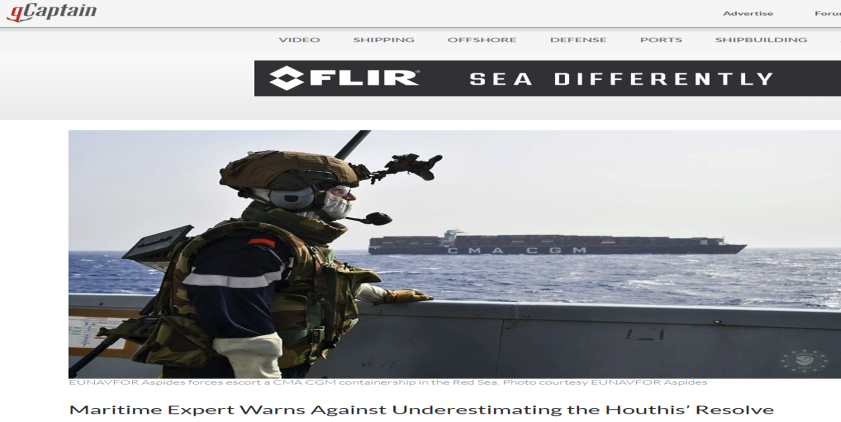
The American maritime security website gCaptain cited maritime security experts warning against underestimating the Yemenis' ability to continue threatening Saudi navigation, considering that their resolve to lift the blockade against them may be more significant than their military capabilities alone.
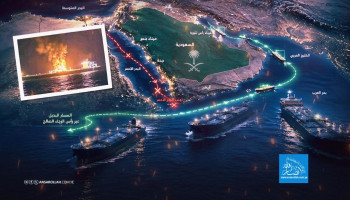
The website highlighted that an unattributed drone attack on the Egyptian Port of Damietta—despite no group claiming responsibility—has heightened fears that the scope of conflict could expand to new maritime waterways, noting that uncertainty surrounding the perpetrator adds further complexity to the regional security landscape.
gCaptain quoted maritime expert Ian Ralby, CEO of IR Consilium, stating that the crisis could rapidly evolve from threatening a single maritime choke point to multiple choke points simultaneously. He emphasized that geopolitics, military tactics, and strategy have become interconnected in a manner that renders escalation scenarios far more complex, noting that many potential possibilities were not taken into account when the war broke out.
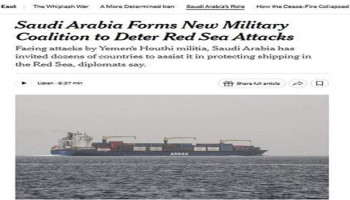
The outlet cited data from Lloyd's List Intelligence showing a 40.7% drop in oil tanker transits through the Bab al-Mandeb Strait between July 20 and July 26 compared to the previous week, alongside a 6% decline in oil tanker transits through the Suez Canal. Additionally, the data tracked vessels rerouting their courses and some switching off their Automatic Identification System (AIS) while entering Saudi ports.
Ralby stressed that focusing solely on the military capabilities of the Yemenis overlooks the most vital factor: their determination to disrupt Saudi and allied maritime commerce in order to lift the blockade imposed on them.
He reiterated that sinking a single ship could achieve a greater maritime impact than launching missiles, adding that Yemen has rebuilt its military stockpile following the 2025 U.S. campaign. He noted that it now possesses greater capabilities than before, alongside developing relationships with armed groups and networks in the Horn of Africa.