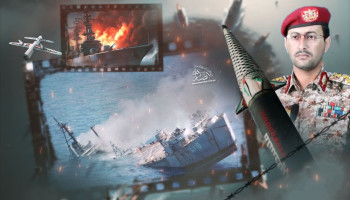

Ansarollah Website Official Report
Recent U.S. military investigations have revealed that Yemeni naval operations have exposed serious vulnerabilities within the U.S. Navy, which has suffered significant losses and demonstrated an unprecedented weakness in its combat readiness. Meanwhile, Yemeni tactics have shown clear superiority, reshaping the balance of maritime power.
The findings confirm the extent of the profound shift in military power dynamics in the Red Sea. According to exclusive official investigations, Yemeni operations against the naval coalition have so disrupted the U.S. Navy that they exposed critical gaps in its combat posture and forced it to incur substantial losses.
The report includes unprecedented strategic admissions, including factors that pushed the Pentagon to establish a new hybrid force—an explicit acknowledgment of the superiority of Yemeni tactics.
The investigations—which covered the period between December 2024 and May 2025—revealed that the carrier and its accompanying strike group had been operating “at their absolute limits” in a combat environment described by U.S. sources as “the most complex and intense since World War II.”
Over 52 consecutive days, as part of Operation Rough Rider, the strike group was subjected to repeated waves of drones, ballistic missiles, and anti-ship missiles, creating operational pressure that, according to admissions by U.S. military investigators, resulted in “chronic fatigue and sleep deprivation” among the sailors.
Senior U.S. military officials acknowledged—in a press briefing held on December 4—that “the U.S. Navy is short 18,000 sailors,” and that personnel aboard the Truman were repeatedly exposed to drone and missile fire, which produced “a state of numbness among some crew members” and a loss of “a sense of purpose in the mission.”
According to the investigation, department heads described the working conditions as “survival mode,” an implicit indication that operational effectiveness had eroded under the weight of continuous Yemeni pressure.
Friendly Fire, Technical Failures, and Leadership Breakdowns
The first incident, on December 22, 2024, exposed a catastrophic gap in coordination and training: the guided-missile cruiser USS Gettysburg (CG-64) fired two Standard Missile-2 interceptors at two U.S. fighter jets that were approaching to land on the Truman, after they appeared on radar screens as “unknown targets” due to a malfunction in the Identification-Friend-or-Foe (IFF) system.
According to the report, the Gettysburg had been operating independently from the strike group 85% of the time during the preceding 45 days.
It had not participated in planning meetings ahead of the December 21 mission, and its friend-or-foe identification systems were inoperative and unreported.
During the watch turnover, incoming operators were unaware that the air-defense fighters were still airborne, and thus issued the order to fire two missiles. One of them struck aircraft No. 107 of the “Red Rippers” squadron (VFA-11), forcing the pilot and weapons officer to eject before the jet was completely destroyed, while aircraft No. 112 survived through evasive maneuvering.
The pilot of aircraft 107 said in his separate statement: “Oh my God, this is insane — I can’t believe they’re shooting down a drone,” before realizing within seconds that they were the actual target.
The pilot of aircraft 112 added: “The missile passed within 100 feet of our jet and shook it. The other aircraft exploded on the water to our left.”
The investigation concluded that “failures in planning and coordination” before the operation were to blame. Gettysburg’s commanding officer, Capt. Justin Hodges, left the ship after a change of command on January 30.
The Navy also issued software corrections for the Aegis system at a cost of $55 million, with a senior official acknowledging the appearance of software flaws and noting that “industry partners have shown commitment to rapidly fixing these issues.”
The second incident, on February 12, 2025, was even more embarrassing: the Truman collided with the commercial oil tanker MV Besiktas-M off the coast of Port Said, Egypt, causing damage to a crane and the hull. Repairs cost $685,000 after the carrier sailed to Souda Bay, Greece.
The investigation by Rear Adm. Todd Whalen uncovered a series of alarming leadership errors: the carrier was sailing at 19 knots in congested waters, with poorly recorded deck logs, ineffective communications, and its Automatic Identification System (AIS) switched off.
In the final two minutes, the navigator “abandoned his responsibility,” while the carrier’s commander, Capt. Dave Snowden, had “abdicated his responsibility for navigational safety” to the navigator.
The report compared the incident to the Fitzgerald and John McCain collisions in 2017, which left 17 sailors dead, warning that “the difference between life and death was a matter of mere feet or seconds.” Whalen wrote: “Had the collision occurred 100 feet forward, it likely would have breached the berthing compartment where 120 sailors were asleep.”
He added: “My team spoke to the eight sailors who were within less than three meters — they will never forget how close they came to losing their lives.”
The Navy relieved Snowden a week after the collision, while the U.S. administration declined to disclose further accountability measures, saying: “I can assure you that accountability actions were taken for all operators involved… We feel no obligation to publish those findings to the world.”
Emergency Maneuvers Cost the Navy Even More Assets
The report also detailed further losses suffered by the U.S. Navy. On April 18—during a standard evasive maneuver to counter a Yemeni ballistic missile—a “Super Hornet” slid off the deck from Hangar Bay 3 and fell into the sea along with its tow tractor from the “Night Hawks” squadron (VFA-136), for a combined loss valued at $36 million.
Capt. Douglas Ivanac’s investigation found that the ship had accelerated from 15 to 30 knots before executing a 15-degree turn, causing it to heel more sharply.
The hangar crew had already removed wheel chocks and tie-down chains. Eyewitnesses described the tires as “rolling freely” despite the brake operator’s attempt to stop them.
The investigation also found that the anti-skid coating in the hangar had not been replaced since January 2018 and had become “slick,” and that poor communication between the bridge and the hangar contributed to the incident.
The fourth incident, on May 6, was “entirely preventable,” according to Rear Adm. Shawn Bailey. As a two-seat Super Hornet from VFA-11 attempted to land, its arresting cable snapped, throwing the jet into the Red Sea.
Bailey’s investigation revealed that the hydraulic arresting gear in recovery station No. 4 had failed because a proper washer had not been installed between the lock nut and the clevis pin.
The washer had not been recovered, indicating that the defect had likely existed for days or even weeks. Despite maintenance performed on May 5 and a pre-operation inspection, the crew failed to detect the problem.
Moments before the crash, the gear’s “ready” light was flashing yellow and green, but the operator responsible for calling “Foul Deck” tried to troubleshoot it instead of stopping the landing. The arresting-gear operator suffered minor injuries after opening the safety cage moments earlier in violation of procedures.
The investigation further found that the section’s quality-assurance program was “ineffective”: only one of three billets was filled, the QA supervisor was not overseeing worker training, and a “substandard maintenance culture” had taken hold. The division was also understaffed—34 sailors remained, down from 50 at the start of the deployment.
Exhaustion Undermines Readiness and Competence
Taken together, the findings of the U.S. Navy’s extensive investigations paint the picture of an aircraft carrier repeatedly thrown off balance by Yemeni attacks, while crushing operational demands placed immense pressure on the ship’s leadership—pushing both the commanding officer and his navigator to a “critical state.”
According to internal testimonies, “the intensity of combat operations produced a state of numbness among some crew members,” and “several personnel described the operational tempo as one of the most significant challenges” facing maintenance teams.
American experts acknowledged that the Navy “asked more of its ships than they were capable of delivering,” as officers and sailors appeared to suffer from chronic fatigue and sleep deprivation—conditions that led to “catastrophic errors in judgment.”
A senior Navy official admitted: “We have an 18,000-sailor gap at sea, and we are working hard to overcome it,” adding: “Fleet commanders only authorize deployments for ships that are properly staffed and trained… but that does not mean we won’t be putting these sailors in difficult situations.”
Strategic Admission: “Scorpion Strike”
In a historic development linked to the Yemeni theater and the consequences of the recent clashes—a development unprecedented in U.S. military history—the United States officially acknowledged the failure of its conventional model and recently announced the formation of the “Scorpion Strike” task force.
This new military unit represents a complete strategic shift in U.S. defense thinking, directly inspired and informed by the Yemeni experience.
“Scorpion Strike” constitutes a new military tactic and also a redefinition of electronic warfare methodology, drawn from America’s challenging encounters with the Yemeni Armed Forces.
Just four months after Secretary of Defense Pete Higgsith directed the accelerated acquisition of low-cost unmanned technologies, the task was assigned to the U.S.-based company Specter Works, while the operations are led by personnel from the U.S. Central Command Special Operations.
This initiative serves as the practical implementation of the U.S. Vice President’s announcement of a new defense strategy, following confrontations in the Red Sea and the broader Middle East that cost the United States billions of dollars, while adversaries employed low-cost, high-efficiency technologies that forced Washington to completely recalibrate its strategic calculations.
Organizational and Technological Structure
The task force consists of a fully integrated squadron of “Lucas” drones—the first U.S. squadron of its kind in the region—operating independently.
This system was developed through the “reverse engineering” of the Iranian “Shahed-136” drone and by leveraging the Yemeni combat methods, which themselves represented a revolution in asymmetric warfare.
Unlike conventional units, “Scorpion Strike” operates as a self-directed force, possessing both offensive and defensive flexibility, based on lessons learned from the “Yemeni model” in using drones as tools for strategic attrition.
Sources indicate that the new force will not rely on traditional aircraft carriers, but rather on mobile and transportable launch platforms, increasing the difficulty of detection and targeting.
Acknowledgment of Competitive Superiority
This shift represents an implicit and public acknowledgment that the U.S. defense sector has fallen behind in keeping pace with low-cost, effective technologies, and that the Yemeni model of prolonged warfare has successfully compelled the world’s largest naval force to revise its combat doctrine.
According to Pentagon officials, “Scorpion Strike” is a direct response to the “unexpected success of low-cost threats” in disrupting the U.S. high-tech defense systems.
The move highlights the “failure of the traditional high-cost weapons model” and underscores the “urgent need to restructure forces to address modern warfare threats,” as noted in the original report.
“Scorpion Strike” is no longer merely a military force; it is a “clear strategic message: the era of absolute technological superiority is over, and the future demands adaptation to a new reality where innovation and cost-effective efficiency prevail over conventional technological dominance.”
Exemplary Strategic Attrition
Investigations indicate that the events in the Red Sea were not merely a series of isolated mistakes, but a direct result of highly effective Yemeni tactics that disrupted U.S. ships despite their technological superiority.
With each incident, a shocking reality for the United States became apparent: Yemeni offensive and defensive capabilities demonstrated the ability to penetrate the Navy’s systems—claimed to be the world’s strongest—and forced them to operate under extreme conditions beyond their capacity.
According to military analysts, the immense operational pressure imposed by Yemeni forces revealed the “fragility of U.S. readiness” and the Navy’s inability to sustain prolonged combat.
Experts noted that “while accountability for officials is necessary, some of these incidents stem from the Navy demanding more from its personnel than they could realistically handle,” emphasizing that “the Yemeni aerial threat alone was sufficient to exert significant operational strain.”
Yemeni Forces Drive the Major Shift
These incidents are no longer seen as mere “human errors,” but as an official American acknowledgment that Yemeni forces successfully imposed a retaliatory combat environment, forcing the world’s most powerful navy to operate under conditions “beyond its capacity.”
According to U.S. military experts, the USS Truman was “operating at its maximum limits,” serving as a “wake-up call” for the Navy regarding the risks of overburdening ships and crews.
Concurrent with the investigations, Washington’s establishment of Scorpion Strike underscores that the future demands “adaptation to a new reality,” where “ingenuity and cost-effective efficiency surpass traditional technological dominance.”
Ultimately, the dramatic advancements achieved by the Yemeni Armed Forces exceeded intelligence estimates, establishing a field reality recognized at the highest levels of the U.S. military.
Their approach is now studied in Western military academies as a “model of asymmetric warfare” that has achieved what even the most heavily armed and trained armies could not.